Have you ever spotted someone across the room and instantly knew you’ve met them before, yet no matter how hard you try, their name refuses to come to mind? It’s an awkward moment almost everyone has experienced. Strangely enough, your brain isn’t failing, it may actually be doing exactly what it was designed to do.
This common experience shows that memory is not a perfect filing cabinet. It is more like a busy librarian who decides which information deserves a front-row seat and which can wait in the back. Sometimes the face gets a VIP pass, while the name is left searching for its ticket.
The difference lies in how our brains process faces and names. A face is rich with information. It has a unique combination of eyes, nose, mouth, expressions, and countless subtle features that make it visually distinctive. A name, on the other hand, is often just an arbitrary label. Think of it like meeting two books for the first time. One has a colourful, detailed cover that immediately catches your attention, while the other is identified only by a serial number. Which one would you remember more easily? Our brains naturally find it easier to remember meaningful patterns than random words.

A face is almost like a visual fingerprint, carrying many clues at the same time. A name such as “Ravi” or “Anita” may not carry the same visual richness unless it becomes connected to something meaningful. In simple terms, the brain often remembers the picture before it remembers the label. As the saying goes, “A picture is worth a thousand words.”
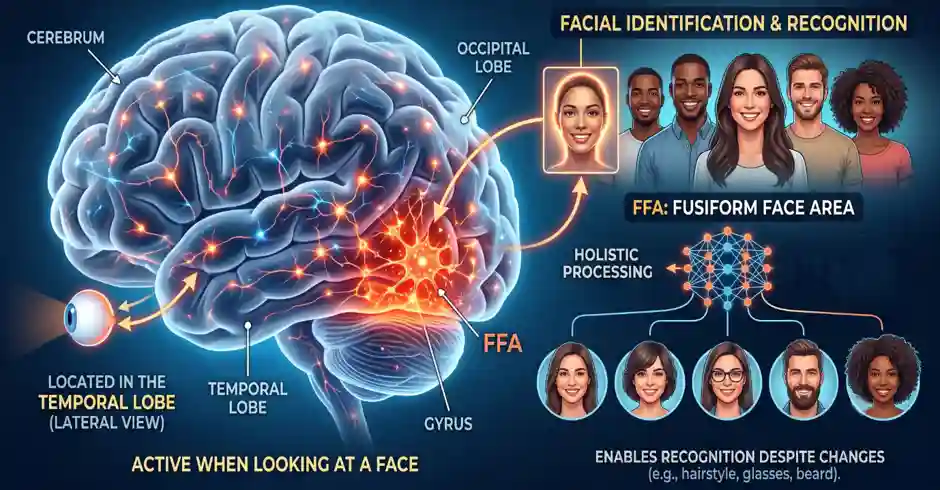
Scientists have even identified specialised brain regions dedicated to recognising faces. One of these, the fusiform face area (FFA), located in the temporal lobe, becomes highly active whenever we look at a face. Rather than remembering each facial feature individually, this region processes the face as a complete pattern, allowing us to recognise someone even if they’ve changed their hairstyle, grown a beard, or started wearing glasses.
The FFA works somewhat like a skilled detective who quickly recognises a familiar pattern from several small clues. This process is part of face perception, a term used in neuroscience to describe how the brain detects and interprets faces. It is a remarkable example of how the brain can turn many tiny visual details into one familiar identity.
Names, however, are handled differently. They rely more heavily on language and verbal memory networks, which must create a connection between an unfamiliar word and a person you’ve only just met. Unless that connection is strengthened through repetition or meaningful association, it’s surprisingly easy for the name to fade while the face remains firmly stored in memory.
This is where memory plays a little trick on us. The brain may recognise the person immediately but struggle to attach the correct word to that recognition. It is almost like knowing a song perfectly but suddenly forgetting its title. The tune is there, but the label has gone missing.
Psychologists also describe this as a problem of retrieval rather than storage. In many cases, the name hasn’t disappeared from your memory. It simply isn’t accessible at that moment. That’s why hearing the first letter or being given a small clue can suddenly make the name pop back into your mind. So, the next time you recognise a familiar face but struggle to remember the person’s name, don’t be too hard on yourself. Your brain evolved to identify people quickly, a skill that helped our ancestors recognise friends, family, and potential threats. Remembering what they were called simply turned out to be a much more complicated task.

This is why the experience can feel so frustrating, even when the memory is still somewhere inside the brain. The name may be hiding behind a locked door, waiting for the right clue to open it. That sudden moment when the name returns is often called a “tip-of-the-tongue” experience. Ironically, the harder we sometimes push the brain to find the word, the more stubbornly it seems to hide.
So, if you ever say, “I know your face, but your name has completely escaped me,” remember that your brain is not necessarily losing the plot. It may simply be prioritising the information that carries more visual meaning. After all, recognising a familiar face can be as easy as spotting an old friend in a crowd, while remembering their name may require the brain to connect several pieces of information at once.