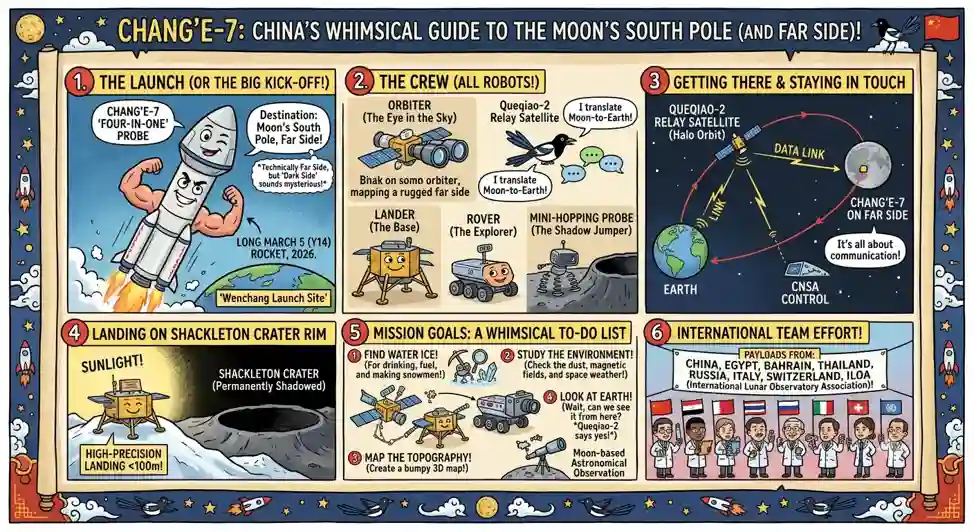
Somewhere between now and August 31, a Chinese rocket will punch through the atmosphere carrying an orbiter, a lander, a rover, and a genuinely bizarre little robot that hops. Its destination is the most sought after places of the decade: the permanently shadowed craters at the Moon’s South Pole. Welcome to , China’s most ambitious lunar mission yet, and the reason space agencies everywhere are suddenly obsessed with places the sun has never touched.
Craters That Haven’t Seen Daylight in a Billion Years
Deep inside pits like the 21 km-wide Shackleton Crater, sunlight simply never arrives. The crater walls block it at every angle, trapping temperatures cold enough to preserve ice for eons in dark areas inside deep craters near the Moon’s poles where sunlight has not reached for millions or even billions of years. Scientists have long suspected water hides in there. NASA all but confirmed it in 2009 by deliberately crashing a rocket segment into a shadowed crater and analyzing the debris plume it kicked up, and by 2020 they’d found water molecules embedded in mineral grains across the lunar surface, with even more likely locked in permanently shadowed ice patches.
What Chang’e-7 brings to the table is precision. Its six-legged hopper is built to leap directly into these black craters, a terrain too treacherous for a traditional rover, and scout exactly where the ice sits, how deep it runs, and whether it’s actually mineable.
Why the Obsession?
This isn’t just scientific curiosity. Frozen lunar water is a geological time capsule: it may hold a record of ancient volcanic activity and of water delivered by comets and asteroids to the Earth-Moon system, hinting at how Earth’s own oceans got their start.
But the real prize is practical. Split that ice apart and you get drinking water for astronauts, coolant for equipment, hydrogen for rocket fuel, and oxygen to breathe, supporting onward missions to Mars or lunar mining. In other words: a gas station and life-support system, already sitting on the Moon, free of charge, if anyone can reach it.
A Race Nobody’s Officially Racing
China isn’t alone in this hunt. Russia’s Luna-25 tried and failed, spinning out of control before it could collect data. India’s Chandrayaan-3 succeeded in 2023, landing near the South Pole and gathering fresh evidence of ice through soil temperature readings. The terrain is brutal, comprising craters, cliffs, and permanent shadow make the south pole far harder to land on than the flat equatorial plains Apollo astronauts once strolled across.
And here’s the twist: nobody can actually own what they find. The 1967 Outer Space Treaty bans any nation from claiming lunar territory, though it leaves the murkier question of who gets to keep mined resources wide open. So while Chang’e-7 won’t be exploring the Moon’s true far side, it’s chasing something just as elusive: pockets of eternal darkness that could quietly decide who gets to live, refuel, and build on the Moon next.