A corn seed does not need anyone to tell it which way to grow. Give it water, warmth and the right conditions, and its roots head down while its shoot pushes upward. But what happens when one of those conditions disappears? Not water or sunlight, but gravity?
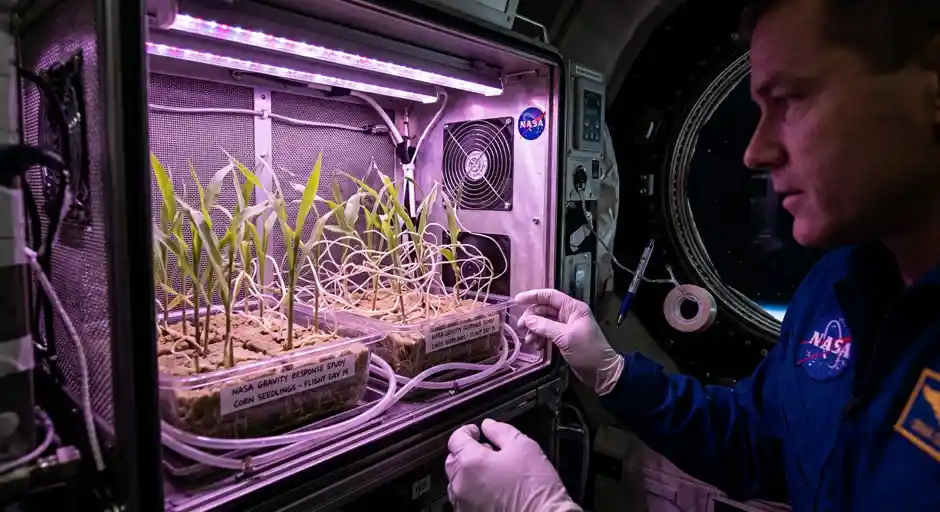
NASA has spent decades asking exactly that question. In spaceflight experiments, researchers germinated corn seeds in microgravity and compared them with seedlings grown on Earth. The seeds successfully sprouted and produced healthy-looking tissues. Yet something was noticeably different: their roots and shoots did not follow the usual organised paths. Instead, they grew in irregular, sometimes tangled directions.
The reason lies in gravitropism – a plant’s ability to sense gravity and use it as a directional signal. On Earth, specialised structures inside plant cells help detect which way gravity is pulling. This information influences the movement of the plant hormone auxin, which controls how cells grow. As a result, roots generally grow towards gravity, while shoots grow away from it. Remove most of that gravitational signal, and the plant loses one of its most reliable guides.
That does not mean the plant suddenly stops growing. In fact, the space-grown corn could still germinate and develop. But without a clear “down,” its roots no longer had the same directional certainty. NASA observations found roots and shoots growing alongside each other, twisting or producing unusual patterns. Gravity is not the only cue plants can use. Light can also act as a kind of compass. This is called phototropism – the same reason a houseplant sitting near a window gradually bends towards the light. Experiments aboard the International Space Station showed that corn shoots could still respond to light in microgravity, while their roots continued to grow in random directions.
This matters far beyond corn. If humans eventually spend months or years travelling to Mars or living away from Earth, growing plants could provide fresh food while also helping recycle carbon dioxide and produce oxygen. But a space farm cannot simply be an Earth farm moved into orbit. Water behaves differently, roots lose their gravitational guide, and plants must rely more heavily on other signals.
So the strange-looking space corn is revealing something surprisingly fundamental: gravity is not merely keeping plants on the ground. It is part of the biological information plants have evolved to read.