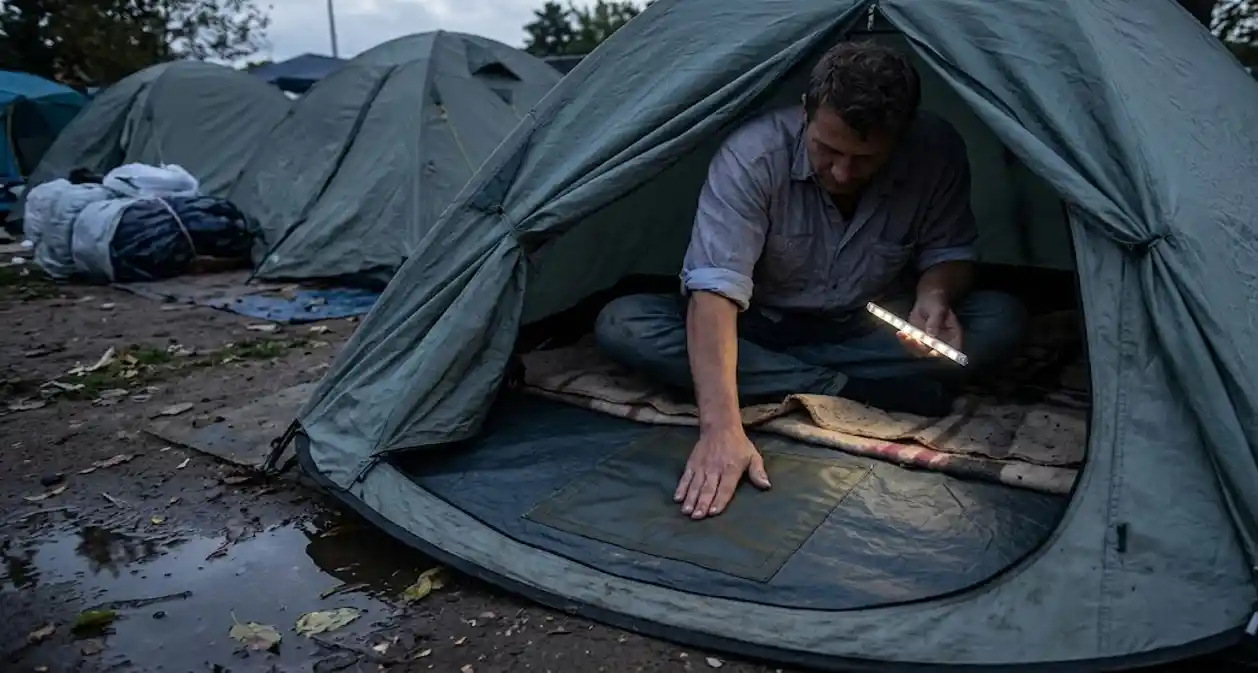
Imagine a tent that turns a rainstorm, a gust of wind, or even just the simple act of tossing and turning at night into electricity. It sounds like science fiction, but researchers at UCLA have pulled it off , and they built it with unhoused communities in mind.
In a new study published in the journal Matter, a team led by bioengineer Jun Chen unveiled a “smart” camping tent woven with special energy-harvesting fabric. The tent doesn’t need sunlight, batteries, or a power outlet. Instead, it scavenges electricity from the everyday chaos of outdoor living, footsteps, rain, wind, even a gentle tap of the hand, and turns it into enough juice to power small gadgets like phone chargers, LED lights, and digital thermometers.
A Shocking Problem Hiding in Plain Sight

Los Angeles has the second-largest unhoused population in the country, and more than 48,000 people there sleep outdoors, many in tents. For them, electricity isn’t a convenience – it’s a lifeline for charging phones, running lights for safety, or powering medical devices. But the usual fixes fall short. Illegally tapping into a nearby building’s power is, well, illegal and risky. Solar panels sound great on paper, but they’re pricey (installations can run past $50,000) and pretty much useless on cloudy days or rainy nights.
So Chen’s team asked a clever question: what if the tent itself could become the power source?
Riding the “Villari Effect”
The secret sauce here is something called the giant magnetoelastic effect, a mouthful of a term for a surprisingly elegant idea. Back in 1865, an Italian physicist named Emilio Villari discovered that squeezing certain magnetic materials changes the magnetic field around them. Fast forward more than a century, and scientists have found a way to build this effect into soft, stretchy textiles instead of clunky metal.
The tent’s fabric contains two layers working in tandem: a stretchy rubber-like layer packed with tiny magnetic particles, and a layer of coiled conductive thread. When the fabric gets squished, stretched, or hit by a raindrop, the magnetic particles jostle around, which shifts the magnetic field. That shifting field induces an electric current in the coil , essentially turning every footstep or raindrop into a tiny jolt of power. It’s the same basic principle that lets a hand-crank flashlight work, just shrunk down and sewn into cloth.
Small Numbers, Big Potential

The researchers didn’t stop at theory, they built and tested the real thing. A patch of this fabric about the size of a placemat produced a peak power of 0.094 milliwatts and kept humming along reliably through 12,000 cycles of squeezing, roughly the wear-and-tear equivalent of months of daily use. A gentle hand tap could juice up a small capacitor to nearly 6 volts in just 1.5 seconds, fast enough to flicker on an LED almost instantly.
The team even tested it against real weather: wind from a fan, artificial rain, and a full water spray. The tent came through waterproof and dustproof, keeping its electrical output nearly unchanged even after a soaking, no small feat for something meant to survive a genuine downpour.
Don’t expect this fabric to outmuscle a car battery anytime soon. The energy it produces is modest, more like a trickle than a flood. But that’s by design, it’s meant as a supplementary power source, not a replacement for the grid. Think of it less as a generator and more as a slow-charging backup battery sewn right into your shelter.
Weathering the Cost-Benefit Storm
Perhaps the most eyebrow-raising detail is the price tag: about $2 per unit in raw materials, and the entire energy-harvesting add-on weighs roughly 10 grams, practically nothing compared to a full tent. That combination of low cost and negligible weight is what could make this idea more than just a lab curiosity.
The researchers say the concept could reach beyond homeless encampments too, disaster-relief shelters, military field camps, and off-grid outdoor gear could all benefit from clothing and fabric that quietly makes its own electricity.
It’s early days, and turning a lab prototype into a mass-produced tent is its own uphill climb. But for a population often left in the dark, literally, even a small, steady trickle of self-made power could go a long way.
References
Fan, X., Tat, T., Chen, G., Shen, S., Zhou, Y., Zhao, X., Yin, J., & Chen, J. (2026). Self-powered magnetoelastic tents for sustainable energy access in unhoused communities. Matter, 9(9), Article 102954. https://doi.org/10.1016/j.matt.2026.102954