You take a yogurt from the refrigerator and notice it expired yesterday. Should it go straight into the dustbin, or is it still safe? Many people treat the printed date like the final judge in a courtroom. But those tiny numbers are not picked out of thin air. They are the result of careful science. As the old saying goes, “A stitch in time saves nine.” A food label quietly speaks to us, saying, “I am here to guide you, not to fool you.”
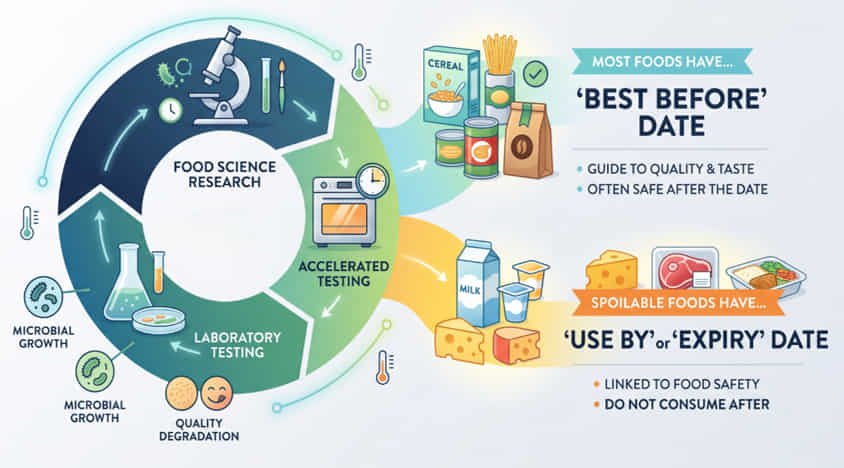
Before any food reaches the supermarket, it goes through many scientific tests. Scientists watch it closely, almost like doctors checking a patient’s health. They store the food in different conditions, such as room temperature, refrigeration, and humid places. They regularly check whether bacteria or fungi start growing, whether nutrients begin to break down, and whether the taste, smell, colour, or texture changes. Every test adds another piece to the safety puzzle.
Sometimes scientists use a method called accelerated shelf life testing. Think of it like watching a fast forward movie instead of the full film. Foods are kept at higher temperatures so that natural ageing happens more quickly. This helps researchers predict how long the product will stay safe and maintain its quality under normal storage conditions. It is like testing how strong an umbrella is by using heavy rain instead of waiting for the next monsoon. In food science, this method saves time without cutting corners.

Many people believe every date printed on a package means the food becomes dangerous the next day. That is where the confusion begins. A “Best Before” date mainly tells you how long the food is expected to keep its best taste, smell, and texture. If stored properly, many foods remain safe even after this date. On the other hand, a “Use By” or “Expiry” date is linked to food safety. For products such as milk, curd, meat, and ready to eat meals, it should be taken seriously because harmful microbes may grow even if the food looks normal. As experts often remind us, “Looks can be deceiving.”
Behind every expiry date stands a team of food scientists, microbiologists, chemists, and quality control experts. They use laboratory tests, microbial analysis, chemical studies, and shelf life evaluation to make sure food remains both safe and nutritious. Their work follows strict food safety standards, leaving little room for guesswork. It is science wearing the uniform of public health.
So, the next time you read a date on a food packet, remember that it is more than ink on plastic. It is a silent promise made after months of careful testing. The label is like a trusted guide holding a torch in the dark, helping us make safer choices while also reducing unnecessary food waste. After all, good science on the shelf helps keep good health on the table.