Health travels with you, but so do your daily habits.
Stepping out of a long international flight can feel like walking through a thick fog. Your eyes feel heavy, your stomach feels strange, and your energy seems to have missed the flight. Most people blame only jet lag, but there is another silent traveller inside you that is also struggling. The trillions of tiny bacteria living in your gut have crossed the same time zones, and they are just as confused. It is as if the passengers have reached the destination, but the body’s internal timetable is still waiting at the departure gate. As the saying goes, “Time and tide wait for no man,” and your gut microbes know this very well.
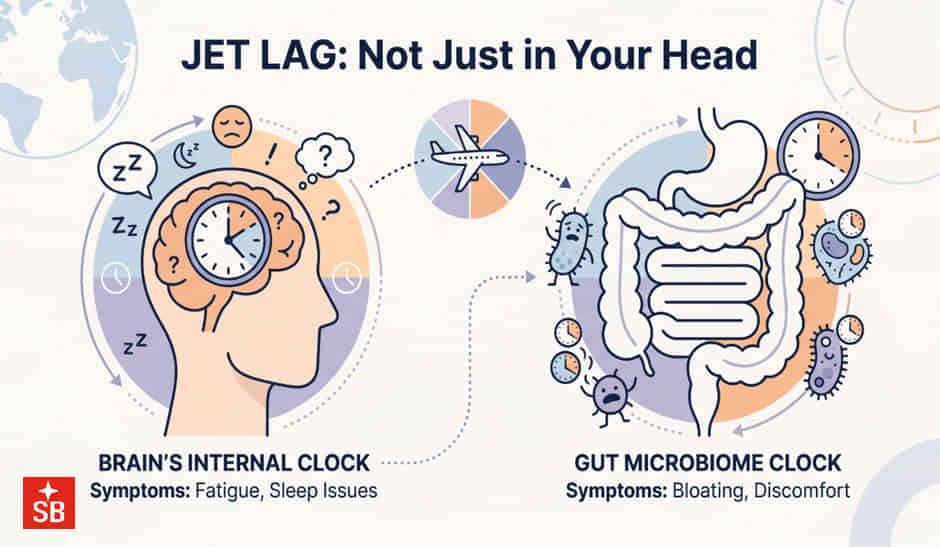
Scientists have found that the gut microbiome, the huge community of helpful bacteria living inside your digestive system, follows its own daily timetable. These tiny helpers are like disciplined factory workers who know exactly when to start and stop their shifts. They become active according to your eating, sleeping, and waking routines. During a long flight, these routines change suddenly, almost overnight. The bacteria seem to whisper, “When is breakfast? Why is everyone awake now?” This confusion disturbs their normal rhythm and changes the way they work. In biology, these natural daily cycles are called circadian rhythms, and they help keep both our body and our gut in harmony.

When the gut’s timetable is disturbed, your digestive system often protests. Some travellers experience constipation, others develop diarrhoea, stomach discomfort, bloating, or even lose their appetite. It is rather ironic that after travelling thousands of kilometres to enjoy delicious local food, the stomach may refuse to cooperate. The gut microbiome becomes like an orchestra where every musician is playing from a different page of the music book. The result is noise instead of harmony. Although these problems are usually temporary, they clearly show that the gut and the brain are closely connected through what scientists call the gut, brain axis.
Researchers believe that most people recover as their body and gut slowly reset their biological clocks. However, people who travel frequently across several time zones, such as pilots, cabin crew, business travellers, and international athletes, may place repeated stress on their gut microbes. It is like asking factory workers to change from a day shift to a night shift again and again without giving them enough time to rest. Over time, this constant adjustment may affect digestion, immunity, and even mental well-being because the gut microbiome influences far more than just the stomach.
Scientists are now studying simple ways to help these tiny companions recover faster. Eating meals at regular local times, getting enough sleep, staying well hydrated, and spending time in natural daylight may help reset both the body’s clock and the gut’s clock. Researchers are also exploring whether personalised diets and probiotics, which contain beneficial bacteria, can reduce the effects of travel-related gut disturbances. These approaches are still being studied, but early findings suggest they could support healthier gut rhythms during long-distance journeys.
This discovery reminds us that humans never travel alone. Hidden inside every one of us is a bustling microscopic city, where trillions of friendly bacteria work day and night without asking for thanks. They digest food, help train the immune system, produce useful chemicals, and even influence how we feel. Like loyal travel companions, they quietly say, “We are with you wherever you go, but please give us time to settle in.” Their story teaches us an important lesson. Good health is not only about reaching a destination, but also about helping every part of the body arrive together.
So, the next time you land after a long flight and your stomach feels out of place, remember that your brain is not the only part adjusting to a new time zone. Your gut bacteria are also resetting their tiny clocks. Give them regular meals, good sleep, and a little patience. After all, even the smallest travellers deserve time to unpack.