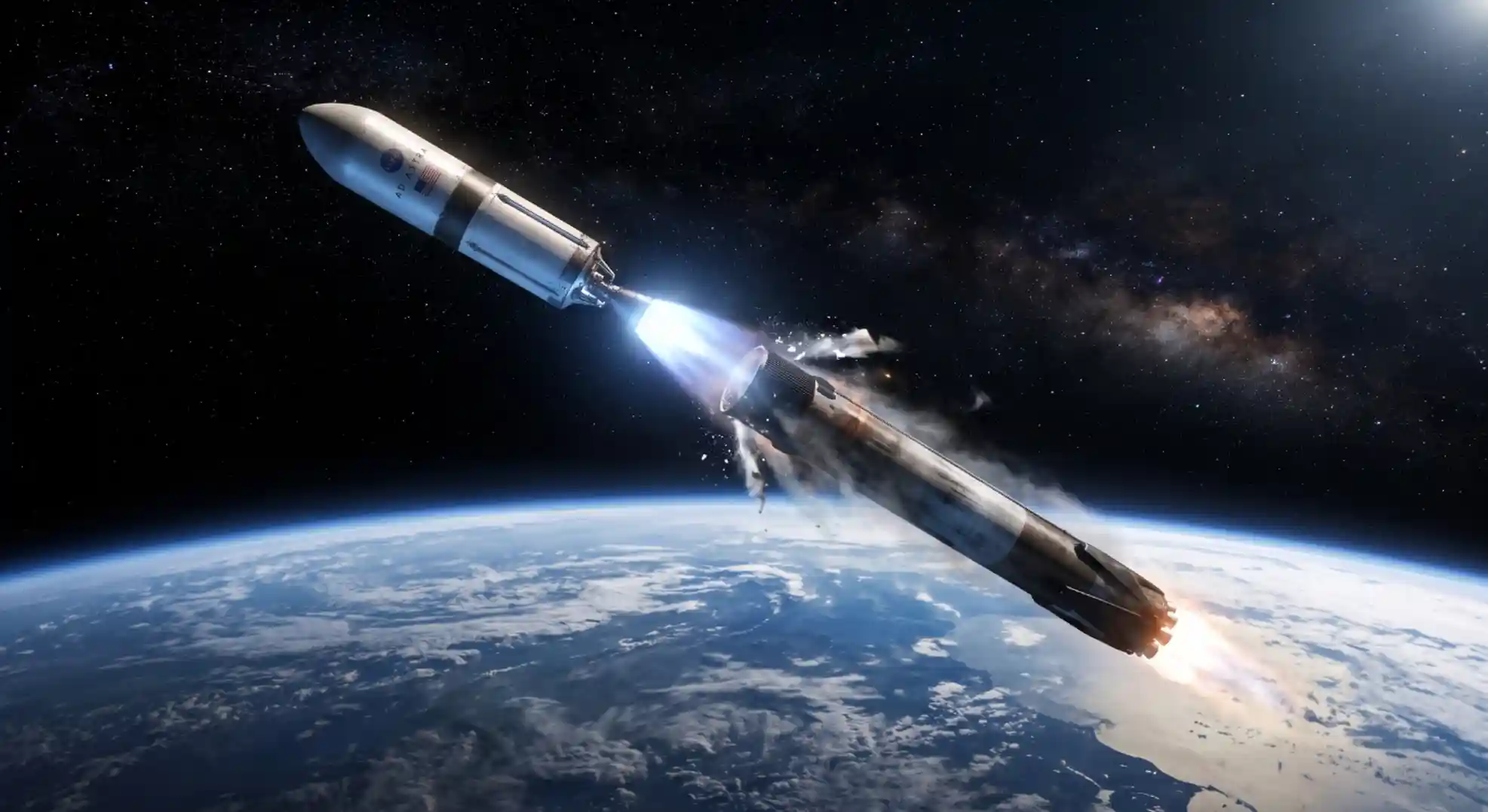
News that a NASA–SpaceX rocket stage crashed into the Moon left many people asking the same question: How can a rocket launched from Earth end up hitting the Moon? Even more puzzling, why wasn’t it brought back after completing its mission? The answer lies in a clever engineering concept called rocket staging, which makes modern spaceflight possible.
Imagine trying to cycle uphill while carrying a backpack full of bricks. The heavier the load, the harder it becomes to pedal. Now imagine being able to throw away the empty backpack once everything inside has been used. Suddenly, the journey becomes much easier. Rockets face a similar challenge. At launch, they carry enormous amounts of fuel to escape Earth’s gravity. Once a fuel tank is empty, however, it becomes nothing more than dead weight that the engines must continue pushing.
To solve this problem, rockets are built in stages. Each stage has its own engines and fuel tanks. After one stage burns through its fuel, it separates from the rest of the rocket, leaving behind the empty structure and making the remaining vehicle much lighter. This simple but ingenious idea dramatically improves fuel efficiency and allows rockets to carry heavier payloads into orbit or beyond.
SpaceX’s Falcon 9 follows this design. Its first stage provides the powerful thrust needed to lift the rocket off the launch pad before separating and, on many missions, returning to Earth for a controlled landing and reuse. The upper stage then takes over, carrying satellites or spacecraft toward their final destination in space. Once its work is finished, however, it often has very little fuel remaining to perform a controlled return to Earth.
That is what happened in the mission making headlines. After completing its task years ago, the Falcon 9 upper stage remained in space, travelling in a long, looping orbit around Earth. Over time, the gravitational pull of Earth, the Moon, and even the Sun gradually altered its path. Because there is virtually no air resistance in space, nothing slowed it down. Even tiny gravitational nudges accumulated over the years, eventually shifting its orbit until it crossed the Moon’s path.
Without an atmosphere to protect it, the Moon offered no resistance. On Earth, most incoming space objects burn up as they plunge through the atmosphere, producing the streaks of light we call shooting stars. The Moon, however, has almost no atmosphere, so the rocket stage slammed into the surface at full speed. The collision blasted out a crater and hurled dust and rocks across the lunar landscape.
The Moon impact may sound extraordinary, but it highlights an important reality of modern space exploration. A space mission does not necessarily end when a rocket finishes its primary job. Discarded rocket stages and other spacecraft components can continue orbiting for years or even decades, their paths gradually reshaped by gravity. Occasionally, as this event demonstrates, those long journeys can end with an unexpected collision on another world.