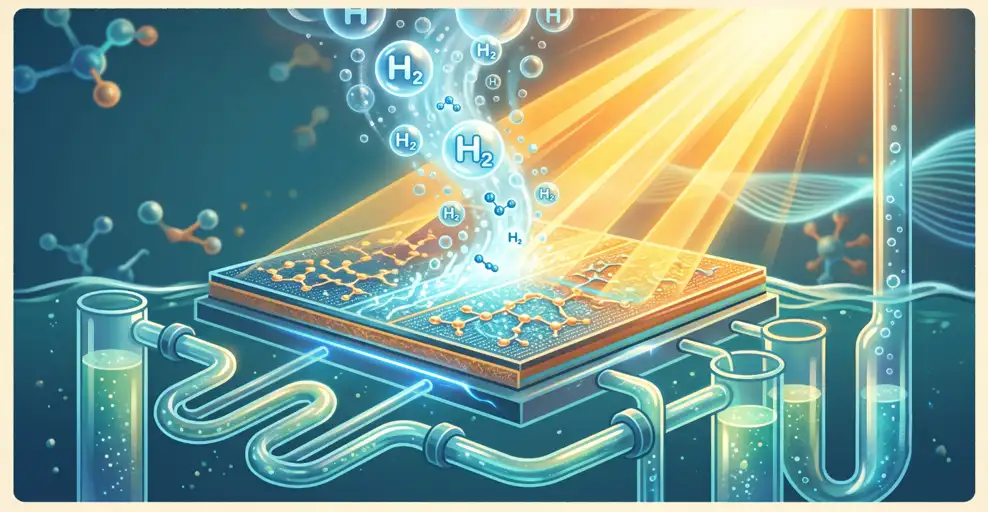
We usually think of solar energy as a way to make electricity. But what if sunlight could skip the electrical step entirely and turn water into hydrogen? That is the idea behind a technology being developed in Australia, where researchers are working on systems that use concentrated sunlight to split water directly into hydrogen and oxygen.
Hydrogen is often described as a clean fuel because when it is used in a fuel cell, its main product is water. The bigger problem is making hydrogen in the first place. Today, one of the main approaches to producing low-emission hydrogen is electrolysis, where electricity is used to split water molecules into hydrogen and oxygen. The Australian approach takes a different route.
Instead of first generating electricity and sending it to an electrolyzer, concentrated sunlight provides the energy needed for the water-splitting reaction directly. The system uses a photocatalyst that absorbs sunlight and helps drive the chemical reactions that separate hydrogen from water.
Sparc Hydrogen, an Australian company linked to the University of Adelaide, has been developing concentrated-solar reactors based on this approach. The underlying technology was demonstrated by Professor Greg Metha’s research group in 2021.
Now, another piece of the technology is being tested with SunHydrogen, whose modules are designed to produce hydrogen from sunlight and water. In August 2026, SunHydrogen reported that its modules exceeded 10% solar-to-hydrogen efficiency in testing at Sparc Hydrogen’s laboratories.
The modules also produced more hydrogen as the sunlight was concentrated.That number matters because efficiency tells scientists how much of the incoming solar energy is ultimately converted into chemical energy stored in hydrogen. But scaling the technology is the difficult part.
SunHydrogen had previously reported 10.8% efficiency from a 100-square-centimetre module, while a larger 1,200-square-centimetre module reached about 9%. The difference shows one of the major challenges in renewable-energy technology: something that works well on a small scale does not automatically work just as well when made much larger.
The new Australian collaboration will now investigate whether SunHydrogen’s modules can be integrated into Sparc Hydrogen’s concentrated-sunlight reactors and eventually tested at pilot scale in South Australia. If successful, the approach could offer a simpler route to solar hydrogen by combining sunlight collection and water splitting into a more direct process.
The exciting idea is simple, though: instead of using the Sun to make electricity and then using that electricity to make hydrogen, scientists are asking whether the Sun can go straight from sunlight to fuel.
Sources: