A global team of 30 researchers argues that a whole new science has been growing quietly in the greenhouse, and that nobody has bothered to give it a name badge.
For decades, the glamour in biology has belonged to the gene. Sequence the DNA, find the gene, fix the crop. It is a tidy story, and it has produced real wins. But ask a farmer why two plants with nearly identical genetics behave completely differently in the same field, and the tidy story starts to wobble.
Now a team of 30 scientists from the United States, Japan, Korea, Germany, India, the Czech Republic, Belgium, China, Canada, France, Ireland, Norway, the Netherlands and the UK has published an opinion piece in Trends in Plant Science making a bold claim: the field that actually answers that question has already become a science in its own right. It is called Plant Phenomics, and according to the authors, it is time the rest of the world noticed.
The discipline that grew up in someone else’s house
Scientific fields tend to mature in stages. First comes the founding phase, where researchers name a new thing to study. Then comes the toolmaking phase. Then the discovery phase, where most of the big insights arrive. Finally a field settles into teaching and preserving what it knows.
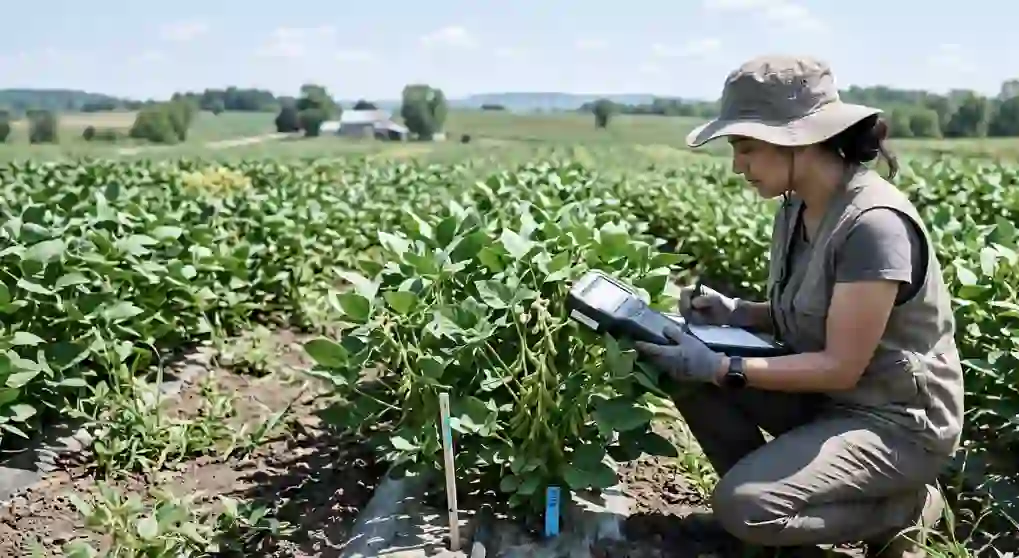
Plant Phenomics has been living an odd life. It was born as the technical support crew for plant breeding and plant physiology, two mature fields that badly needed better measurement. So it inherited a toolbox before it ever got an identity. Drones flying over olive orchards to measure water stress. Laser scanners mapping every branch of an apple tree. X ray tomography peering at root anatomy underground. Robots photographing thousands of seedlings on a schedule no graduate student could keep. The numbers tell the story. Searching Scopus, the authors found that papers on plant phenotyping methods have exploded past 1000 per year, while papers actually labelled Plant Phenomics have only recently crept up toward 140. In other words, the field built a spectacular set of instruments and forgot to claim the science it was doing with them.
A word you probably have not heard: the phene
Here is the idea at the heart of the paper, and it is genuinely elegant. Most people know the word phenotype. It is everything you can measure about a plant: height, leaf colour, root angle, sugar content. The authors argue that a phenotype is not a fixed property. It is the visible result of a process, and that process is what deserves a name. They call the individual processes phenes. A phene is not a thing you can weigh. It is a rule, a transformation. Picture a plant whose only trait is rooting depth. On day five, in one particular soil, the rule produces 30 centimetres. On day ten, or in drier soil, the same rule produces 40 centimetres. The rule did not change. The circumstances did. The full set of these rules is the phenome. And that reframing does something quietly radical. The classic textbook formula treats a phenotype as genetics plus environment plus their interaction. The new framework replaces genetics with the entire set of measurable traits across every scale of the plant, and lets the environment act on the transformation rules rather than simply adding to a sum.
From photons to forests, all at once
The authors also reject a comfortable assumption: that small things build big things in one direction only. Molecules make cells, cells make tissues, tissues make plants. Simple.
Their “Phenomics wheel” insists it runs both ways. Scales range from the quantum, where individual photons are absorbed by leaf pigments in fractions of a millisecond, all the way out to entire ecosystems shifting over millennia. And a mountain range or a neighbouring tree, both very large and very slow, decide how much light reaches a leaf, which decides how quantum scale energy transfer plays out inside it. A mutation that takes seconds can shape a plant lineage adapting to degraded land over a thousand years. Nothing gets to be the boss. Everything is talking to everything else.
Two plants, same soil, different superpowers
The framework produces a useful distinction. Imagine Plant 1 with deep roots, brilliant at chasing water down through dry soil. Plant 2 has shallow roots and releases compounds that unlock phosphorus in the topsoil, where phosphorus tends to sit. Measure both and you get variation in one simple trait: rooting angle. But that number hides two different survival strategies. Plant 1 will shrug off drought and struggle in poor soil. Plant 2 is the reverse. The authors call these plants variants, and the point is that the interesting biology is not in the measurement itself but in the strategy the measurement reveals.
Meet the phenomicist, and why AI cannot take the job
The paper introduces a job title: plant phenomicist. Ecologists explain interactions. Physiologists explain mechanisms. Geneticists explain inheritance. Phenomicists, they write, explain the dynamics that produce a measurable plant. There is no single training route into it yet. You need biology, mathematics, sensors, statistics and software, plus a tolerance for working outside your own discipline. The authors are also refreshingly direct about artificial intelligence. AI is superb at finding patterns inside knowledge that already exists. But a phenomicist’s core work is proposing phenes that nobody has ever described, using measurements nobody has invented yet. As the paper puts it, AI models are a reference of existing human knowledge, useful precisely so a scientist can be sure they are adding something new to it.
Why this matters well beyond the lab
The community has already done the unglamorous work of becoming a real field. Shared data standards. Ontologies. The MIAPPE standard for experiment metadata. BrAPI for connecting breeding data. CyVerse for sharing datasets. An international network spanning 18 regional organisations, plus two dedicated journals. What the authors want now is recognition from funders and scientific academies, the kind that Systems Biology and Bioinformatics eventually won. Their stated moonshot is unapologetically large: to understand and unlock a plant’s full potential in any environment, and to deliver plant yields and services anywhere, anytime, and for everyone.
That is a lot of ambition for a field most people have never heard of. But it sits on top of some very practical questions. Which crops survive the next drought. Which roots find nutrients in exhausted soil. Which trees keep sequestering carbon as the climate shifts. The plant, it turns out, has been telling us all of this the whole time. We are only now building the language to write it down.
Source:
Bucksch, A., Chung, Y. S., Clarke, J. L., Gerth, S., von Gillhaussen, P., Guo, W., Kholová, J., Pariyar, S., Pickering, E., Sankaran, S., Shafiee, S., Cervantes-Perez, S. A., Dhondt, S., Han, Z., Hossain, K., LaVoy, W., Lynch, J. P., Negrão, S., Pridmore, T., Schneider, H., Schwartz, S., Stavness, I., Sun, S., Vadez, V., West, L., & van de Zedde, R. (2026). Plant Phenomics—the unrecognized rise of a scientific discipline. Trends in Plant Science. Advance online publication. https://doi.org/10.1016/j.tplants.2026.08.001
Shneider, A. M. (2009). Four stages of a scientific discipline; four types of scientist. Trends in Biochemical Sciences, 34(5), 217–223. https://doi.org/10.1016/j.tibs.2009.02.002
Houle, D., Govindaraju, D. R., & Omholt, S. (2010). Phenomics: The next challenge. Nature Reviews Genetics, 11(12), 855–866. https://doi.org/10.1038/nrg2897