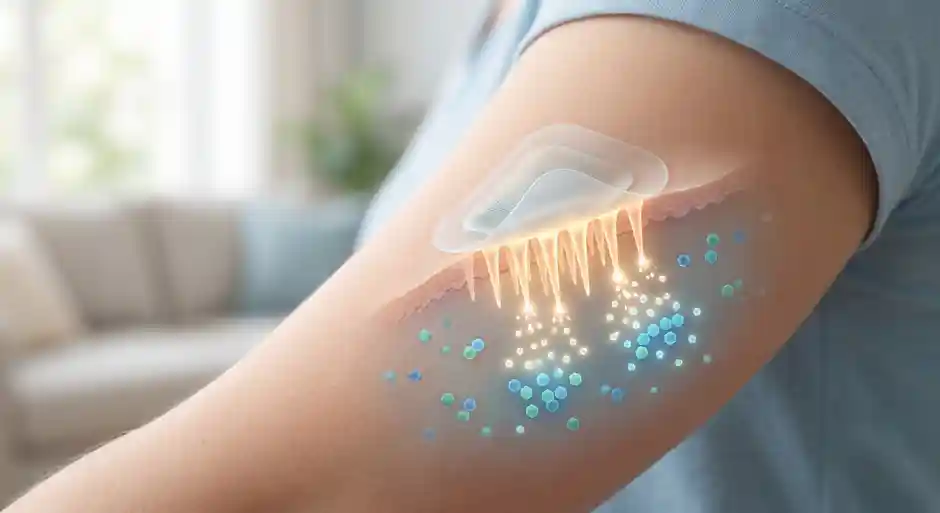
For people who depend on insulin, keeping blood glucose within a healthy range means constantly matching insulin doses to changing glucose levels. Researchers are now working on a different approach: a tiny patch that can sense glucose and release insulin when levels rise. The idea uses microneedles, extremely small projections that can pass through the outer layer of the skin without the deeper, more painful penetration of a conventional injection. These needles can carry insulin or connect to systems that deliver it beneath the skin.
But the more interesting part is what makes some of these patches “smart.”
In one approach, the microneedles contain a material that responds directly to glucose. When glucose levels rise, the material changes its properties and makes insulin easier to release. When glucose levels fall, the trigger becomes weaker, reducing insulin release.One 2020 study developed a patch containing insulin and a glucose-responsive polymer. The polymer used phenylboronic acid molecules that could bind glucose. This caused the material to swell and loosen its interaction with insulin, allowing more insulin to be released when glucose was high. The patch regulated blood glucose in diabetic mice and minipigs, with glucose control lasting more than 20 hours in the larger animals.
Other researchers have taken the idea further by combining microneedles with an actual glucose sensor and miniature pump. In a 2024 study, a wearable patch detected glucose in the fluid beneath the skin and automatically activated a pump to deliver insulin when glucose crossed a set threshold. The system successfully controlled blood glucose in diabetic rats.
Together, these approaches are moving toward closed-loop insulin delivery – a system that senses glucose, decides when insulin is needed and delivers it without requiring each dose to be manually triggered. But these technologies are still being developed. Researchers need to solve challenges including reliable glucose sensing, precise insulin dosing, device stability and safe long-term use in humans.
The goal is not simply to replace an injection with a patch. It is to make insulin delivery respond to the body’s changing needs in real time.
Source: