A study conducted by researchers at the University of East Anglia’s Norwich Medical School and biotechnology company Oxford BioDynamics investigated the biological mechanisms connecting five clinically distinct disorders: myalgic encephalomyelitis/chronic fatigue syndrome (ME/CFS), long COVID, post-traumatic stress disorder (PTSD), rheumatoid arthritis, and multiple sclerosis (MS).
Traditionally, these conditions have been viewed as unrelated due to their widely varying origins:
- ME/CFS often emerges following non-specific viral infections.
- Long COVID arises following SARS-CoV-2 infection.
- PTSD is triggered by psychological trauma.
- Rheumatoid arthritis is an autoimmune disorder primarily affecting peripheral joints.
- Multiple sclerosis involves autoimmune attacks on the central nervous system.
Despite these disparate origins, patients across all five conditions report a shared constellation of debilitating symptoms, including overwhelming physical fatigue, cognitive impairment (“brain fog”), disturbed sleep patterns, reduced day-to-day functioning, and autonomic dysfunction (disturbances in involuntary bodily regulations such as blood pressure and heart rate). The researchers aimed to establish whether an underlying biological framework unites this persistent exhaustion across clinical boundaries.
Methodology and Key Findings
The researchers utilized a computational approach rather than collecting new biological samples. They aggregated data from published genome-wide association studies (GWAS) for long COVID, PTSD, rheumatoid arthritis, and multiple sclerosis, and combined these with three-dimensional (3D) genomic datasets derived from an earlier ME/CFS cohort.
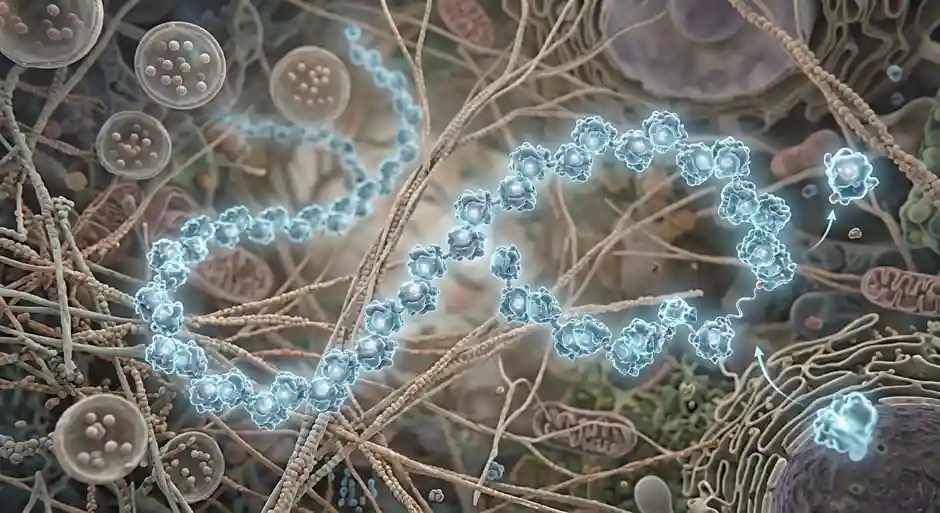
To evaluate these datasets, the team applied the proprietary EpiSwitch® Orion platform developed by Oxford BioDynamics. Rather than reading linear DNA sequences alone, this platform models 3D chromosomal architecture—analyzing how chromatin folds inside cellular nuclei and predicting spatial contact points between distant genomic regions that regulate gene expression.
- Linear Genetic Divergence: At the individual gene level, there was surprisingly little direct overlap among the five disorders.
- Network-Level Convergence: When the genes were mapped within higher-order regulatory and interactome networks, the conditions demonstrated pronounced convergence. The genetic factors clustered within shared biological circuits responsible for:
- Persistent immune activation and systemic inflammatory signaling.
- Mitochondrial energy production and metabolic pathways.
- Neuroendocrine stress-response pathways and cellular resilience mechanisms.
Implications for Diagnosis and Treatment
Lead researcher Professor Dmitry Pshezhetskiy noted that chronic exhaustion may represent a visible manifestation of a deeper systems-level failure across immune, metabolic, and neuroendocrine axes rather than a mere secondary symptom. Different inciting events—whether viral pathogens or severe emotional trauma—appear capable of funnelling into identical downstream regulatory disruptions.
Clinically, conditions like ME/CFS and long COVID have historically lacked objective laboratory biomarkers, requiring diagnoses based largely on exclusion and subjective symptom reporting. The identification of shared 3D chromatin architectures offers a path toward developing blood-based diagnostic signatures and multi-condition therapeutics targeting shared biological pathways.
References
Hunter, E., Alshaker, H., Vugrinec, D., Bautista, S., Gebregzabhar, A., Virdi, A., Croxford, J., Dring, A., Powell, R., Salter, M., Kingdon, C., Green, J., Akoulitchev, A., & Pchejetski, D. (2026). Beyond genes: EpiSwitch® and Orion platform-powered 3D genome architecture biomarkers reveal shared biology across ME/CFS, long COVID, PTSD, rheumatoid arthritis, and multiple sclerosis. Journal of Translational Medicine, 24, Article 08874-9. https://doi.org/10.1186/s12967-026-08874-9