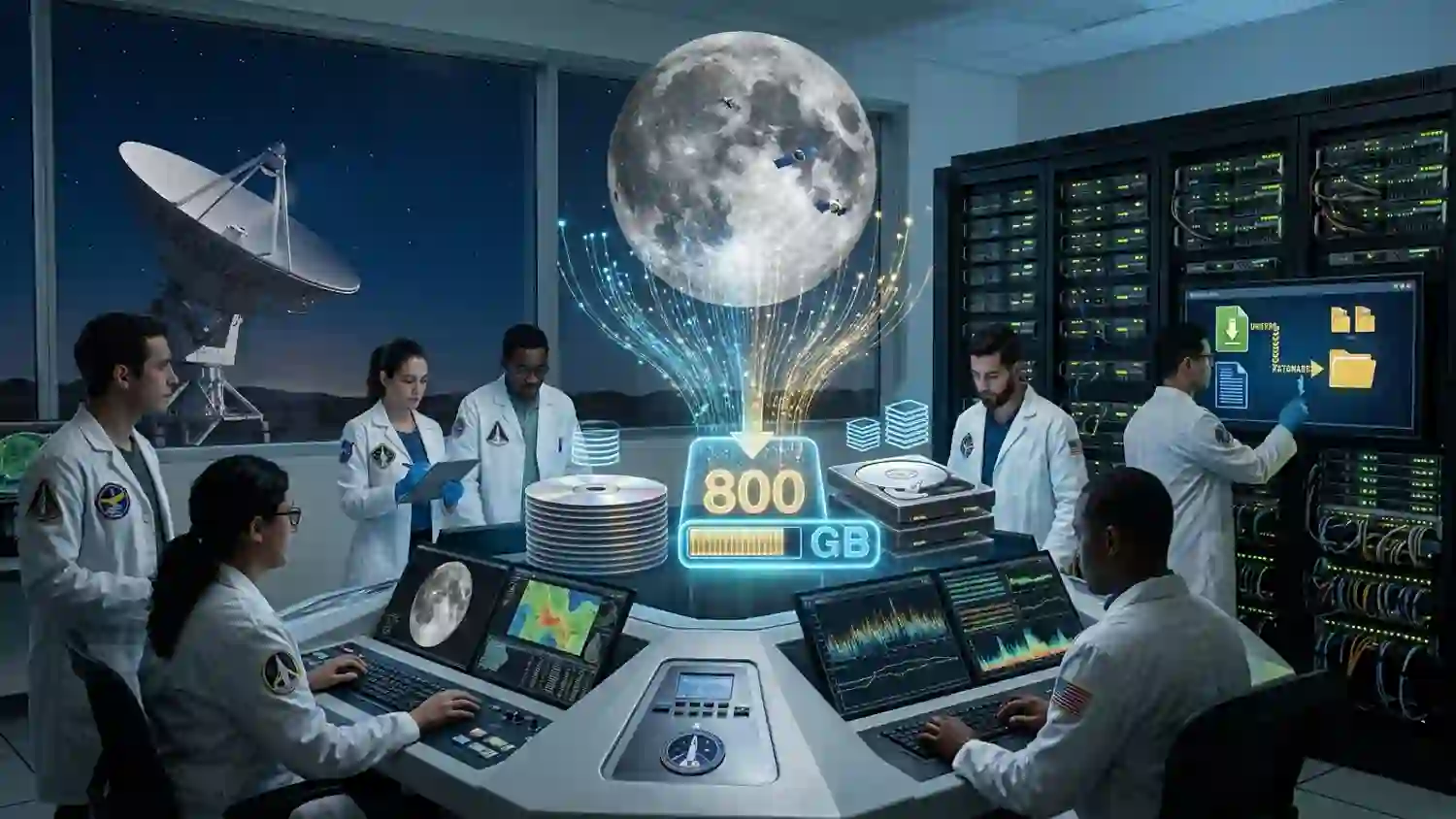
When astronauts look at the Moon from space, they notice things that a photograph alone might miss. Subtle colour differences, shadows inside craters and brief flashes of light can all offer clues about the Moon’s surface and its history. Now, NASA has released more than 800 gigabytes of scientific data from its Artemis II mission, giving researchers and the public access to thousands of images, hours of audio and observations recorded by the astronauts during their journey around the Moon in April 2026. The collection includes more than 11,000 full-resolution images and videos, around 8.5 hours of audio recordings, and photographs annotated by the crew. It also includes NASA’s preliminary lunar science report, which documents some of the most interesting observations from the mission.
One finding stands out: five tiny flashes of light spotted on the Moon’s far side.
During the lunar flyby, astronauts Reid Wiseman, Victor Glover and Jeremy Hansen reported seeing extremely faint, pinprick-like flashes while observing the darkened lunar surface. Scientists had actually asked the crew to watch for such events. The flashes are produced when rocky fragments from space strike the Moon at high speed, releasing energy as light. The sightings were particularly valuable because the astronauts observed them with their own eyes from aboard Orion, roughly 46,000 miles from the Moon. The science team examined the reports and ruled out other possible explanations, including reflections from the spacecraft and cosmic rays.

But the flashes are only one part of the dataset.
The astronauts also described colours and surface features that can be difficult to interpret from images alone. Their notes recorded variations in the appearance of lunar terrain, while their observations of shadows and crater details could help scientists understand how lighting changes as spacecraft move around the Moon. This human perspective matters because cameras do not always reproduce exactly what the eye sees. Combining astronauts’ descriptions with photographs and observations from robotic spacecraft could help researchers interpret lunar landscapes more accurately. NASA describes this as the first planetary science dataset collected primarily by humans in more than half a century. The information will also help scientists prepare for future Artemis missions, including plans for astronauts to explore the lunar surface.
The mission may be over, but the science is just beginning. Thousands of images and hours of recordings are now available for researchers to revisit, compare and investigate, potentially revealing details that were not obvious during the journey itself.