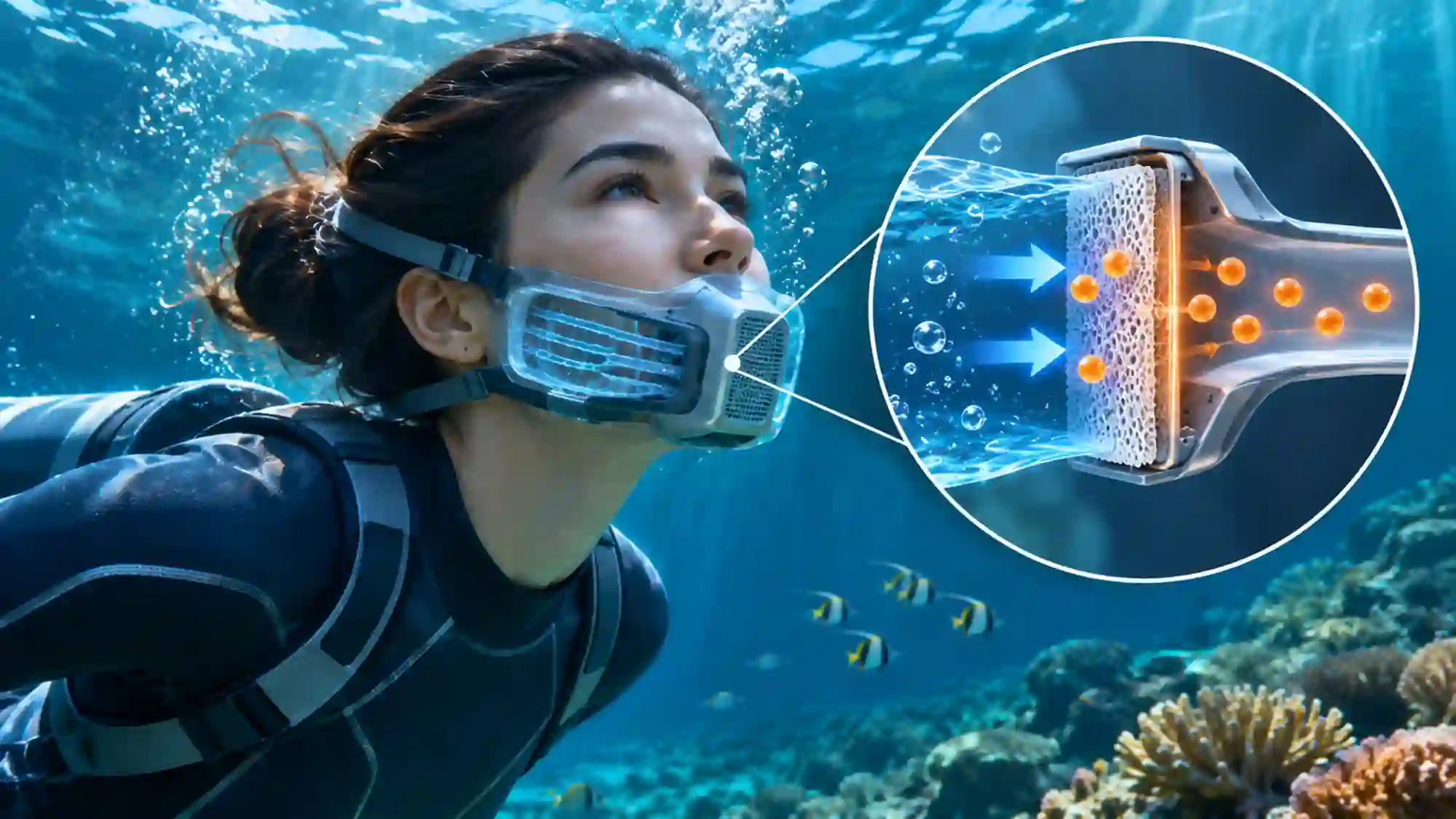
Imagine swimming beneath the ocean without carrying a heavy oxygen tank, breathing directly from the surrounding water just like a fish. It sounds like science fiction, but scientists have been investigating a technology called artificial gills that could one day make this possible.
Fish extract dissolved oxygen from water using specialised organs called gills. Researchers are attempting to recreate this process using advanced membranes, oxygen-capturing materials and miniature oxygen-transfer systems. However, making such a device powerful enough for a human remains an enormous engineering challenge.
How Would Artificial Gills Work?
Unlike air, water contains relatively little oxygen. Artificial gills aim to extract this dissolved oxygen and transfer it into breathable air.
One proposed design uses extremely thin, gas-permeable membranes. Water flows along one side while air or an oxygen-absorbing liquid moves along the other. Oxygen passes through the membrane, allowing it to be collected and supplied to a breathing system.
Scientists have also investigated oxygen carriers such as haemoglobin solutions, which can absorb oxygen from water and release it under controlled conditions.
Have Scientists Actually Built Them?
In 2019, researchers developed and experimentally tested an artificial gill system using gas-permeable membranes. Their device demonstrated underwater oxygen extraction and allowed a stag beetle to survive submerged for more than 60 hours. However, carbon dioxide accumulation remained a limitation.
Earlier research in 2003 explored a haemoglobin-based artificial gill. The researchers estimated that supplying oxygen to a resting human would require approximately 63.8 square metres of membrane surface area. This illustrates how difficult it is to scale the technology for human use.
Why Can’t Humans Breathe Like Fish?
The biggest problem is the amount of oxygen available in water. Human beings consume oxygen much faster than small aquatic organisms, meaning an artificial gill would need to process enormous volumes of water continuously.
Another challenge is carbon dioxide removal. A breathing system must not only supply sufficient oxygen but also remove the carbon dioxide produced by the body.
Water is also much denser and more viscous than air, making it energy-intensive to pump through a device. The system must additionally remain compact, lightweight and reliable underwater.
Could This Become Reality?
Artificial gills are still experimental, and no practical wearable device currently allows humans to breathe indefinitely underwater by extracting oxygen directly from surrounding seawater.
Nevertheless, advances in membrane technology, oxygen carriers and fluid engineering continue to improve the possibilities.
The dream of breathing underwater without oxygen tanks remains distant, but researchers are gradually turning an extraordinary biological ability into an engineering challenge.
Could Humans Ever Breathe Underwater Without Oxygen Tanks?
Scientists are experimenting with artificial gills that use gas-permeable membranes and oxygen carriers to extract oxygen from water, but the huge oxygen needs of humans, CO2 removal and the energy cost of pumping dense water mean a practical wearable device is still far off.