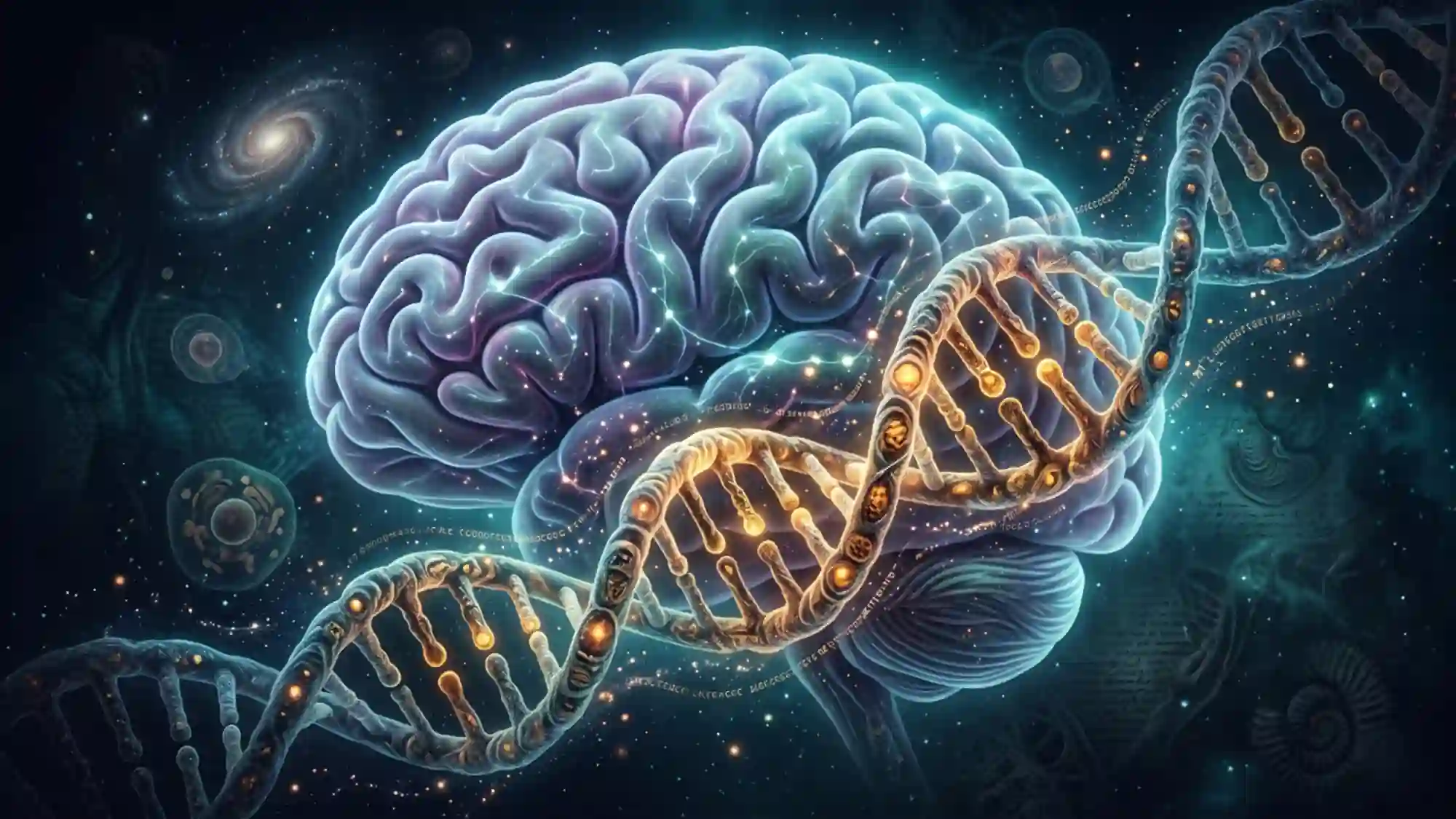
Your brain runs on about 20 watts, roughly a dim light bulb. It recognises faces, parses jokes, and plans your weekend with that. A modern AI data centre can burn through megawatts to do something comparable. That gap is one of the most embarrassing facts in computing, and a team in Bengaluru is trying to close it.
The problem: computers have a commute
Today’s computers keep memory in one place and processing in another. Every calculation means shuttling data back and forth between the two, and that shuttling is where much of the energy goes. AI makes it worse. At its core, AI is mostly matrix multiplication, which means enormous amounts of data moving around for enormous numbers of tiny calculations.
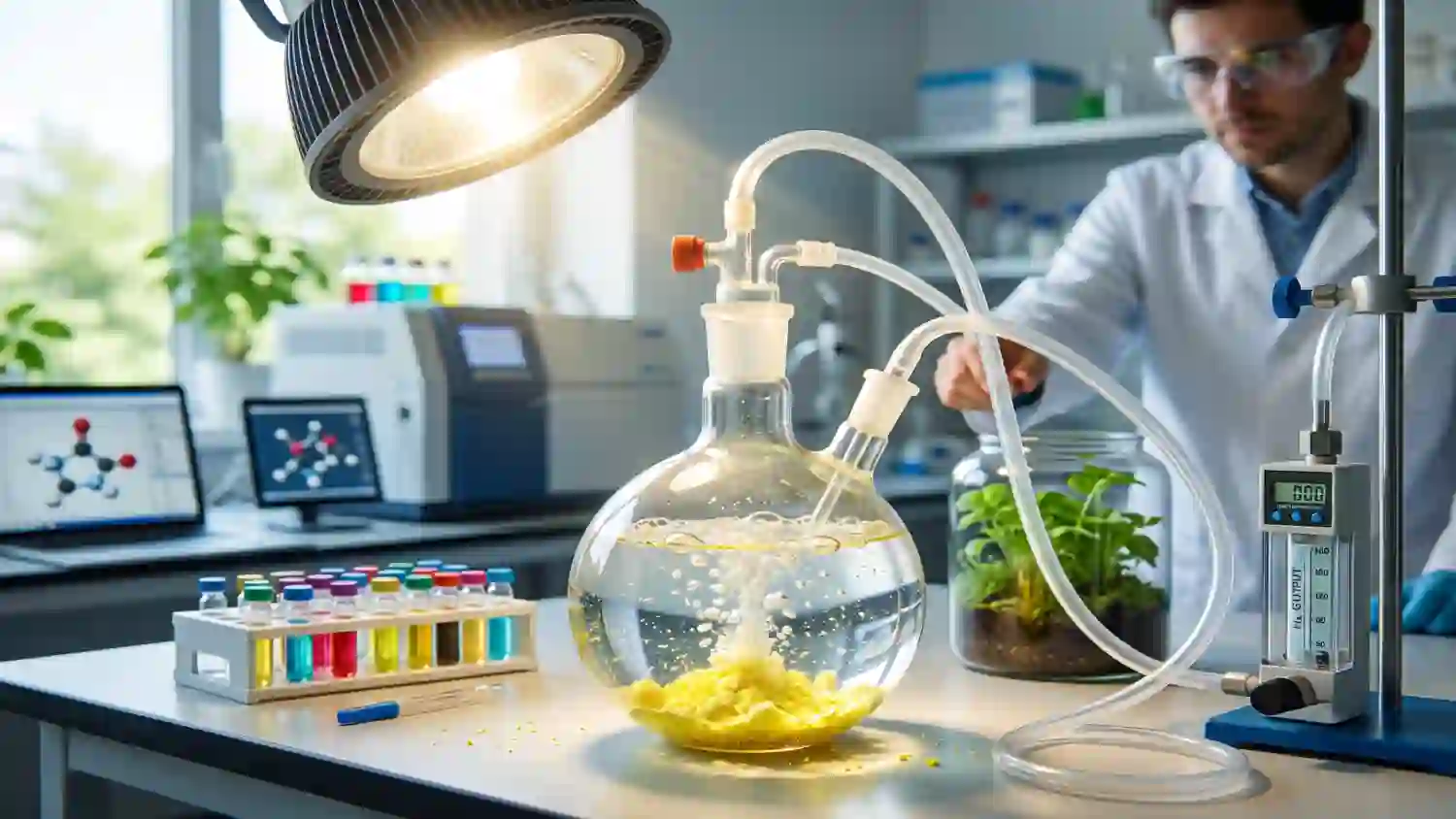
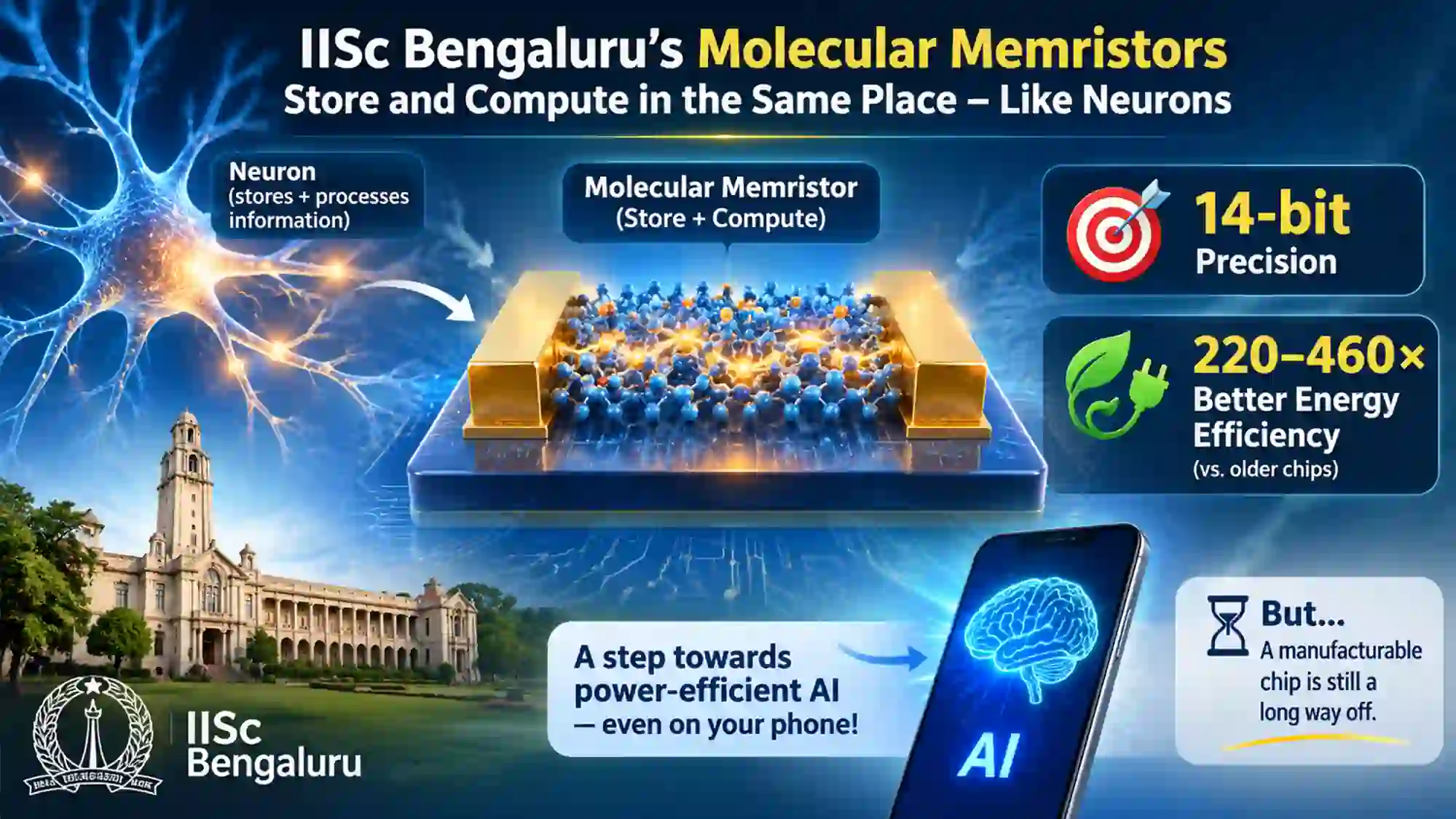
Your brain doesn’t do this. Neurons store and compute in the same place. That is the inspiration behind neuromorphic computing: build hardware that works more like biology.
Enter the molecular memristor
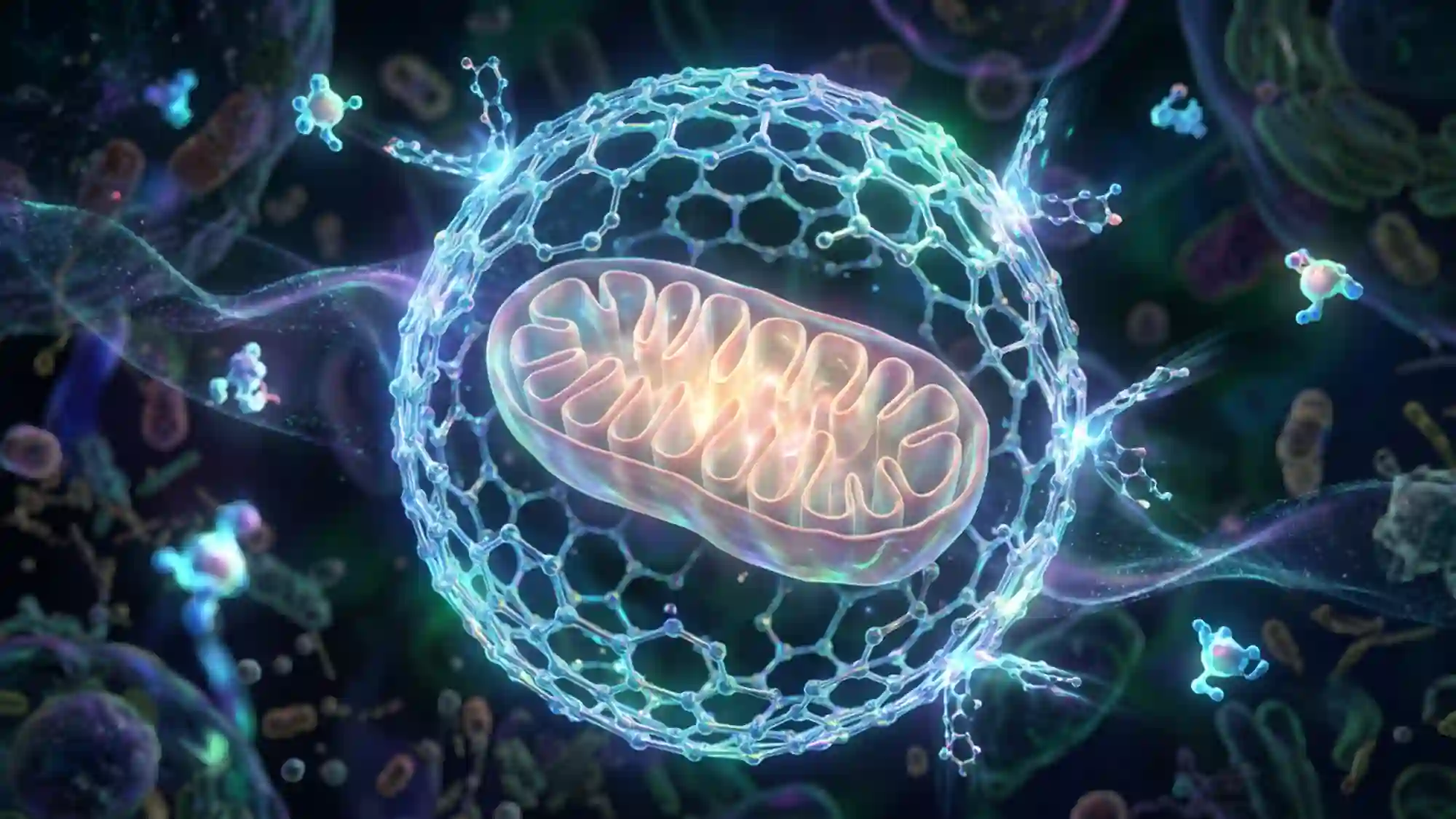
At the Indian Institute of Science (IISc), Bengaluru, a team led by Sreetosh Goswami at the Centre for Nano Science and Engineering is building molecular memristors. These are tiny devices that store information and compute with it in the same physical structure, no commute required.
Most digital memory is binary: high or low, 1 or 0. The IISc devices use a thin film of a ruthenium-based molecular complex, where molecules and ions shift around under precisely timed voltage pulses. Each arrangement gives a slightly different electrical conductance. Learn to control and read those shifts, and a device that was a light switch becomes a dimmer with thousands of settings.
The numbers
In their 2024 Nature paper (Sharma et al., 2024), the team reported:
- 16,520 distinct analog conductance levels in a single device, equivalent to 14-bit resolution. Earlier neuromorphic hardware was largely limited to low-accuracy tasks.
- A 64 × 64 crossbar array that performs dot products, the basic operation of AI, in a single time step.
- Large energy savings: up to 220× better energy efficiency than an NVIDIA Tesla K80 GPU on one task, and up to 460× less energy than an 18-core Intel Haswell CPU in another comparison.
One caveat matters here. Those comparisons are for specific tasks, against older-generation chips, in a lab prototype. They show real promise, not a like-for-like win over today’s hardware. Still, a 14-bit analog device is a significant step for a field long held back by precision.
Why your phone should care
Most heavy AI today runs in the cloud. Your request travels to a data centre, gets processed, and comes back. That costs energy, needs a connection, and sends your data somewhere else.
Efficient on-device hardware could change that. If this technology matures, powerful AI could run directly on laptops and smartphones, working offline, responding faster, and keeping data local. IISc’s own announcement frames this as a step toward democratising AI development, since training and running models would no longer be the exclusive territory of giant data centres (Indian Institute of Science, 2024).
The honest reality check
This isn’t in your pocket yet. Moving from a lab device to a manufacturable chip is hard. The molecular materials must be made reliably at scale, and the devices must work alongside conventional silicon. The team says it is working toward a system-on-a-chip, but that is the road ahead, not the arrival.
Still, the idea is elegant: chemistry and electrical engineering teaming up so that molecules wiggling in a film do the heavy lifting of AI. If it works, the future of efficient intelligence may be built less like a warehouse of servers and more like a brain.
Sources:
Indian Institute of Science. (2024, September 11). Neuromorphic platform presents huge leap forward in computing efficiency. https://iisc.ac.in/events/neuromorphic-platform-presents-huge-leap-forward-in-computing-efficiency/
Sharma, D., Rath, S. P., Kundu, B., Korkmaz, A., Harivignesh, S., Thompson, D., Bhat, N., Goswami, S., Williams, R. S., & Goswami, S. (2024). Linear symmetric self-selecting 14-bit kinetic molecular memristors. Nature, 633(8030), 560–566. https://doi.org/10.1038/s41586-024-07902-2