Today, a mathematician at an AI company said he may have solved the most famous open problem in mathematics. Here’s why the right response is neither hype nor dismissal.
The problem that won’t die
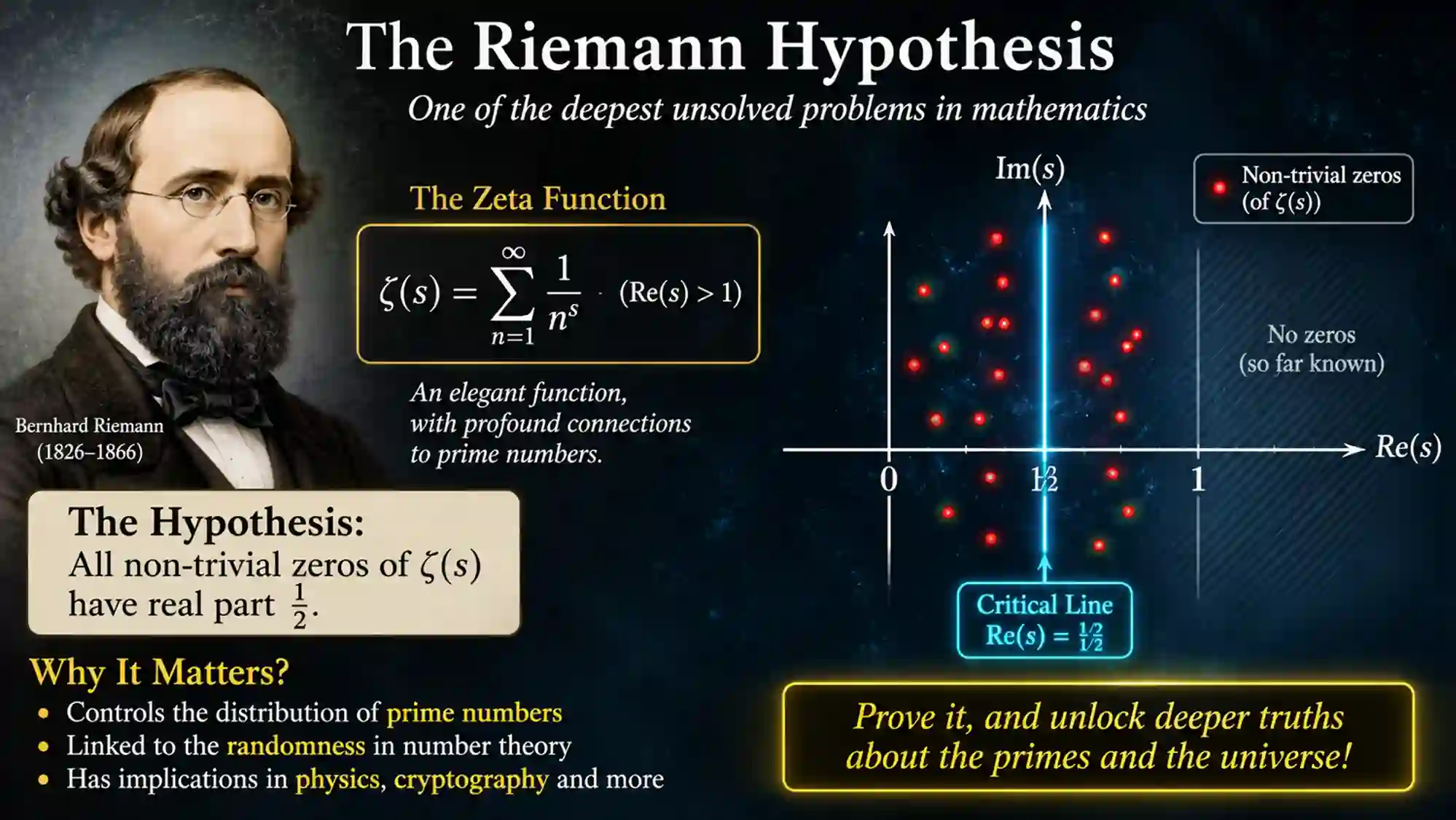
In 1859, Bernhard Riemann noticed that the erratic spacing of prime numbers is governed by a single function, the zeta function, ζ(s). Its “non-trivial zeros,” the inputs where it equals zero, each add finer detail to our picture of the primes. Riemann guessed that all of them sit on one vertical line in the complex plane, where the real part equals ½ (Riemann, 1859; Bombieri, 2000).
That guess, the Riemann Hypothesis, has resisted proof for roughly 170 years. A $1 million prize announced in 2000 is still unclaimed. If it’s true, primes are about as evenly spread as they can be. If it’s false, a single stray zero off the line would break it. Scientific American

What was claimed today
On Friday, November 20, Levent Alpöge, an Anthropic mathematician, posted a note on his website saying he believes he has, working with Claude, discovered a proof. The note says the method also settles the Generalized Riemann Hypothesis and that the whole argument has been formalized in the Lean proof assistant. fourweekmbaofficechai
Why Lean matters, and what it doesn’t settle
Lean is software that checks every logical step of a proof mechanically. If a Lean file compiles, the reasoning inside it is valid, whatever the author’s confidence or reputation.
That doesn’t end the debate, though. Lean verifies that the code proves the statement written in the code. The community still has to confirm that the theorem proved in Lean really is the Riemann hypothesis and not a slightly different statement. One early commenter said the formalized statement in the release does appear to be the Generalized Riemann Hypothesis, which answers the first worry. That is a first look, not a verdict. nacionaleofficechai
Another reaction pointed out that a human-readable version would stretch past 250,000 pages. If that holds, the proof can be trusted only through machines, because no human could read it. officechai
A track record that invites caution
Famous mathematicians have announced proofs of the Riemann Hypothesis before. One of the most recent big claims, from Sir Michael Atiyah in 2018, stayed under heavy skepticism and was declared flawed by several mathematicians. A claim this large gets checked before it gets believed. arxiv
This isn’t Claude’s first swing at the problem
Three months ago, Anthropic described what happened when a staff member asked an unreleased Claude model to “take a real stab” at the hypothesis. Claude quickly gave up on proving or disproving it and turned to a related question. Along the way it raised the proven lower bound on the proportion of zeta zeros known to lie on the critical line from 41.6% to 67.2%. Two in-house mathematicians confirmed the result and it was formalized in Lean. Anthropic said at the time that it didn’t expect the techniques to lead to a proof of the full hypothesis. Oxford’s James Maynard offered a similar assessment: “there is no pathway for any of these approaches to deal with the actual Riemann hypothesis.” no ai didnt just solve the thorniest problem in math +3
Today’s claim is a different and far bolder one. It is also a different kind of claim: AI is no longer just assisting with a known problem, it is the one doing the exploring. MIT’s Andrew Sutherland described the August result as evidence that AI can do interesting mathematical research, not just solve problems fed into it. Scientific American
What to watch next
- Do the Lean files build for outsiders? Independent compilation is the first real test.
- Is the formal statement faithful? Experts must confirm the theorem matches the Riemann Hypothesis (or its generalization) in every definition.
- Can humans understand it? Even a correct proof is far more valuable if it yields ideas people can learn from.
The bottom line
Until independent experts check it, this is a claim, not a theorem. But the way it was released, as machine-checkable code rather than a conventional paper, may be a preview of how mathematics gets verified in the years ahead. Whatever the verdict, the question has changed from “can AI do real mathematics?” to “how do we check what it finds?”
Sources:
Riemann, B. (1859). Über die Anzahl der Primzahlen unter einer gegebenen Grösse [On the number of primes less than a given magnitude]. Monatsberichte der Königlichen Preußischen Akademie der Wissenschaften zu Berlin, 671–680.