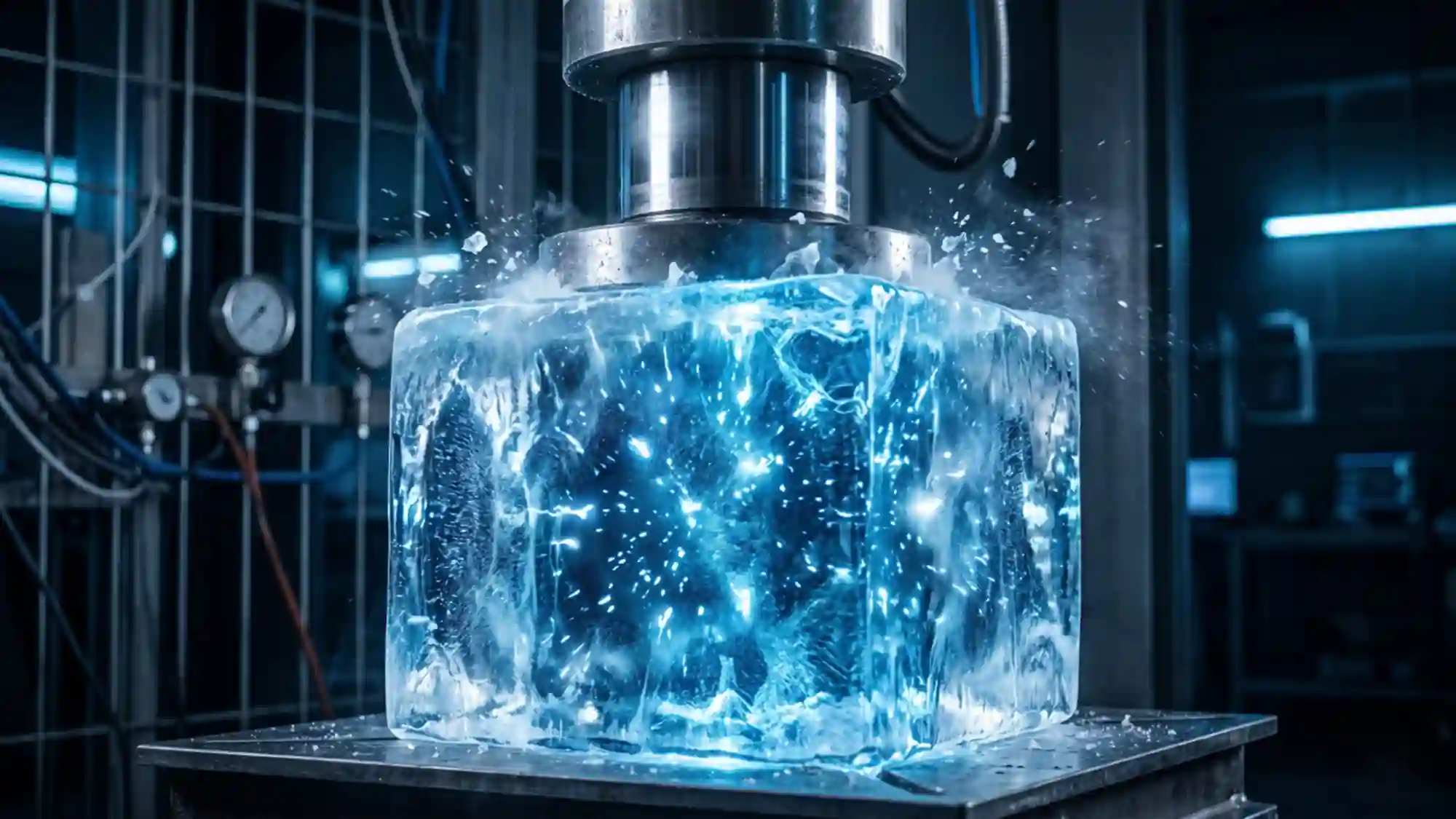
Ice may seem like an unlikely rival to concrete. It can support enormous loads under the right conditions, yet a small crack can cause it to fracture suddenly. What if ice could be engineered to resist that weakness?
Scientists have now developed a reinforced ice composite that is significantly stronger than ordinary ice and much harder to break apart. The material, called BioPykrete, was developed by researchers led by a team at the Hebrew University of Jerusalem. Inspired by an older attempt to strengthen ice using wood pulp, the scientists combined ice with tiny plant-derived crystals and a specially designed protein. Their results, published in Colloids and Surfaces B: Biointerfaces, suggest that this combination could eventually have applications in construction in extremely cold environments.
How do you make ice stronger?

The key ingredient is cellulose, a natural material that helps give plant cell walls their structure. The researchers used cellulose nanocrystals, extremely small, rigid particles that can reinforce a material. As the mixture froze under controlled conditions, these crystals formed a three-dimensional network within the ice. However, simply adding reinforcing particles was not enough. The team designed a protein called CBM3a-AFPIII to connect the cellulose network to the surrounding ice. This protein combines two functional components: one that binds to cellulose and another that attaches to ice. Acting like a molecular adhesive, the protein helps anchor the reinforcing network to the ice itself. This connection is important because a material’s strength depends not only on the ingredients it contains, but also on how effectively those ingredients work together.
Why does this ice resist breaking?
Ordinary ice is brittle. Once a crack begins to spread, it can travel rapidly through the material, causing sudden failure. BioPykrete appears to resist this process by creating a network that obstructs crack growth. As cracks encounter the cellulose structure, they must overcome or disrupt the network rather than spread freely through the ice. The protein strengthens the connections between the two components, making it harder for the material to separate. In laboratory compression tests, BioPykrete was approximately 10 times stronger than ordinary ice, reaching strength levels comparable to conventional concrete. It also absorbed around 70 times more energy before failure. This means it can deform and break more gradually rather than shattering as abruptly as ordinary ice.
Could it become a building material?
They see potential applications in Arctic and Antarctic regions, where transporting conventional construction materials can be expensive and difficult. Since the composite is made mainly from ice and plant-derived cellulose, it could offer an alternative for certain temporary or specialised structures in cold environments. The idea also has a historical predecessor. During the Second World War, researchers experimented with Pykrete, a mixture of ice and wood pulp intended for large floating structures. BioPykrete builds on that concept by using nanoscale reinforcement and molecular engineering to improve how its components interact. However, this does not mean concrete can be replaced by ice just yet. The experiments were conducted on small samples, and the material still needs testing for long-term durability, repeated freezing and thawing, and deformation under sustained loads. Its practical environmental benefits will also depend on how it is produced, transported and maintained. For now, BioPykrete is a promising example of how biological materials and protein engineering can change the properties of familiar substances. The bigger breakthrough may not be that ice can become stronger than expected, but that carefully designed molecular connections can turn a brittle material into something far more resistant to failure.
Sources:

Adar, C., Baron, Y., Rofman, B., Bar Dolev, M., Bahari, L., Yashunsky, V., Sirotinskaya, V., Shoseyov, O., & Braslavsky, I. (2026). Biomimetic engineering of a fortified ice composite with enhanced mechanical properties. Colloids and Surfaces B: Biointerfaces, 268, 116037. https://doi.org/10.1016/j.colsurfb.2026.116037