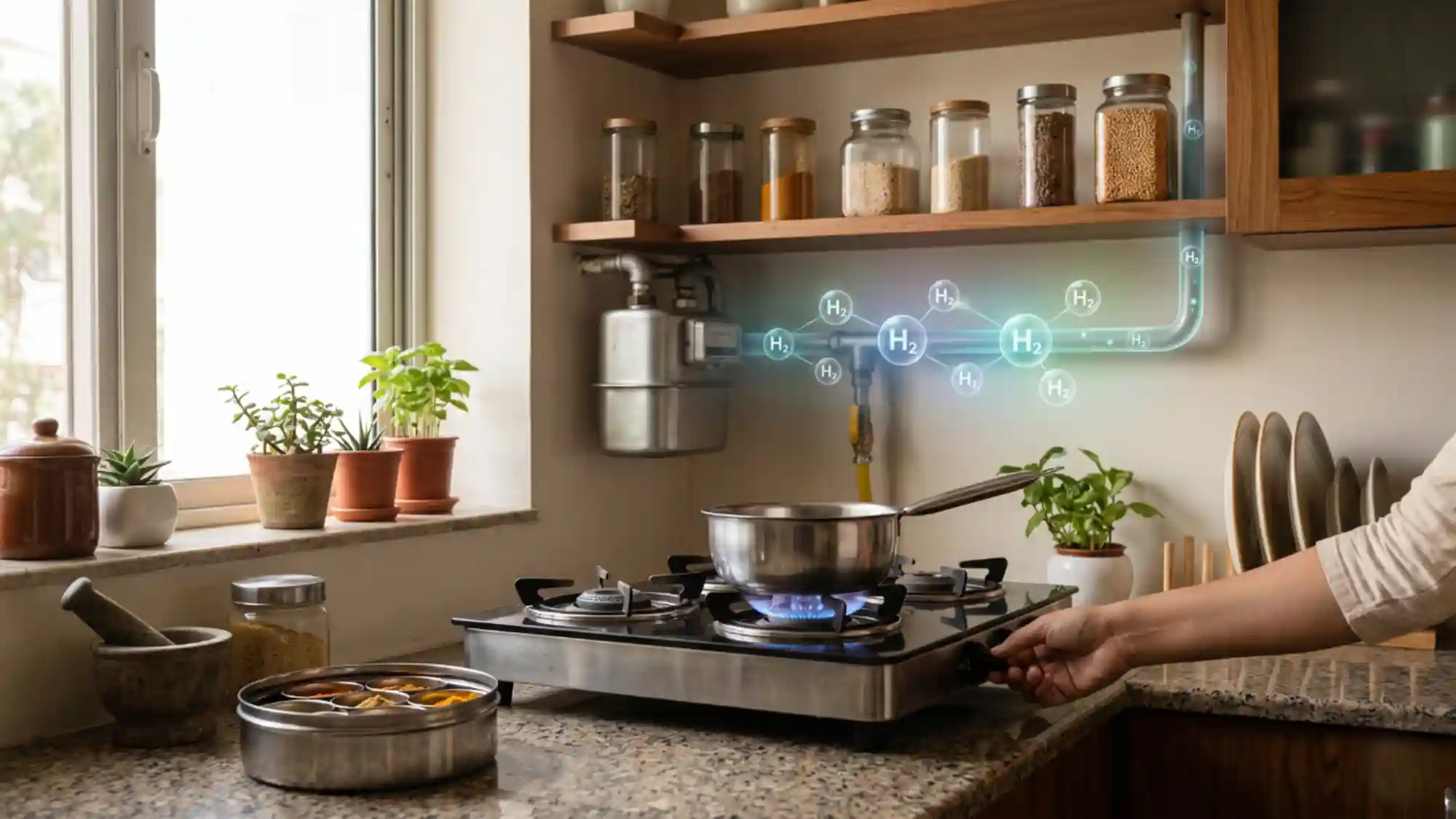
The gas that reaches your kitchen could one day contain something unexpected: hydrogen. India’s petroleum and natural gas regulator has proposed allowing hydrogen to be blended into the piped natural gas supplied to households, as part of efforts to explore cleaner energy alternatives. The idea sounds simple—add a small amount of hydrogen to existing gas supplies and potentially reduce reliance on fossil fuels. But making that change safely involves more than adjusting the gas mixture.
What exactly has India proposed?
The Petroleum and Natural Gas Regulatory Board (PNGRB) has released draft guidelines that propose allowing up to 5% hydrogen by volume to be blended with domestic piped natural gas, commonly called PNG. The proposal concerns gas delivered through household pipeline networks, rather than every type of gas infrastructure. It does not automatically permit hydrogen blending across all networks. Distributors would need to demonstrate that their systems are suitable and obtain the necessary regulatory and statutory approvals before commercial supply begins. Under the proposed framework, 5% is the maximum permitted concentration, not necessarily the level that every network would routinely use. The actual operating concentration would depend on technical assessments and safety requirements.
How could hydrogen make gas cleaner?
Natural gas consists mainly of methane, a fossil fuel that releases carbon dioxide when burned. Hydrogen, by contrast, produces water when it burns in oxygen, without directly releasing carbon dioxide at the point of combustion. Blending hydrogen into natural gas could therefore reduce the amount of methane in the fuel mixture and potentially lower direct carbon dioxide emissions from cooking. It could also create a new route for using hydrogen produced through cleaner energy systems. However, the environmental benefit depends on how the hydrogen is made. Hydrogen produced using renewable electricity can have a much lower carbon footprint than hydrogen made from fossil fuels without effective emissions controls. There is another important detail: hydrogen contains less energy per unit volume than natural gas. A mixture containing 5% hydrogen by volume does not replace 5% of natural gas’s energy contribution. Consequently, the reduction in emissions and fossil-gas use may be modest.
Why can’t hydrogen simply be added everywhere?
Hydrogen behaves differently from natural gas. It is highly flammable, can leak through some seals and connections more readily, and may affect certain metals and components under particular operating conditions. Its combustion characteristics also differ, which means existing appliances cannot automatically be assumed to work identically with every blend. The proposed guidelines therefore emphasise checks on pipelines, valves, meters, regulators and household appliances. Operators would also need to monitor hydrogen concentrations, maintain gas quality, address billing implications and establish emergency procedures. India has already explored hydrogen blending through pilot projects in locations including Indore, Kawas and Ahmedabad. These trials provide useful experience, but the performance of one network cannot guarantee that every pipeline system and appliance is compatible.
What happens next? The draft guidelines are open for stakeholder comments, with the PNGRB listing 12 November 2026 as the deadline. Further approvals and technical assessments are needed before commercial implementation under the proposed framework. If adopted, hydrogen blending could become one small part of India’s wider clean-energy transition. But it is not a complete replacement for natural gas, nor does a hydrogen blend automatically make household cooking carbon-neutral. The real test will be whether the system can deliver measurable emissions reductions while remaining safe, affordable and compatible with the equipment already used in homes. For now, hydrogen in household gas is a proposal under development, not yet a nationwide change to the fuel coming through kitchen pipelines.
Sources:
BW Businessworld. (2026, Month Day). PNGRB proposes 5% hydrogen blending in domestic gas networks. https://www.businessworld.in/article/pngrb-proposes-5-hydrogen-blending-in-domestic-gas-networks-628319