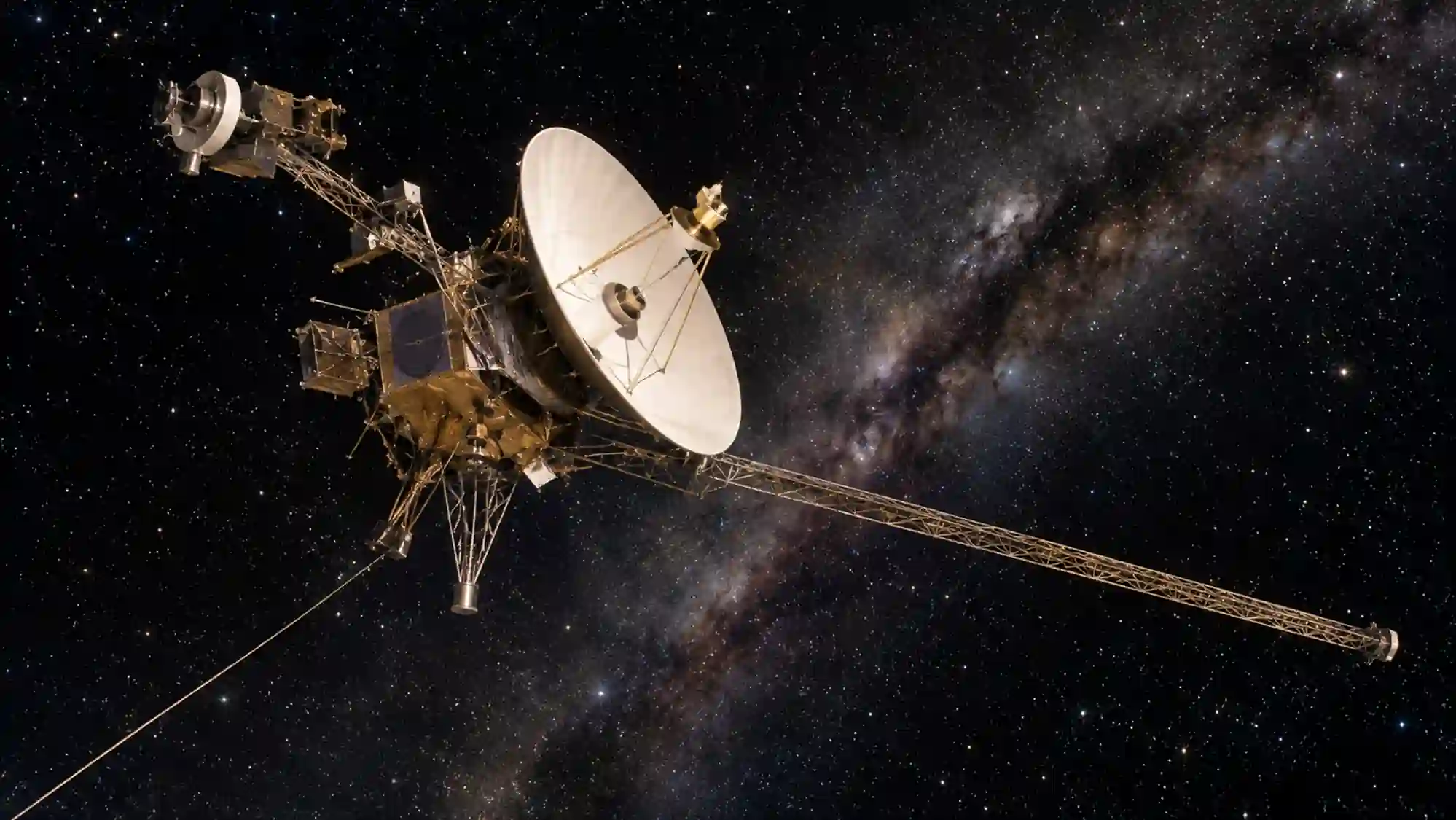
On Nov. 18, humanity’s most distant ambassador crossed a line no human-made object has crossed before.
The day light’s “commute” hit 24 hours
Radio waves travel at the speed of light, about 300,000 km every second. For almost half a century, the delay between Mission Control and Voyager 1 has grown steadily. Now it has passed a symbolic mark. On Nov. 18, 2026, Voyager 1 was 16.094 billion miles (25.902 billion kilometers) from Earth, which is the distance light travels in 24 hours, or one light-day. The crossing was calculated for 10:16:07 UTC, which is 3:46 PM in India.
If you send Voyager a command today, it arrives a day later. Any reply takes another day to come back, so a simple question-and-answer takes 48 hours.
How big is a light-day?
Our usual yardsticks give out here:
- The Moon is about 1.3 light-seconds away. Light crosses that distance in 1.3 seconds, while the Artemis II astronauts needed about three days. nasa
- Neptune is the outermost planet. It is roughly four light-hours and 10 light-minutes away. nasa
- Voyager 1 is now about 173 astronomical units from Earth. That is more than five times Neptune’s distance.
At that range, the Sun is just a very bright star in Voyager’s sky.
A 49-year road trip
The probe took 49 years, two months and 11 days to cover one light-day. That is a slow trip by cosmic standards. Voyager 1 has been traveling on the same trajectory at about 38,000 miles per hour since its Saturn flyby in November 1980. Light does the same distance in a day.
The spacecraft has been through a lot along the way:
- 1979–1980: Flybys of Jupiter and Saturn. At Jupiter, it found a faint ring system.
- 1990: The famous “Pale Blue Dot” image. Its cameras were used a final time on Valentine’s Day 1990 to photograph the planets from 3.7 billion miles away. CBS News
- 2012: It crossed the heliopause, the edge of the Sun’s bubble of influence, in August 2012. That made it the first human-made object to enter interstellar space. iflscience
Surviving on a power budget
Voyager 1 runs on a radioactive power source that weakens every year. To keep the spacecraft alive, engineers have been switching off instruments one at a time. In April 2026, NASA turned off the Low-Energy Charged Particle instrument to save energy. The core science continues, such as measuring the plasma and magnetic fields of interstellar space. Each shutdown is a trade-off between more science now and a longer mission.
Is a light-day really a milestone?
Partly it is symbolic. Nothing physical happens at the 24-hour mark, and no one sees a finish line. There is no tape to break and no one to throw confetti. The number depends on where Earth is in its orbit, so a purist could argue that a light-day from the Sun is the more meaningful threshold.
Even so, round numbers help us grasp scale. And no human-made object has been here before.
What’s next?
- Voyager 2 will not follow soon. It isn’t expected to reach one light-day until November 2035. aol
- The end of contact looms for Voyager 1. By 2036, its signal may be too faint for NASA’s antennas to detect. skyatnightmagazine
After that, the spacecraft will drift through the Milky Way, carrying the Golden Record, a message in a bottle from our species. It is a small piece of Earth now far beyond the Solar System.
Sources:
NASA. (2026). What is a light-day? NASA Science. https://science.nasa.gov/mission/voyager/voyager-1/voyager-1-what-is-a-light-day/
Stone, E. C., Cummings, A. C., McDonald, F. B., Heikkila, B. C., Lal, N., & Webber, W. R. (2013). Voyager 1 observes low-energy galactic cosmic rays in a region depleted of heliospheric ions. Science, 341(6142), 150–153. https://doi.org/10.1126/science.1236408