A black hole is defined by a boundary beyond which nothing not even light can escape. This boundary is called the event horizon. It might therefore seem that a black hole’s influence should be confined to its immediate surroundings.
But supermassive black holes at the centres of galaxies tell a very different story.
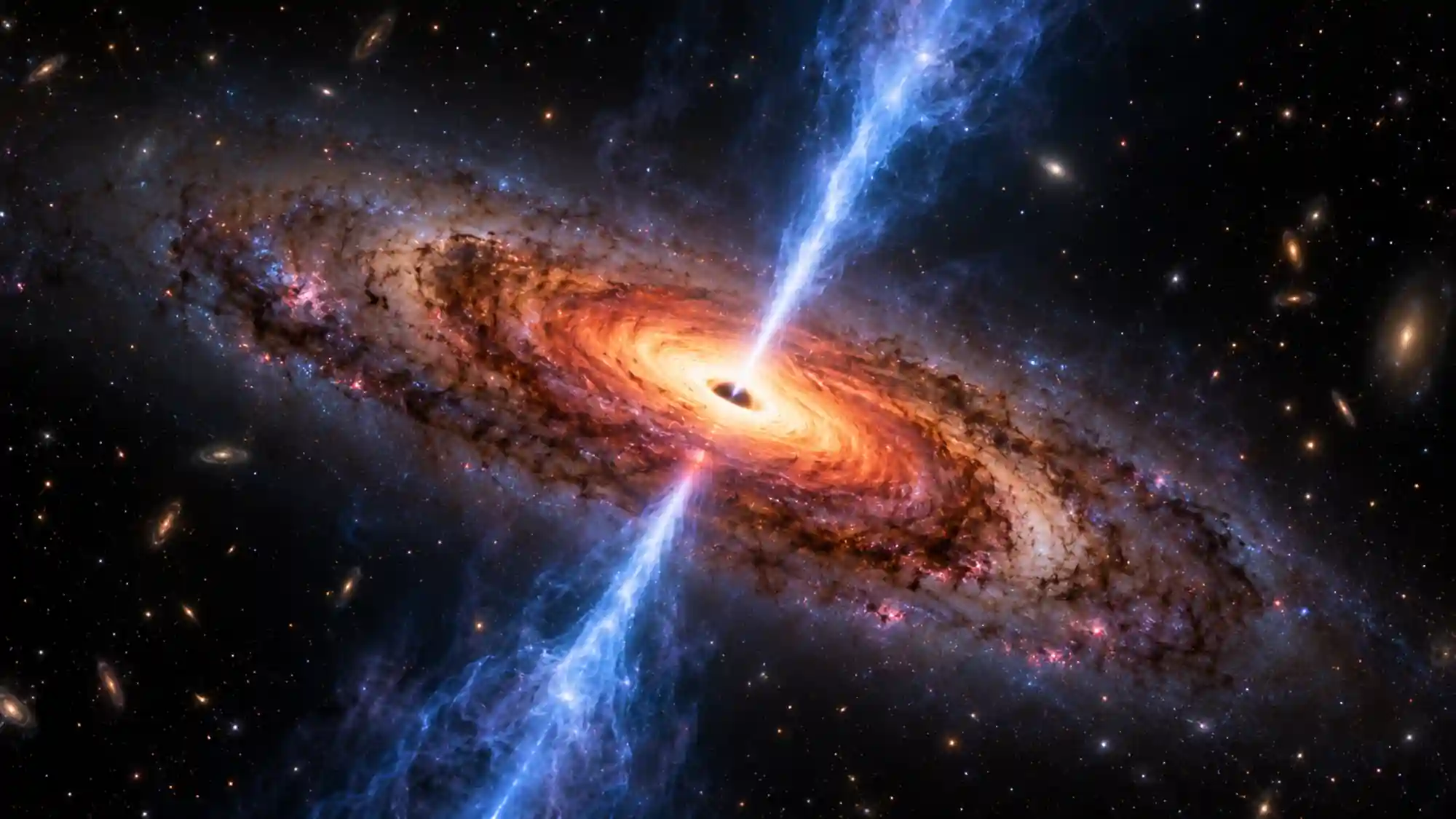
When one of these enormous black holes is actively feeding, material spiralling toward it can form an accretion disk that becomes extraordinarily hot and luminous. Some active black holes also launch powerful winds and narrow jets of plasma moving at close to the speed of light. These outflows can travel far beyond the immediate neighbourhood of the black hole and interact with the surrounding galaxy.
This process is known as active galactic nucleus (AGN) feedback. It is one of the most important ideas in modern galaxy-evolution research because a black hole can contain only a tiny fraction of its host galaxy’s mass while nevertheless influencing enormous quantities of gas.
The reason is energy. As matter falls into an accretion disk, gravitational energy is converted into radiation and kinetic energy. Powerful winds and jets can then inject some of this energy into the galaxy’s interstellar and circumgalactic gas.
That can have a dramatic consequence for star formation.
Stars form when relatively cool gas collapses under gravity. If black-hole-driven outflows heat, accelerate or expel this gas, the supply of material available to form new stars can decrease. Observations of luminous quasars have detected high-velocity winds carrying enough kinetic power to potentially affect the gas throughout their host galaxies.
But the relationship is more complicated than simply saying that black holes “kill” galaxies. Under some circumstances, energy from an active black hole may compress surrounding gas and trigger new episodes of star formation. Recent observations have found evidence of star-forming structures extending thousands of light-years from active galactic nuclei, suggesting that feedback can sometimes suppress star formation in one region while encouraging it elsewhere.
There is also growing evidence that the connection between black holes and galaxies is established very early in cosmic history. Observations of distant galaxies have revealed supermassive black holes that appear surprisingly massive compared with their host galaxies, raising questions about whether black holes and galaxies grew together or whether black holes sometimes developed ahead of their hosts.

Importantly, the black hole does not need to gravitationally pull on individual stars across the entire galaxy. Its large-scale influence is mainly indirect: energy released by material falling toward the black hole is transported outward through radiation, winds and jets.
The result is one of astronomy’s most remarkable feedback loops. A tiny region surrounding a supermassive black hole can release enough energy to alter the behaviour of gas across a galaxy.
The event horizon may mark the boundary of escape but it does not mark the boundary of the black hole’s astrophysical influence.
Sources:
Nardini E, Reeves JN, Gofford J, Harrison FA, Risaliti G, Braito V, Costa MT, Matzeu GA, Walton DJ, Behar E, Boggs SE, Christensen FE, Craig WW, Hailey CJ, Matt G, Miller JM, O’Brien PT, Stern D, Turner TJ, Ward MJ. Galaxy evolution. Black hole feedback in the luminous quasar PDS 456. Science. 2015 Feb 20;347(6224):860-3. doi: 10.1126/science.1259202. PMID: 25700515.
Schawinski K, Khochfar S, Kaviraj S, Yi SK, Boselli A, Barlow T, Conrow T, Forster K, Friedman PG, Martin DC, Morrissey P, Neff S, Schiminovich D, Seibert M, Small T, Wyder TK, Bianchi L, Donas J, Heckman T, Lee YW, Madore B, Milliard B, Rich RM, Szalay A. Suppression of star formation in early-type galaxies by feedback from supermassive black holes. Nature. 2006 Aug 24;442(7105):888-91. doi: 10.1038/nature04934. PMID: 16929291.