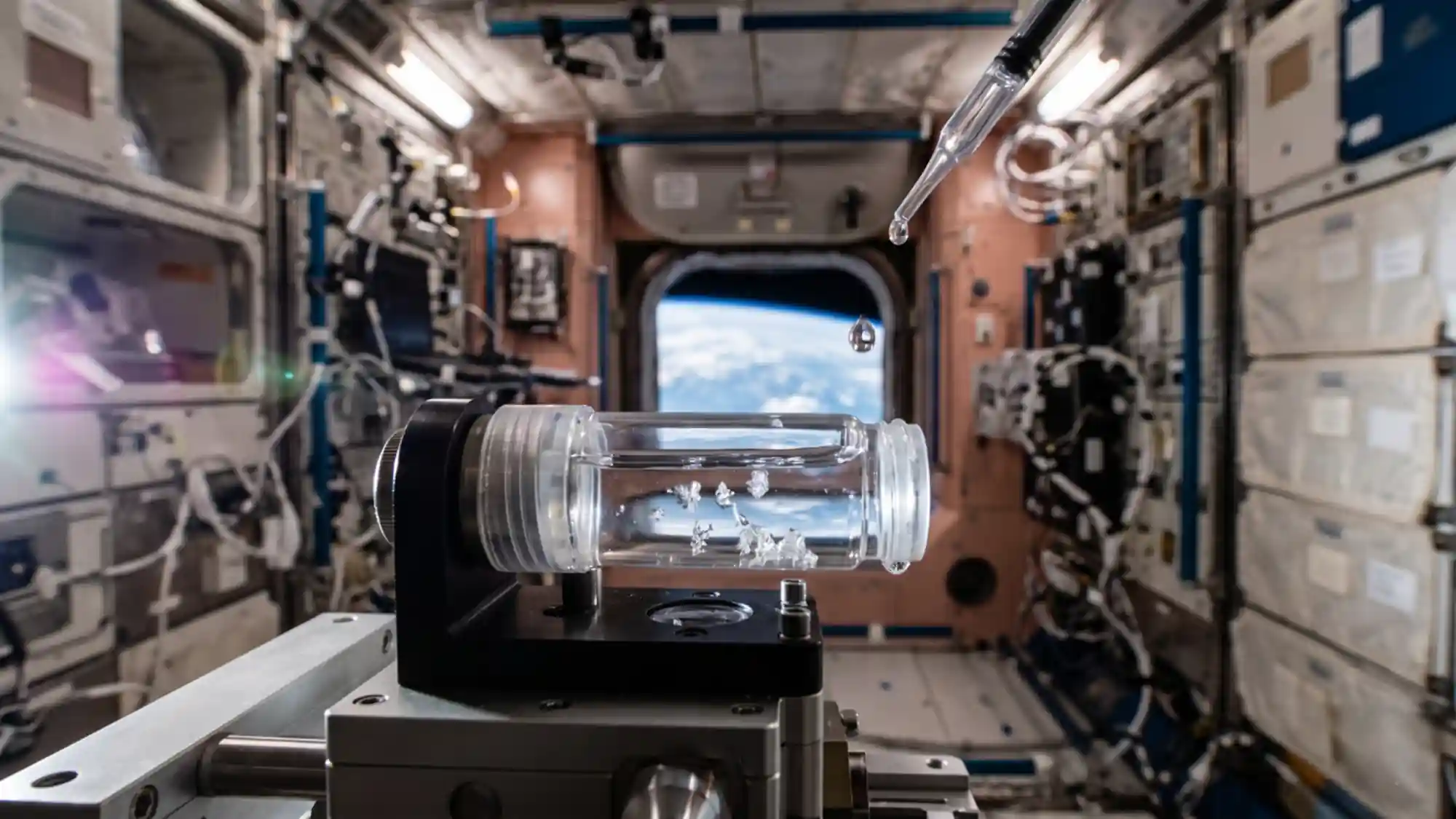
What do human tears and space exploration have in common? A protein called lysozyme is providing an unexpected connection. NASA has highlighted crystals of this naturally occurring protein grown aboard the International Space Station (ISS), where researchers are investigating how crystals form in microgravity. The experiment may look unusual, but it addresses a fundamental scientific challenge: understanding how to grow well-ordered protein crystals for detailed structural analysis. The crystals were grown using Redwire’s PIL-BOX experimental hardware. An image released by NASA shows the crystals aboard the ISS on June 5, 2024. Although lysozyme itself is not a new discovery, its use in the experiment helps researchers study crystal formation under conditions that are difficult to reproduce on Earth.
The protein that helps defend your body. Lysozyme is found in several bodily fluids, including tears, saliva and milk. It forms part of the body’s innate immune defence by helping break down bacterial cell walls, making it one of the ways the body protects itself against certain microorganisms. Scientists also use lysozyme extensively in laboratory research because it is a well-studied protein. In this space experiment, it serves as a control compound, a familiar material that can help researchers observe and assess how crystals develop under microgravity conditions.
But why grow a protein into a crystal in the first place?
Proteins carry out many essential biological functions, from immune defence to controlling chemical reactions inside cells. Their three-dimensional structures help determine how they work and interact with other molecules. To investigate these structures, researchers can use X-ray crystallography. An X-ray beam is directed at a protein crystal, and the resulting diffraction pattern provides information about how atoms are arranged within the protein. This can reveal structural details that are difficult to determine through other methods. The challenge is producing crystals that are sufficiently ordered for reliable analysis. Irregularities in a crystal can reduce the quality of the resulting data, making the growth process an important part of structural biology.
What makes space different?
On Earth, gravity contributes to fluid movement through convection and causes particles to settle. These processes can disturb the environment around growing crystals, affecting how protein molecules reach and join the developing structure. Aboard the ISS, microgravity greatly reduces gravity-driven convection and sedimentation. Under suitable conditions, this can allow protein molecules to assemble more gradually and produce crystals with fewer defects, potentially improving the quality of structural measurements. However, the outcome depends on the protein and the experimental conditions; space does not automatically produce better crystals in every case. Understanding protein structures can help researchers investigate diseases and design molecules that interact with specific biological targets. Previous experiments aboard the ISS have studied medically relevant proteins, including targets associated with cancer and other diseases. Better structural information can help guide drug research, although crystal growth alone does not create a treatment. The lysozyme experiment is best understood as part of this broader effort to learn how microgravity affects crystal formation. It is not evidence that the tear protein itself has produced a new medicine. By studying familiar biological molecules in an unfamiliar environment, researchers can investigate the physical processes that shape proteins at the molecular level. Sometimes, understanding a complex scientific problem begins with something as ordinary as a tear and a crystal grown hundreds of kilometres above Earth.
Sources:
HQ Web Team. (2026, February 19). Crystals grown in space. NASA. https://www.nasa.gov/image-article/crystals-grown-in-space/