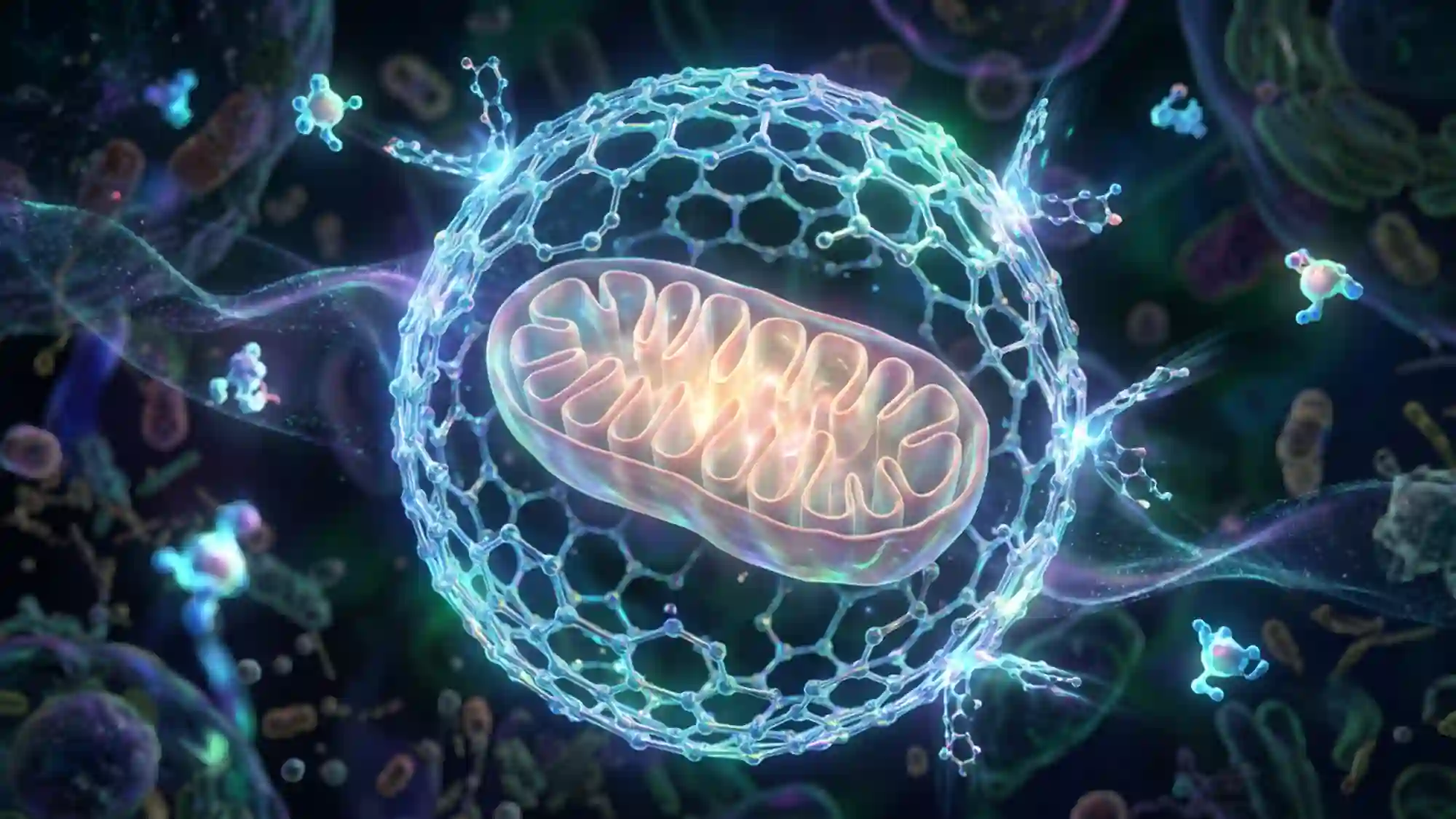
What if scientists could give the tiny power plants inside our cells a protective coat without stopping them from producing energy? It sounds like a materials-engineering challenge, but researchers have taken an important step towards making it possible. They have developed a way to wrap mitochondria in a specially designed porous material while preserving much of their ability to generate cellular energy.
Mitochondria are best known for producing ATP, the molecule that powers many of the cell’s essential activities. They are particularly important in energy-demanding tissues such as the brain, heart and muscles. When mitochondria malfunction, the consequences can range from rare inherited disorders to problems affecting several organ systems. One emerging research strategy is mitochondrial transplantation, in which healthy mitochondria are introduced into cells that are struggling to function. However, isolated mitochondria are delicate structures. Handling them outside cells can compromise their membranes and energy-producing machinery, making successful delivery difficult.
Researchers from the IRCCS Fondazione Istituto Neurologico Carlo Besta and Politecnico di Milano in Italy turned to a class of materials called metal-organic frameworks, or MOFs. MOFs are structures assembled from metal ions and organic molecules. Their porous architecture and adjustable chemical properties make them useful in applications ranging from gas storage to drug delivery. The team used a particular MOF called ZIF-8 to create a coating directly on isolated mitochondria. By carefully controlling the concentrations of its chemical building blocks, the researchers formed the layer under relatively mild conditions, helping avoid damage to the organelles. The crucial question was whether the coating would interfere with the mitochondria’s main job: producing energy.

Could coated mitochondria still work?
Laboratory measurements showed that the coated mitochondria retained respiratory activity, meaning they could still consume oxygen as part of the process that generates ATP. Although some respiratory measurements were lower than those of uncoated mitochondria, their overall ability to respond to metabolic demands remained largely intact. They then introduced the coated mitochondria into mouse embryonic fibroblasts, a type of laboratory-grown cell. The treated cells showed increased respiratory activity compared with untreated cells, suggesting that the coating did not prevent mitochondrial uptake or function in this experimental system. These results are promising because a protective layer could eventually be customised to improve mitochondrial stability, help guide organelles towards particular cells, or make their delivery more efficient. Mitochondrial dysfunction is associated with several serious conditions, including inherited mitochondrial diseases and some neurological and cardiovascular disorders. In principle, transferring functional mitochondria could help restore energy production in damaged cells. However, the current study does not demonstrate that the coating treats any disease. The experiments were conducted using isolated mitochondria and laboratory cells, not in patients. This still needs to establish whether the coating improves delivery in living organisms, how long the mitochondria remain functional, and whether the material is safe over time. For now, the achievement lies in showing that a delicate biological structure can be modified with an engineered material without completely disrupting its function. The next challenge is to turn that protective layer into something more than a clever laboratory technique and determine whether it can help healthy mitochondria reach the cells that need them most.
Sources:
Marco D’Amato, Ivano Di Meo, Maria Nicol Colombo, Chiara Santanatoglia, Francesca Baldelli Bombelli, Valeria Tiranti, Pierangelo Metrangolo; Engineered Metal-Organic Frameworks Preserve Mitochondrial Bioenergetics at Micromolar Concentrations. Journal American Chemical Society 18 November 2026; 148 (45): 48924–48935. https://doi.org/10.1021/jacs.6c11154