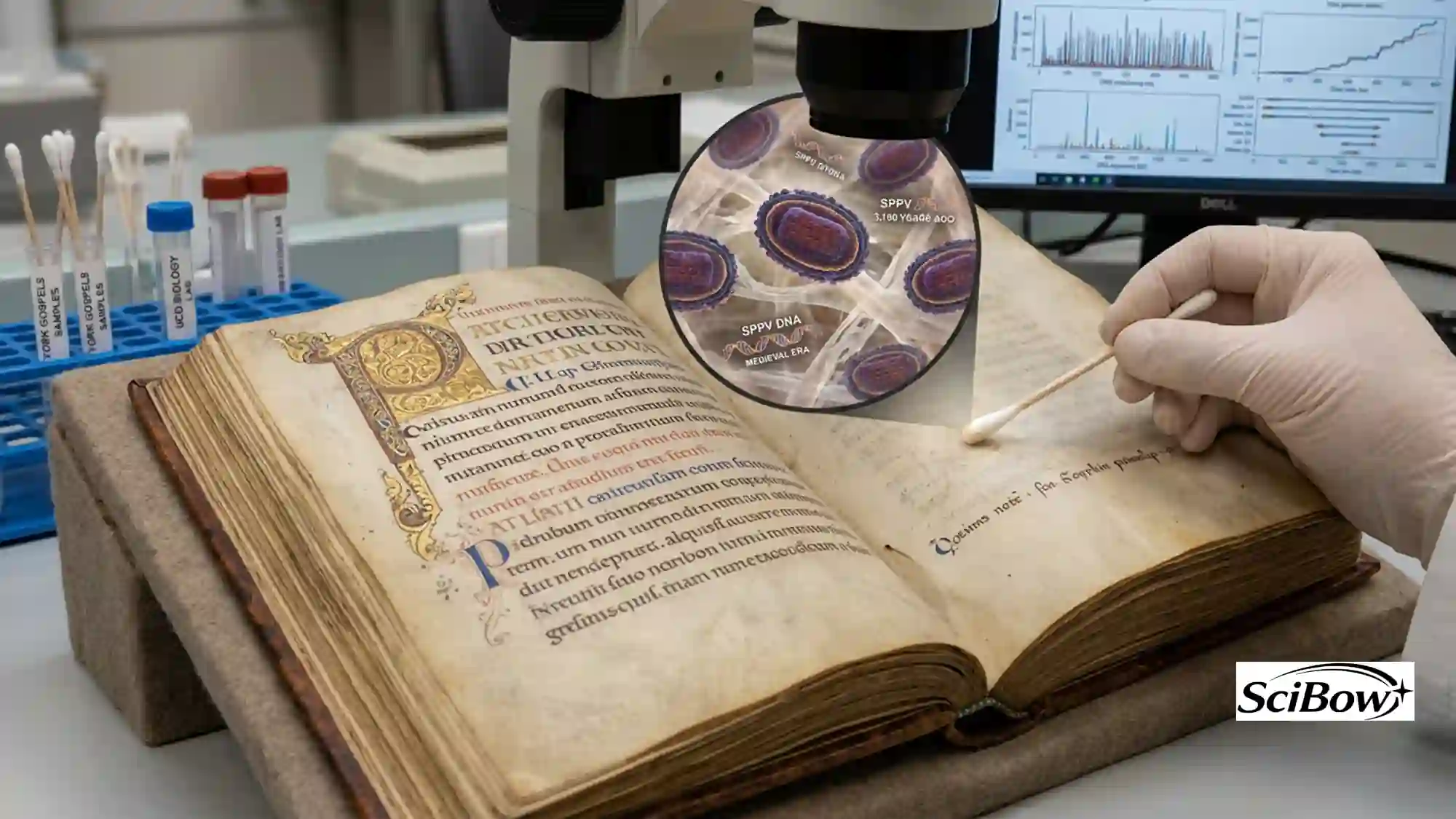
Imagine opening a thousand-year-old gospel book. You see gold-lit lettering, careful scribal hands, centuries of devotion. Now imagine a molecular biologist looking at the same page and seeing something else: a viral fossil hiding in the parchment.
A book made of sheep (and calves)
Before paper, books were made from animal skin. Parchment was typically made from sheep, goat or calf hides, and it carried more than ink. Scientists have found that ancient manuscripts, including the York Gospels, preserve viral DNA from a deadly sheep virus, opening a window onto the 3,500-year history of sheeppox virus (SPPV).
The York Gospels were probably produced at Canterbury around 990 to 1020 CE. Other manuscripts in the study came from Britain, France, Austria and the Upper Rhine region.

Reading the DNA
A team led by Louis L’Hôte at University College Dublin screened 754 samples and detected the virus in 39 Eurasian archaeological and historical specimens, including sheep teeth from the Eurasian steppe and medieval parchment and paper. Teeth are excellent genetic archives because they often keep DNA from past infections for thousands of years. biorxiv
Putting teeth and parchment together, the findings show that sheeppox has threatened sheep herds for more than 3,700 years. The medieval pages were not just bystanders. The authors report an especially high number of viral genomes from the medieval period, suggesting that sheep infection was a frequent challenge for European societies. eurekalertyahoo
A virus that barely changed
The most striking finding is how little the virus changed. Smallpox, a distant poxvirus relative, evolved considerably over time. The study’s authors found that sheeppox virus, unlike smallpox, stayed remarkably stable over the last few millennia. Whatever worked for this pathogen in the Bronze Age, it kept working. Fox News
The deeper family tree is also revealing. The main lineages leading to sheeppox, goatpox and lumpy skin disease viruses split roughly 11,500 to 3,700 years ago, a window that overlaps with animal domestication and the movement of sheep from the steppe into Europe. Farming, it seems, gave the virus new opportunities as well as us. archaeologymag
Puzzles still on the page
Not everything is settled. Sheeppox DNA also turned up in parchment made from cattle and goat skin, which could mean cross-species infection or contamination from another source. Researchers suggest the virus may have been transferred during parchment manufacture. Intriguingly, the pages carrying viral DNA generally show no visible signs of lesions, so these traces are invisible to the naked eye. biorxivmedievalists
Why it matters today
The disease still affects sheep farms today, and ancient viral DNA lets researchers compare past and present strains. A pathogen’s long-term behaviour can inform how we monitor and respond to modern outbreaks in livestock. archaeologymag

It also shows that cultural heritage is a scientific archive. The next time you see a medieval manuscript behind museum glass, remember that its pages may hold two stories: the one the scribes wrote, and one written by a virus.
Sources:
L’Hôte, L., et al. (2026). 3,500 years of sheeppox virus evolution inferred from archaeological and codicological genomes [Preprint]. bioRxiv. https://doi.org/10.64898/2026.02.23.707469
Teasdale, M. D., et al. (2017). The York Gospels: A 1000-year biological palimpsest. Royal Society Open Science, 4(10), Article 170988. https://www.ncbi.nlm.nih.gov/pmc/articles/PMC5666278/