India’s GSLV-F17 successfully launches EOS-05, opening a new era of geosynchronous Earth imaging
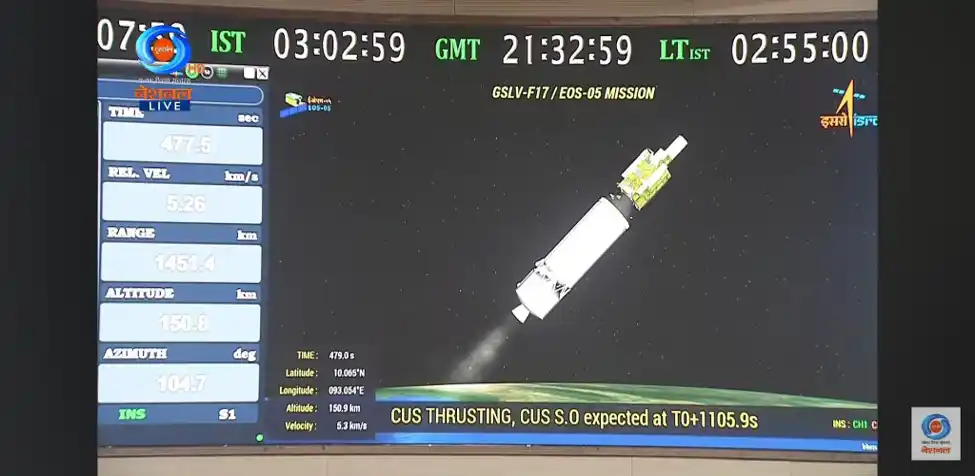
Sriharikota, September 4, 2026: At 2:55 a.m. IST, while much of India was asleep, the night sky over Sriharikota was transformed by the roar of India’s Geosynchronous Satellite Launch Vehicle (GSLV-F17).
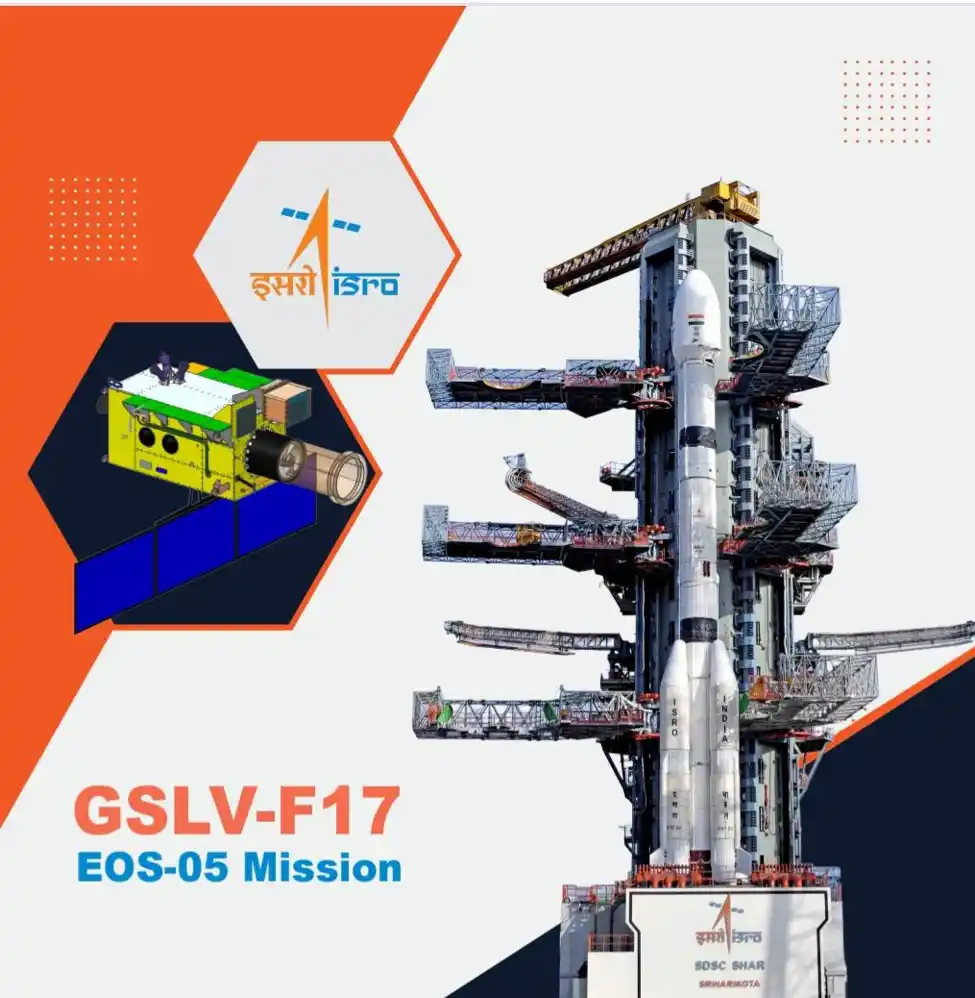
Lifting off from the Second Launch Pad at Satish Dhawan Space Centre, the 51.7-metre-tall rocket carried EOS-05, a 2,367-kg Earth-observation spacecraft, on a mission that was far more than another satellite launch.
It was a technological statement: India now has an imaging spacecraft designed to observe Earth from geosynchronous orbit.
The mission was successfully completed, with EOS-05 injected into its intended Sub-Geosynchronous Transfer Orbit (Sub-GTO).
Why EOS-05 is different
Most Earth-observation satellites operate much closer to Earth, often travelling in low Earth orbit and repeatedly passing over the same regions.
EOS-05 is designed for something fundamentally different.
According to the ISRO mission brochure, it is India’s first imaging satellite designed to operate from geosynchronous orbit.
From an eventual orbit around the geosynchronous region, roughly 36,000 km above Earth, a spacecraft can maintain prolonged observation of a broad geographic region.
That capability can be particularly valuable for applications such as:
- Weather and atmospheric monitoring
- Cyclone tracking
- Flood and disaster monitoring
- Agricultural observation
- Environmental and forest monitoring
- Rapid imaging of large geographic regions
- Persistent observation of the Indian subcontinent and surrounding areas
The key advantage is not simply seeing farther. It is the ability to keep watching a large region for much longer periods.
Meet GSLV-F17
Getting EOS-05 into space required a sophisticated three-stage launcher.
GSLV-F17 represents the 19th flight of India’s GSLV, according to the mission brochure. It stands 51.7 metres tall and had a lift-off mass of approximately 420.5 tonnes.
Its configuration was:
S139 + 4 L40H + GL40HT + CUS15 + 4-metre composite ogive payload fairing
In simpler terms, the rocket combines a powerful solid core, four liquid strap-on boosters, a liquid second stage and India’s cryogenic upper stage.
The three-stage architecture
Stage 1 – GS1
The first stage consists of the S139 solid motor accompanied by four L40H liquid strap-ons.
The S139 uses HTPB-based solid propellant, while the L40H boosters use UH25 and N₂O₄.
Stage 2 – GS2
The GL40HT second stage is another liquid-propellant stage using UH25 and N₂O₄.
Stage 3 – GS3
At the top sits the CUS15 cryogenic upper stage, powered by liquid hydrogen and liquid oxygen (LH₂/LOX).
This cryogenic stage is particularly important because it provides the high-energy performance needed for missions involving demanding high-altitude transfer orbits.
The precision behind the mission
The target wasn’t simply “space.”
EOS-05 had to be delivered into a carefully defined orbit.
The mission brochure specified a nominal Sub-GTO perigee of 170 km, an apogee of 28,934 km, and an inclination of 19.28°. The planned payload mass was approximately 2,367 kg.
After liftoff, the rocket’s stages performed their jobs sequentially, ultimately handing the satellite over to its orbital trajectory.
Post-launch reports indicate that EOS-05 reached the intended transfer orbit approximately 18 minutes after liftoff.
Reports following the mission indicated an achieved orbit of approximately 171 × 31,026 km, compared with the expected transfer orbit of about 170 × 29,000 km.
That additional performance is significant because every bit of launch-vehicle energy can matter when a spacecraft has to raise its orbit further toward geosynchronous altitude.
From transfer orbit to geosynchronous observation
There is an important distinction here.
GSLV-F17 did not simply place EOS-05 directly into a circular 36,000-km geostationary orbit.
Instead, the launch vehicle inserted the spacecraft into a Sub-Geosynchronous Transfer Orbit.
From there, the spacecraft must use its own propulsion system to progressively raise and reshape its orbit until it reaches its operational geosynchronous configuration.
Reports indicate that the orbit-raising phase is expected to be completed within days, followed by spacecraft checkout before operational service begins.
Why this launch matters for India
The significance of EOS-05 goes beyond the successful launch of another Earth-observation satellite.
It represents the expansion of India’s Earth-observation architecture into a new orbital regime.
A satellite operating from geosynchronous orbit can provide a very different observational perspective from conventional low-Earth-orbit platforms.
Imagine trying to monitor a cyclone.
A low-orbit satellite may obtain extremely detailed imagery, but it passes over a particular region periodically.
A geosynchronous imaging spacecraft can remain focused on a broad geographic area, allowing scientists and disaster-management agencies to observe how conditions evolve over time.
That difference can be crucial when minutes and hours matter.
A powerful technical package
The mission also demonstrates the capabilities of the GSLV configuration itself.
- The vehicle combines:
- 420.5 tonnes of lift-off mass
- 51.7 metres of rocket height
- Three propulsion stages
- Four liquid strap-on boosters
- Indigenous cryogenic upper stage
- 2,367-kg Earth-observation spacecraft
- 4-metre composite payload fairing
These specifications make GSLV-F17 a highly complex engineering system rather than simply a larger version of a conventional launch vehicle.
From a rocket launch to an Earth-monitoring platform
The most fascinating part of this mission begins after the spectacular launch is over.
The rocket’s job was to provide the initial push.
EOS-05’s job is much longer.
Once it completes orbital manoeuvres and commissioning, the spacecraft will become a persistent observer high above Earth.
Its images and observations could contribute to understanding rapidly changing conditions across the Indian region—from extreme weather and floods to agriculture and environmental changes.
In other words, GSLV-F17 is the vehicle that opened the door; EOS-05 is the eye that will look through it.
A new chapter after liftoff
At 2:55 a.m. on September 4, the GSLV-F17 rose from Sriharikota carrying 420 tonnes of hardware and decades of Indian launch-vehicle experience.
Around 18 minutes later, its most important passenger had begun its journey toward the geosynchronous realm.
For ISRO, this was a successful launch.
For Earth observation, it represents a new capability.
And for India, it is another reminder that some of the most important technologies are not necessarily the ones we see on Earth.
Sometimes, they are 36,000 kilometres above it.
Source:
GSLV-F17EOS-05 Mission, Office of Media and Public Relations (OMPR)
Indian Space Research Organisation
Department of Space, Government of India.