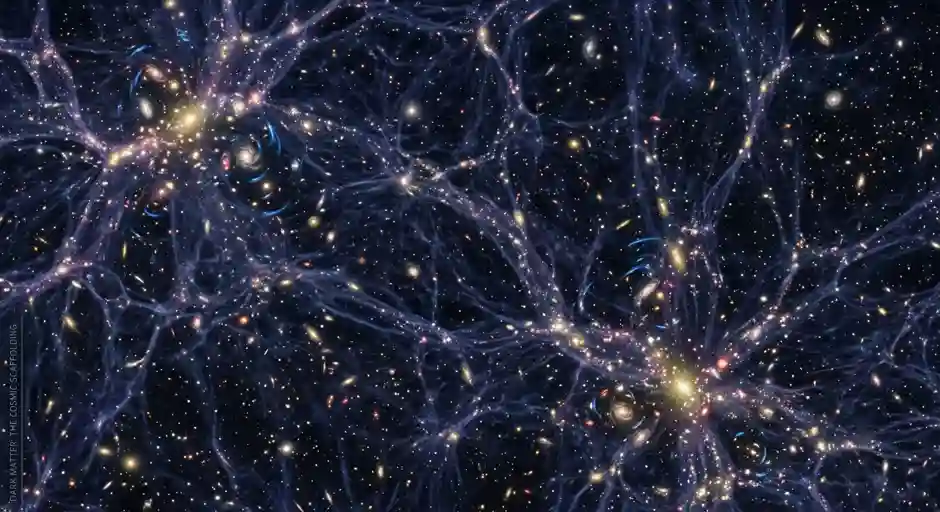
For almost a century, scientists have known that something is influencing the universe that we cannot see. Galaxies rotate as though they contain far more mass than their stars and gas can account for. Gravity bends light around massive objects in ways that reveal unseen matter. Whatever this invisible material is, scientists call it dark matter. Now, an experiment buried nearly a mile underground may have recorded something that could finally be a direct clue to what dark matter actually is.
But what exactly is dark matter? It isn’t simply ordinary matter that happens to be invisible. Normal matter includes stars, planets, people and everything around us that interacts with light. Dark matter appears not to. Scientists know it is there mainly because of its gravitational effects: its gravity helps hold galaxies together and influences how matter is distributed across the universe. Scientists estimate that dark matter makes up roughly 85% of all matter, yet its actual identity remains unknown.
That is why researchers have spent decades trying to catch dark matter interacting with ordinary matter. One leading possibility is a particle called a WIMP, or weakly interacting massive particle. The idea is simple: if these particles exist, one might occasionally collide with an ordinary atom. The collision would be extraordinarily rare, but it could leave behind a tiny detectable signal.
To look for that almost-impossible event, scientists built LUX-ZEPLIN (LZ) deep underground in South Dakota. The detector contains about 10 tonnes of ultra-pure liquid xenon. The underground location is important because thousands of particles constantly rain down on Earth from space. A kilometre of rock helps shield the detector from this cosmic background, allowing scientists to search for the much rarer interactions they are interested in.
And something unusual appeared.
In data collected over 220 days between March 2023 and April 2024, LZ found one particle interaction with characteristics consistent with a high-energy nuclear recoil – the kind of signal that could potentially be produced when a WIMP collides with a xenon nucleus. The event had a measured recoil energy of about 248 keV, and researchers could not find a known background process that satisfactorily explained it.
That sounds like a discovery. It isn’t. At least not yet.
The event has a statistical significance of 2.6 sigma, meaning there is still about a 0.5% probability that the result could arise from known background processes. In particle physics, scientists generally look for a much stronger 5-sigma signal before declaring a discovery. The LZ team is therefore calling this an intriguing hint, not a confirmed detection.
That distinction matters. One unexplained event could disappear as more data arrive, or it could become the first piece of evidence revealing what dark matter actually is. For now, scientists have something almost as valuable as an answer: a signal worth chasing.
Sources: LZ Sees Surprising Result in Search for Dark Matter – Berkeley Lab – Berkeley Lab News Center