Plants have spent hundreds of millions of years growing under one constant force: gravity. Their roots grow down, their shoots grow up, and even the smallest parts of a plant respond to Earth’s gravitational pull. But what happens when that force almost disappears? NASA got a chance to find out when it grew chile peppers aboard the International Space Station.
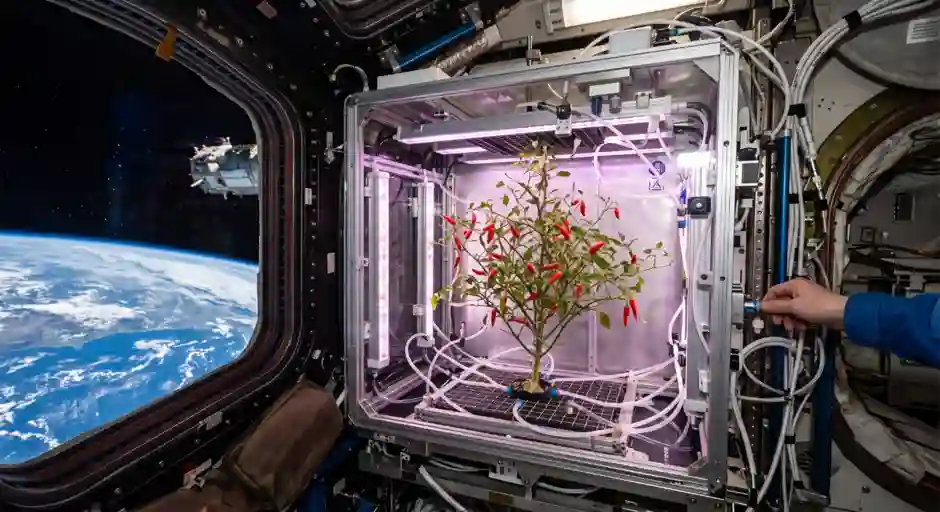
In 2021, NASA launched its Plant Habitat-04 experiment, placing 48 seeds of the NuMex ‘Española Improved’ chile pepper inside the Advanced Plant Habitat on the ISS. The experiment lasted about 137 days and eventually produced 26 peppers from four plants. It was one of the longest continuous plant-growth experiments conducted on the space station. But the peppers did more than simply survive. They grew differently.
One of the most unusual observations involved the small stems connecting the flowers to the developing fruit. On Earth, these structures, called pedicels, normally curve as they grow. In microgravity, however, the pepper plants produced pedicels that were remarkably straight. That strange shape provides a small window into one of the biggest problems in space agriculture: plants have evolved with gravity in mind.
On Earth, plants sense gravity through specialized cells and use that information to determine which direction to grow. Roots generally grow toward gravity, while shoots grow away from it. This process, known as gravitropism, helps a plant organize itself even when light or other environmental signals change. Remove most of the gravitational signal, and the plant has to rely more heavily on other cues.
The pepper experiment also revealed other differences. The plants took longer to produce mature fruit than comparable plants grown on Earth, and pollination presented a challenge. Pepper flowers are capable of self-pollination, but in microgravity pollen does not behave the same way it does under Earth’s conditions. NASA used airflow inside the growth chamber, while astronauts also helped pollinate some flowers manually. Getting peppers to grow was important for another reason: future astronauts will need food that can actually be grown in space.
Packaged meals can supply calories and nutrients, but fresh crops could provide vitamins such as vitamin C while also adding variety to astronauts’ diets. NASA selected this pepper partly because it performed well in ground tests and is a good source of nutrients. There is also a psychological side to growing food in space. Caring for a living plant and eventually eating something freshly harvested could make long missions feel a little less disconnected from Earth. The bigger challenge, however, lies ahead. A mission to Mars could last years, making it impractical to carry every kilogram of food from Earth. Future spacecraft and habitats may therefore need systems capable of producing at least some food locally.
The tiny space pepper experiment shows that this won’t simply mean taking Earth’s agriculture and moving it into a spacecraft. Plants have to learn how to grow in a world where gravity no longer tells them which way is up. And 26 peppers have given scientists a surprisingly spicy place to start.
Sources: