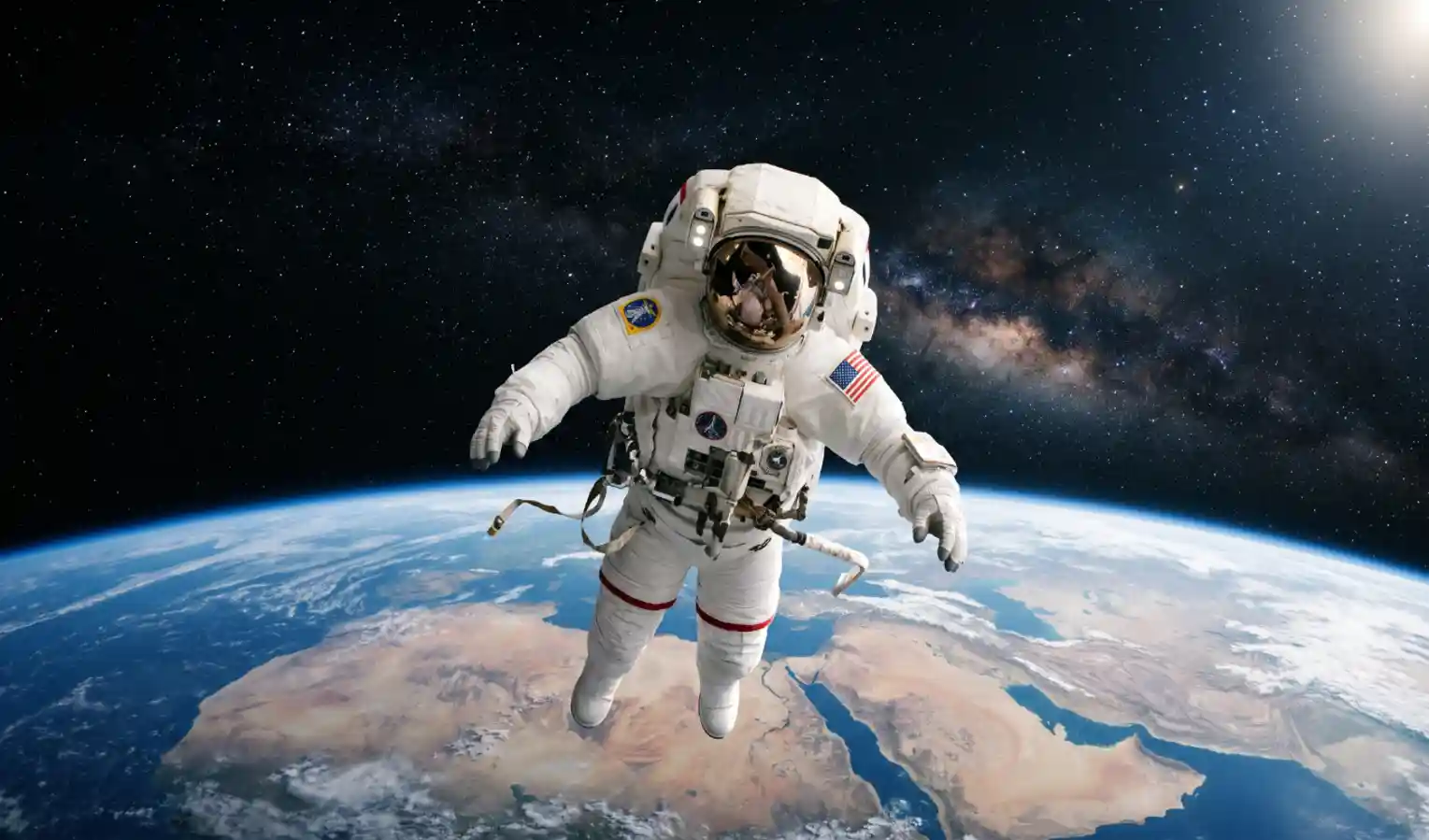
Stepping into space can make astronauts feel like they have received a surprise growth spurt. Within just a few days of reaching the International Space Station, many astronauts become 2 to 5 centimetres taller. It may sound like a scene from a science fiction movie, but it is pure science. The funny part is that they do not stay taller forever. As soon as they return to Earth, the extra height quietly packs its bags and disappears within a few days. It is almost as if gravity says, “Welcome back, now stand where you belong.”
The reason has nothing to do with growing new bones. The real hero of this story is the spine. Our backbone is made of small bones called vertebrae, and between them are soft, jelly-like cushions known as intervertebral discs. These discs act like tiny shock absorbers, protecting the spine whenever we walk, run, or jump. Every second on Earth, gravity gently presses down on our body.
It is like carrying an invisible backpack that we never notice. Throughout the day, this constant pull slightly squeezes the discs, making us a little shorter by evening than we were in the morning.
Space changes the rules of the game. Inside a spacecraft, astronauts live in microgravity, where the pull of gravity becomes extremely weak. Without Earth’s constant squeeze, the intervertebral discs slowly absorb more fluid and expand, much like a sponge that regains its full shape after a heavy stone is lifted away. As the gaps between the vertebrae increase, the spine stretches, allowing astronauts to grow a few centimetres taller.
This is not real growth but a temporary change in body structure caused by altered biomechanics, the science of how forces act on the human body.
However, every silver lining has its cloud. A longer spine places extra tension on the muscles and ligaments that normally support the back. Many astronauts complain of back pain during their first few days in orbit because these tissues are suddenly being stretched beyond their usual length. “My back feels different up here,” many astronauts have reported during space missions. It is the body’s way of adjusting to an entirely new environment where the usual rules no longer apply.
“Even the tallest tree bows before nature, because every force has its place.”
Long stays in space bring another challenge. Bones and muscles become weaker because they no longer have to fight against gravity. It is a classic case of “use it or lose it.” To stay healthy, astronauts spend about two hours every day exercising on special treadmills, resistance machines, and stationary bicycles aboard the International Space Station.
These workouts help their muscles and bones remember the hard work they normally perform on Earth.
The moment astronauts return home, gravity welcomes them back with open arms. Slowly but surely, it begins pressing on the spine once again. The extra fluid leaves the intervertebral discs, the spaces between the vertebrae shrink, and their height returns to normal within a few days. Like a stretched spring settling back into place, the body quietly returns to its familiar shape.
Space often feels like a place where the ordinary becomes extraordinary. Yet this fascinating height increase reminds us of a deeper truth. Gravity is the silent sculptor of the human body, patiently shaping our bones, muscles, and spine every single day. We may rarely notice its invisible hand, but the moment it lets go, our bodies tell the story in the most remarkable way.