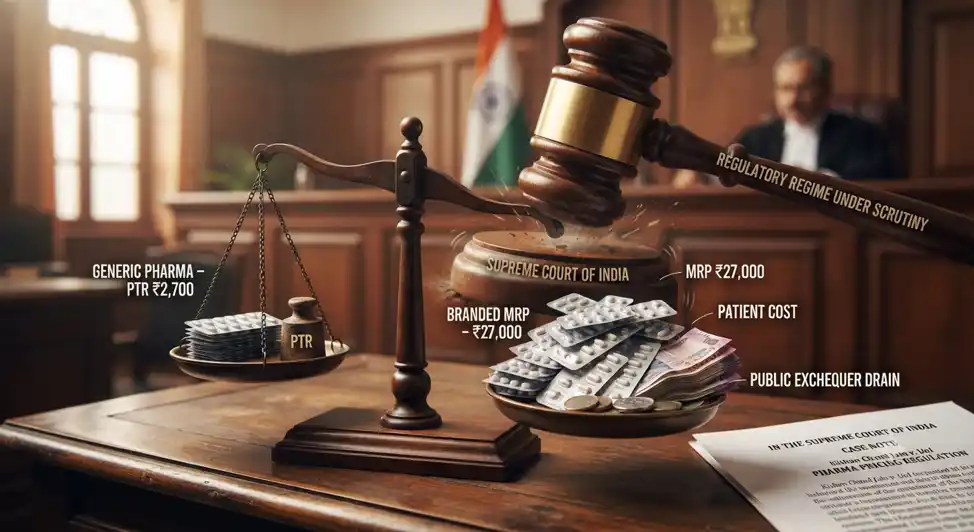
In Kishan Chand Jain v. Ethics and Medical Registration Board, heard alongside Dr. Sanjay Kulshresthra v. Union of India, a Supreme Court Bench of Justices Vikram Nath and Sandeep Mehta (22 September 2026) confronted the regulatory vacuum surrounding drug pricing in India, flagging instances where medicines with a Price to Retailer of ₹2,700 carry a printed MRP of ₹27,000, a ten-fold mark-up borne entirely by the patient. Justice Mehta’s oral observations characterised the practice as tantamount to extortion and “broad daylight dacoity”, noting that such inflated pricing also drains public exchequer funds through reimbursements under schemes like Ayushman Bharat. The petitioners attributed the disparity to a structural gap in the Drugs (Prices Control) Order, 2013, under which roughly 82% of medicines classified as “non-scheduled”, escape any ceiling on initial price fixation, with only subsequent increases capped at 10% annually. With the Union government and the Indian Pharmaceutical Alliance yet to fully respond, the matter stands part-heard, adjourned to 29th September 2026, but the hearing has already placed sustained judicial scrutiny on the adequacy of India’s pharmaceutical price-control framework.
What happened in court
Hearing two connected writ petitions on drug-pricing regulation, the Bench was shown data on the gap between the Price to Retailer (PTR), which is what a manufacturer actually charges the trade, and the Maximum Retail Price (MRP) printed on the pack, which is what the patient pays. In the specific instance cited, an essential cancer medicine with a PTR of ₹2,700 carried a printed MRP of ₹27,000, a ten-fold mark-up.
Justice Mehta’s oral remarks were unusually blunt for a courtroom. He questioned why manufacturers should be permitted to fix MRPs several times higher than the actual sale price, and on record described the practice as “extortion,” asking rhetorically what else it could be if not that, and noting that patients sometimes sell their homes or jewellery to afford such medicines. He went further, characterizing the pricing gap in terms ordinarily reserved for criminal conduct, invoking words like “rampage,” “carnage,” and “broad day light dacoity” with reference to how patients are treated. He also flagged that the authorities responsible for acting on this appear to have stayed silent.
Importantly, the Court also connected this to public exchequer harm: Justice Mehta observed that many patients receiving treatment under PM-JAY/Ayushman Bharat effectively have inflated MRPs reimbursed from taxpayer money, and called this a clear case of fraud on the face of it.
The legal architecture being tested
Petitioner-in-person Kishan Chand Jain’s core submission was that this isn’t a stray anomaly but a regulatory gap. Under the Drugs (Prices Control) Order, 2013 (DPCO):
- Only medicines listed in Schedule I (roughly 1,000 formulations, the “scheduled” medicines) have their ceiling price fixed by the government, via the National Pharmaceutical Pricing Authority (NPPA).
- Non-scheduled medicines have no regulation on the manufacturer’s initial price fixation a company can price a new drug at one rupee or a thousand, the only constraint kicks in afterward, capping subsequent price hikes at 10% a year.
- Jain submitted that roughly 82% of medicines in the market are non-scheduled, spread across around 60,000 brands, against a price-control mechanism covering fewer than 5,000 products; by value, about 83% of the market is non-scheduled.
An illustrative anomaly flagged during the hearing: Rosuvastatin (a commonly used statin) sold alone is non-scheduled and costs around ₹240 a strip, but when combined with aspirin it becomes a “scheduled” combination under DPCO and the same strip costs only around ₹70. The price control paradoxically applies to a value-added combination but not the simpler drug. Co-petitioner Dr. Sanjay Kulshresthra placed additional data before the Bench, including a medicine with a printed price of ₹4,196 available for ₹980, and an antibiotic (TG-BEX) with a price disparity of 1,500%, and separately argued that fat margins on antibiotics create a perverse incentive to over-promote them at a time when India is battling antimicrobial resistance.
Government and industry response
Additional Solicitor General K.M. Nataraj indicated the Union was not treating the matter adversarially and pointed to the Pradhan Mantri Bhartiya Janaushadhi Pariyojana (generic-medicine stores) as an existing remedy, to which the Court asked the obvious follow-up: what about patients needing a medicine that isn’t stocked at a Janaushadhi Kendra? Senior Advocate Kapil Sibal, for the Indian Pharmaceutical Alliance, argued manufacturers weren’t the ones profiting excessively and pointed at retailer margins, a submission Justice Mehta countered by noting that it is the manufacturer who fixes the MRP in the first place. Sibal’s fuller response is due at the next hearing on 29th September 2026.
Why this matters, in plain terms
- MRP vs. PTR is essentially the difference between “what you’re charged” and “what it cost to get the drug to the shop.” A 10x gap means roughly 90% of what a patient pays for that medicine is pure margin stacked across the supply chain and not the cost of making or moving the drug.
- Because most medicines in India fall outside price control (the “non-scheduled” category), there’s no legal ceiling stopping a company from fixing a very high MRP the day a drug launches, the only rule is on future increases, not the starting number.
- This isn’t just a consumer-protection issue; it’s a public health and public finance issue, since inflated MRPs also inflate what government insurance schemes like Ayushman Bharat end up reimbursing, using taxpayer money.
- The Court has not yet passed a judgment or binding order. These are oral observations during arguments, which carry weight in signalling judicial concern and can shape eventual directions, but are not themselves law.
References:
Supreme Court of India. (n.d.). Case status: Kishan Chand Jain v. Ethics and Medical Registration Board (Erstwhile Medical Council of India), W.P.(C) No. 794/2023, Diary No. 25176/2023. Retrieved September 22, 2026, from https://www.sci.gov.in/case-status-case-no/
Supreme Court of India. (n.d.). Case status: Dr. Sanjay Kulshresthra v. Union of India, W.P.(C) No. 717/2026, Diary No. 25121/2026. Retrieved September 22, 2026, from https://www.sci.gov.in/case-status-case-no/
Ministry of Chemicals and Fertilizers, Department of Pharmaceuticals. (2013). Drugs (Prices Control) Order, 2013. Government of India. https://www.nppaindia.nic.in/