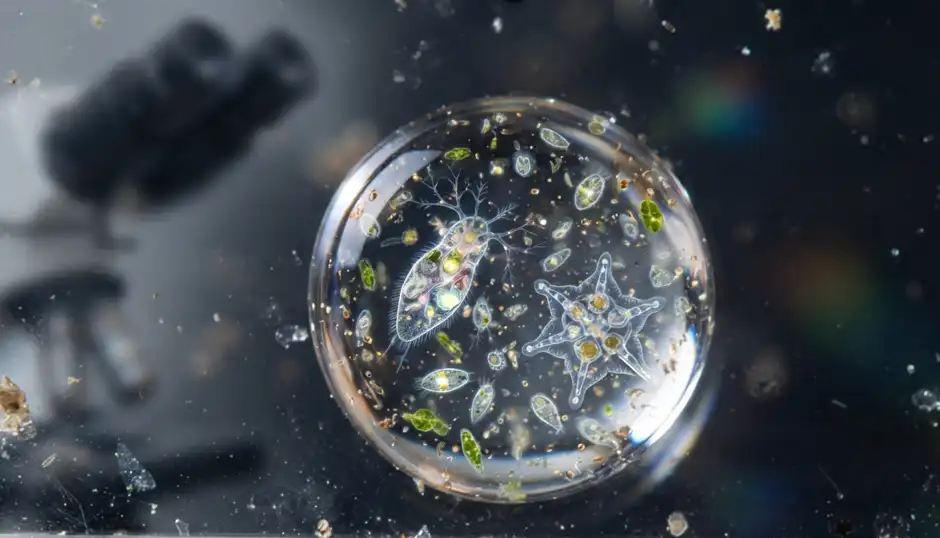
A drop of brackish water from a North Carolina marsh contained something scientists had never seen before: two previously unknown species of microscopic amoebae.
The organisms belong to a rare genus called Paulinella. Unlike the amoebae most people picture as shapeless cells that crawl around and engulf food, these tiny organisms are photosynthetic. They contain structures called chromatophores that capture light and provide the cell with energy.
When evolutionary biologist Julia Van Etten examined the water sample under a microscope, she noticed two tiny cells that looked unusual. Each was only around 15 micrometres long, roughly one-sixth the width of a human hair, but their shapes and outer coverings suggested that they might represent species that had not yet been described.

Finding a new species from a single microscopic sample is only the beginning. Researchers later isolated the organisms and examined them using culturing, genetic analysis and scanning electron microscopy. These investigations revealed consistent differences between the two forms, including their size and the arrangement of the tiny silica scales covering their cells.
The researchers named the species Paulinella marae and Paulinella murrayi. Their discovery increases the number of known photosynthetic Paulinella species from four to six. Both were found in the same brackish-water environment and remained extremely rare, with researchers sometimes encountering no more than a single cell in a drop of water.
But these organisms are interesting for another reason.
Paulinella represents an unusually recent example of primary endosymbiosis, the evolutionary process in which one cell takes another organism inside itself and, over time, turns that former partner into a permanent photosynthetic structure.
The photosynthetic organelles found in plants and algae are thought to have originated through a similar process more than a billion years ago. Paulinella underwent its own independent version much more recently, making it a rare opportunity to study what such a transformation can look like while it is still relatively young in evolutionary terms.
The discovery of P. marae and P. murrayi therefore does more than add two names to the list of known species. It gives scientists two more living pieces of evidence for studying how complex cells acquire new biological abilities, one microscopic organism at a time.
Source: