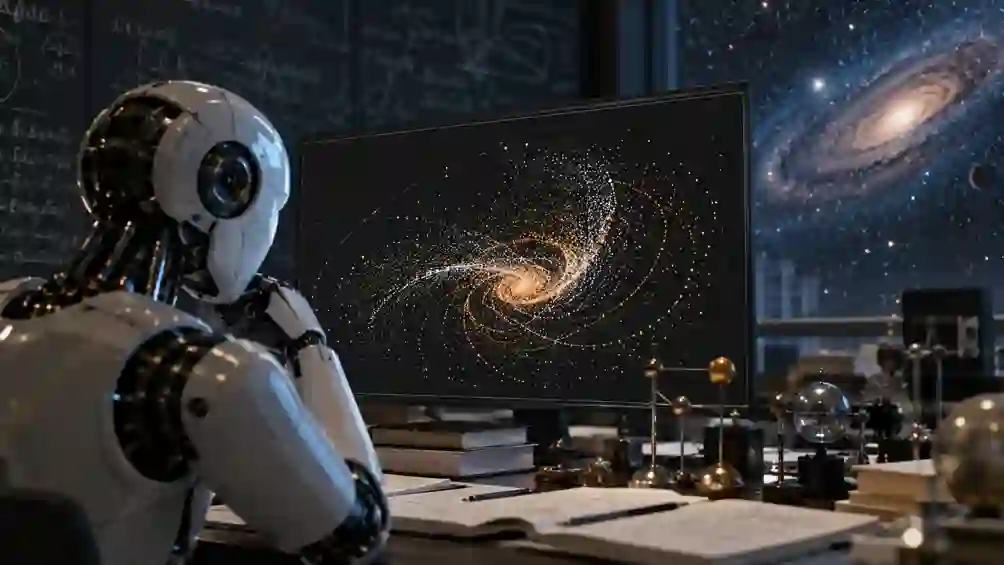
For centuries, physicists have searched for equations that explain how nature works. Newton described motion with a few mathematical laws, Einstein transformed our understanding of gravity, and quantum mechanics introduced an entirely new framework for describing matter and energy. But what if the next important physical law is discovered not by a human scientist, but by an artificial intelligence?
Modern AI is already capable of finding patterns in enormous datasets. The more ambitious goal is to make AI systems that can go beyond prediction and discover the mathematical relationships underlying those patterns.
One promising approach is called symbolic regression. Instead of being given a particular equation and asked to estimate its parameters, an AI system searches through mathematical expressions to find one that best explains the observations. Ideally, the result is not an opaque neural-network prediction but a relatively simple equation that scientists can inspect and interpret.
Researchers have demonstrated that machine-learning systems can rediscover known physical laws from experimental measurements. In some cases, AI can identify relationships that would be difficult to recognize from raw data alone. This makes it potentially useful for problems where researchers have large datasets but do not know which mathematical structure to test.
The next step is considerably more ambitious: discovering relationships that humans have not previously recognized. AI can search enormous spaces of possible equations much faster than a person can manually test them. It can also combine information from simulations, experiments and existing physical theories to generate candidate models.
However, finding a mathematical pattern is not automatically the same as discovering a new law of nature. An AI can identify correlations that work extremely well for a particular dataset but fail under different conditions. It can also produce equations that fit experimental noise rather than representing a genuine physical principle.
This is why scientists increasingly envision AI as a scientific collaborator rather than an autonomous physicist. A promising equation generated by an algorithm still needs to survive theoretical analysis, independent experiments and attempts to falsify it.
There is another fascinating possibility. AI might discover equations that reproduce observations correctly but are expressed in a mathematical language unfamiliar to humans. Scientists would then face a second challenge: understanding why the equation works and whether it represents a deeper physical principle.
The ultimate test will therefore not be whether AI can fit data. Modern machine learning can already do that remarkably well. The real breakthrough would occur when an AI proposes a simple, experimentally testable relationship that humans did not know to look for and subsequent experiments confirm that nature actually follows it.
If that happens, AI will not merely be helping scientists calculate faster. It could become a tool for exploring the space of physical laws itself.