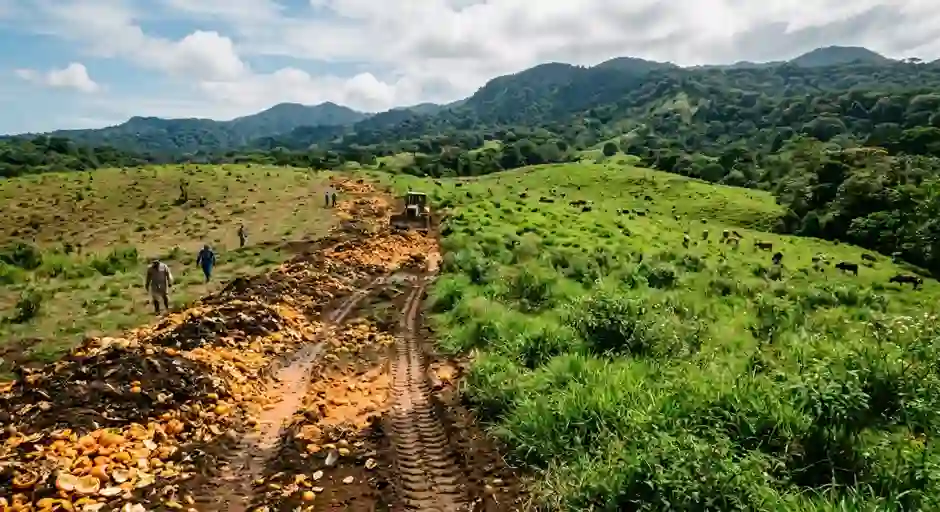
In 1998, researchers tried something that sounded more like waste disposal than forest restoration. About 12,000 tonnes of processed orange peels and pulp were spread across a three-hectare patch of severely degraded cattle pasture in northwestern Costa Rica.
Sixteen years later, the area looked dramatically different.
The pasture had been left with compacted, rocky, nutrient-poor soil after years of cattle grazing and repeated fires. An invasive grass also dominated the land, making it difficult for young trees to establish. The idea was to use a huge amount of organic waste from a nearby orange-juice operation to help restore the damaged ecosystem. Then the project was stopped by a legal dispute, and the site was essentially left alone. Nobody expected it to become one of the more unusual long-term restoration experiments. When researchers returned in 2014, they compared the former waste-treated area with a nearby untreated plot. The difference was striking. The treated area had three times as many woody plant species and 176% more aboveground woody biomass. Its canopy was also much denser, while soil samples showed higher concentrations of several nutrients.

So what had the orange waste actually done?
The researchers think it may have worked in two stages. At first, the thick layer of orange material appears to have smothered the invasive grass, removing competition for naturally arriving seedlings. As the waste decomposed, it then added organic matter and nutrients to the depleted soil, potentially creating better conditions for plants to establish and grow. But there is an important catch: this was not a controlled experiment designed to prove exactly what caused the recovery. It was one three-hectare site, and the researchers could not separate every possible factor involved. The study therefore shows a strong association, rather than proving that orange waste alone transformed the pasture.
Still, the result is remarkable. Something that would normally be treated as an industrial waste product ended up supplying nutrients to soil, suppressing a dominant grass and coinciding with the return of a much more diverse plant community. The experiment also points to an intriguing idea for ecological restoration: agricultural waste does not always have to be something we dispose of. In the right environment, it could become part of the process of rebuilding an ecosystem.
The Costa Rican pasture is only one example, and the approach would need careful testing before being applied elsewhere. But sometimes, restoration may begin with something as ordinary as what a juice factory throws away.