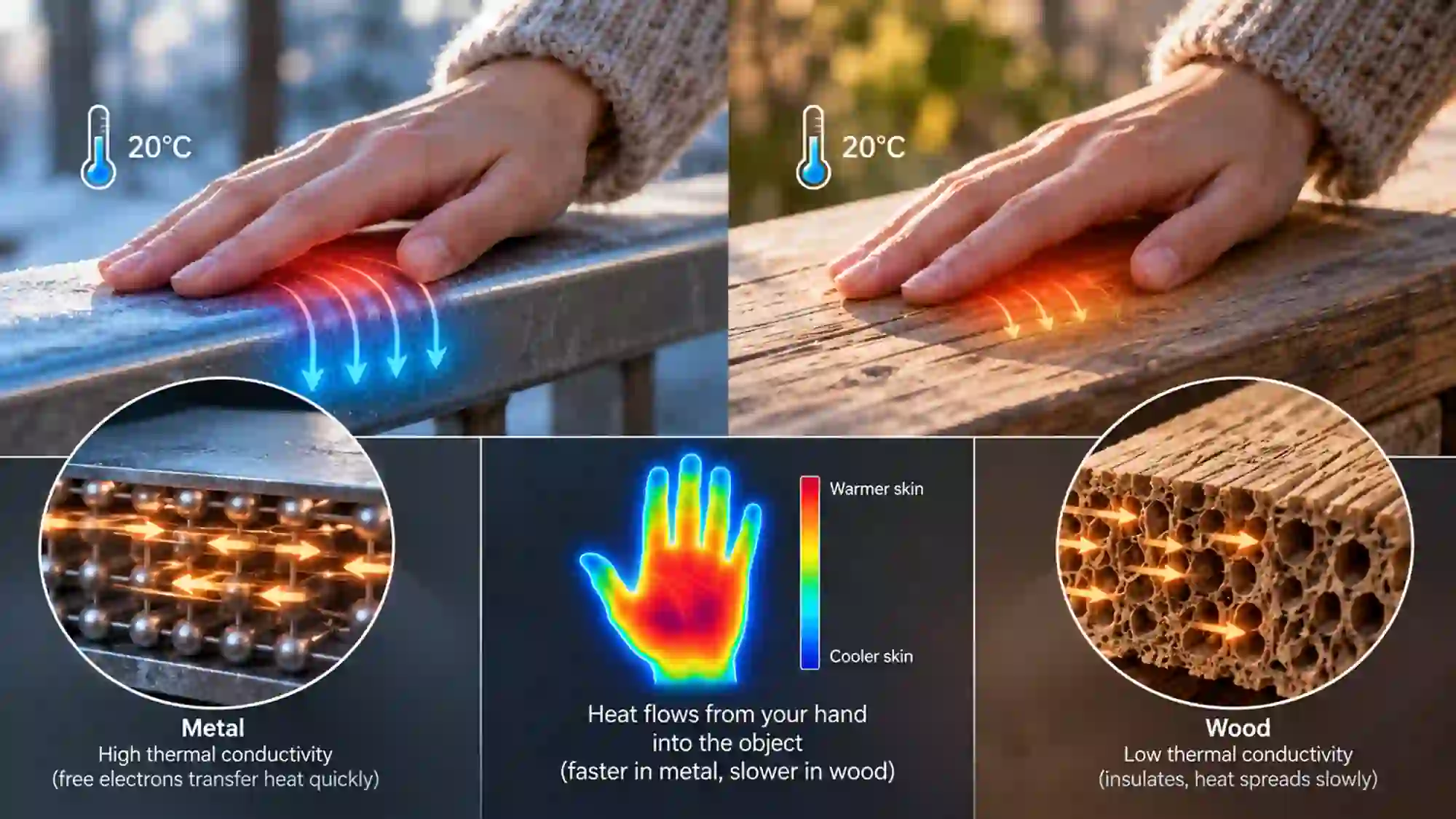
Place your hand on a metal railing and a wooden surface on a cold morning. Even if both objects have been sitting outside for hours and are at exactly the same temperature, the metal will usually feel much colder. But the metal is not actually colder. The difference comes from how quickly each material transfers heat away from your skin.
Temperature tells us how hot or cold an object is, but it does not tell us how rapidly heat will flow between that object and your body. When your hand touches an object that is cooler than your skin, thermal energy moves from your skin into the object. The faster this happens, the stronger the sensation of cold.
Metal is an excellent thermal conductor. Its free electrons can transport energy efficiently through the material, allowing heat to move rapidly away from the area where your hand is touching it. As a result, the temperature of the skin surface can fall quickly, stimulating temperature-sensitive receptors and producing a strong sensation of cold.

Wood behaves very differently. It has relatively low thermal conductivity and acts more like an insulator. Heat entering the wood from your hand does not spread away as rapidly. The small region of wood touching your hand therefore warms relatively quickly, reducing the temperature difference between your skin and the surface.
This means that your sense of temperature is strongly influenced by the rate of heat transfer, rather than temperature alone. Experiments comparing different materials have demonstrated that people perceive materials differently because of differences in their thermal properties. A study examining ten tabletop materials, for example, found that materials with lower thermal effusivity, including wood-based materials, produced different surface-temperature responses after contact and were perceived as more pleasant to touch.
Scientists use a property called thermal effusivity to describe how effectively a material exchanges heat with another material. It depends on properties including thermal conductivity, density and specific heat capacity. A material with high thermal effusivity can draw thermal energy from your skin rapidly, making it feel colder when both objects begin at the same temperature.
The phenomenon also works in reverse. If two objects are warmer than your skin, a material that transfers heat to your hand more rapidly can feel hotter. Research has shown that the perceived difference between materials can even reverse when the surrounding temperature rises above skin temperature.
There is therefore an important distinction between temperature and thermal sensation. A thermometer might show that a metal block and a wooden block are both at 20°C, but your nervous system does not experience their temperatures as identical because the rate at which they exchange heat with your skin is different.
This simple everyday observation reveals an important principle of physics and biology: your sense of temperature is not simply measuring how hot or cold an object is it is responding to how that object changes the temperature of your skin. So the next time metal feels dramatically colder than wood, remember: the metal isn’t colder. It is simply much better at taking your body’s heat away.

Sources:
Bergmann Tiest, W. M., & Kappers, A. M. L. (2008). Thermosensory reversal effect quantified. Acta Psychologica, 127(1), 46-50. https://doi.org/10.1016/j.actpsy.2006.12.006
Podrekar Loredan, N., Lipovac, D., Jordan, S., Burnard, M. D., & Šarabon, N. (2022). Thermal effusivity of different tabletop materials in relation to users’ perception. Applied Ergonomics, 100, Article 103664. https://doi.org/10.1016/j.apergo.2021.103664