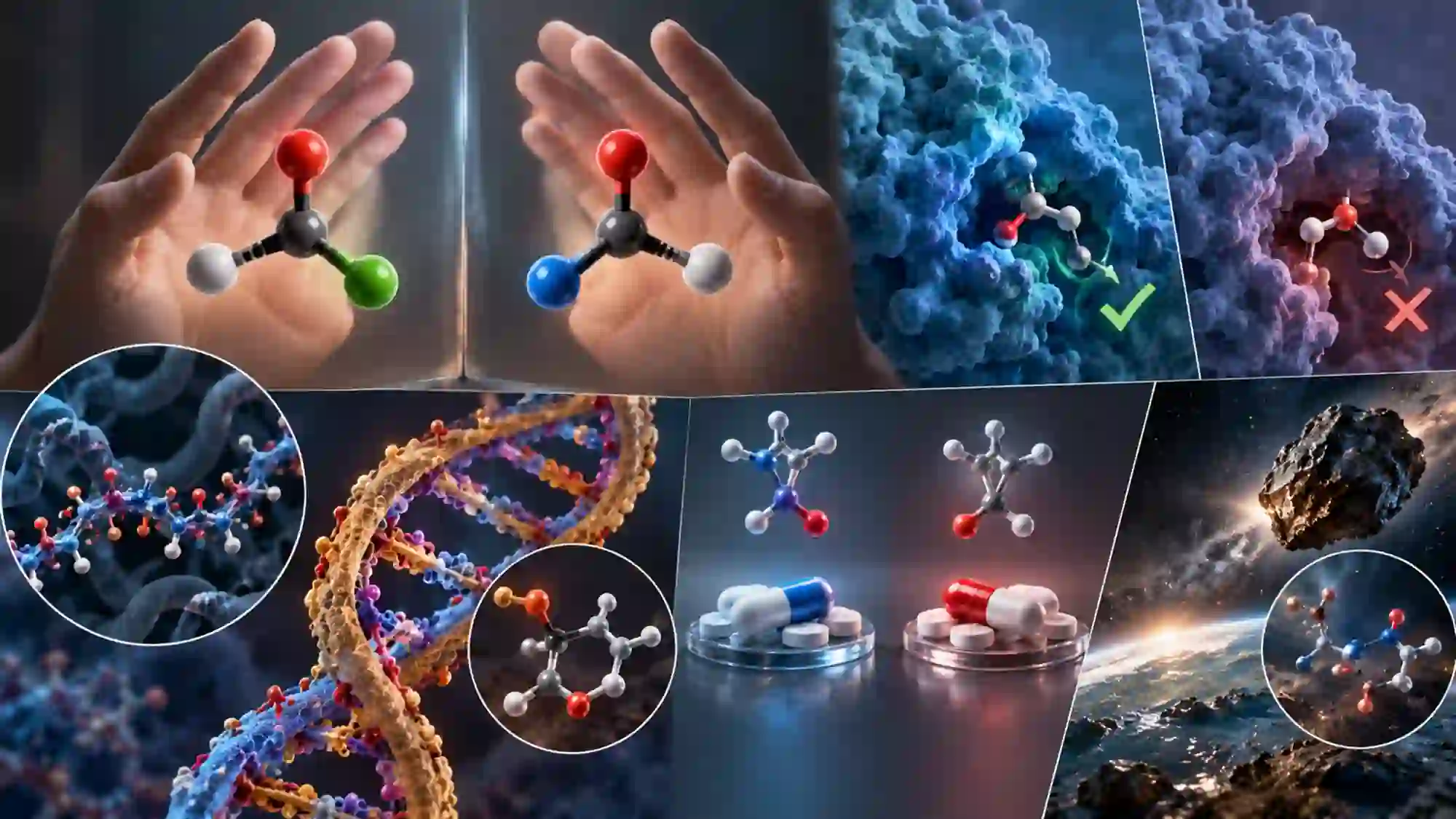
Two molecules can contain exactly the same atoms, connected in exactly the same order, yet behave differently simply because their three-dimensional arrangements are mirror images of one another. This phenomenon is known as molecular chirality, and it is fundamental to chemistry, biology and medicine.
The word chirality comes from the Greek word cheir, meaning hand. Human hands provide the perfect analogy: a left hand and a right hand are mirror images, but they cannot be perfectly superimposed. Molecules with this property are called chiral molecules, and their mirror-image forms are known as enantiomers.
At the molecular level, chirality commonly arises when a carbon atom is attached to four different groups. The resulting three-dimensional arrangement can exist in two configurations. Although these forms have essentially identical properties in many achiral environments, they can interact very differently with other chiral molecules.

This becomes particularly important in living organisms because biology is inherently three-dimensional. Enzymes, receptors, DNA and proteins have specific molecular shapes, allowing them to recognise particular molecular partners. A left-handed molecule may therefore fit precisely into a biological receptor while its mirror image fits poorly or interacts with an entirely different target.
This is why chirality can have major consequences for medicines. Two enantiomers of the same drug can have different biological activities, metabolism and toxicity. The body’s enzymes may selectively bind one form because their active sites are themselves chiral.
One of the most remarkable examples of molecular handedness occurs in the fundamental molecules of life. Modern biology overwhelmingly uses L-amino acids to build proteins, while the sugars incorporated into DNA and RNA predominantly have the D configuration. This consistent preference is called biological homochirality.
But this raises a much deeper question: why did life choose one molecular “hand” over the other?
Scientists do not yet have a definitive answer. One possibility is that a small initial imbalance between enantiomers occurred through chemical or physical processes and was subsequently amplified. Another possibility involves extraterrestrial chemistry: some meteorites contain amino acids with measurable enantiomeric excesses, and circularly polarised light has been investigated as a possible source of molecular asymmetry.
Researchers have also demonstrated chemical mechanisms capable of amplifying tiny differences between mirror-image molecules. Such processes could have helped transform a small initial asymmetry into a much stronger molecular preference during the chemistry preceding life.

The mystery of chirality therefore extends far beyond an interesting property of organic chemistry. It touches one of the biggest questions in science: how did the chemistry of the early Earth transition into the highly organised molecular system we call life? A molecule may be unimaginably small, but its “handedness” could have helped determine the fundamental architecture of biology itself.
Sources:
Blackmond, D. G. (2019). The origin of biological homochirality. Cold Spring Harbor Perspectives in Biology, 11(3), Article a032540. https://doi.org/10.1101/cshperspect.a032540
Gal, J. (2013). Molecular chirality: language, history, and significance. Topics in Current Chemistry, 340, 1–20. https://doi.org/10.1007/128_2013_435