A US government-commissioned review of more than 7,200 studies found no significant protective effect of alcohol at any level of drinking, and risk climbs steeply once intake passes one drink a day.
The comforting story we were told
For decades, a tidy idea circulated in nutrition circles: people who drink lightly seem to live a little longer than people who never drink. Plot death risk against drinks per week and you get a shallow “J” — low drinkers dip below abstainers, heavy drinkers soar above them. The heart gets most of the credit, since observational studies repeatedly linked light drinking to fewer ischaemic heart disease events and strokes.
The trouble is that observational data is slippery. Early studies often lumped former drinkers, who may have quit because they were already ill, into the “abstainer” group, which makes abstainers look unhealthy. Light drinkers also tend to be wealthier and healthier in many other ways. That is why a fresh, comprehensive look at the whole body of evidence matters. (This paragraph is general background, not drawn from the new study.)

How the study was built
The Alcohol Intake and Health Study is not a new clinical trial. It is a large evidence synthesis, published on 9 June 2026 in the Journal of Studies on Alcohol and Drugs (DOI 10.15288/jsad.25-00435), led by Kevin Shield of the University of Toronto, with co-authors including Katherine Keyes (Columbia) and Timothy Naimi (University of Victoria).
The method has three steps:
- Review the literature. Medical experts went through more than 7,200 scientific articles on alcohol-related diseases and injuries to pin down how much risk each condition carries at each level of drinking.
- Apply the risks to real populations. Those risk estimates were run through large national US health datasets.
- Model a lifetime. Statistical modelling then estimated how different lifelong drinking levels change the chance of illness or death, combining every condition causally linked to alcohol into one total.
A standard US drink is 12 oz of beer, 5 oz of wine or 1.5 oz of spirits. The government’s health agency SAMHSA commissioned the work to help shape the nation’s dietary advice.
What it found
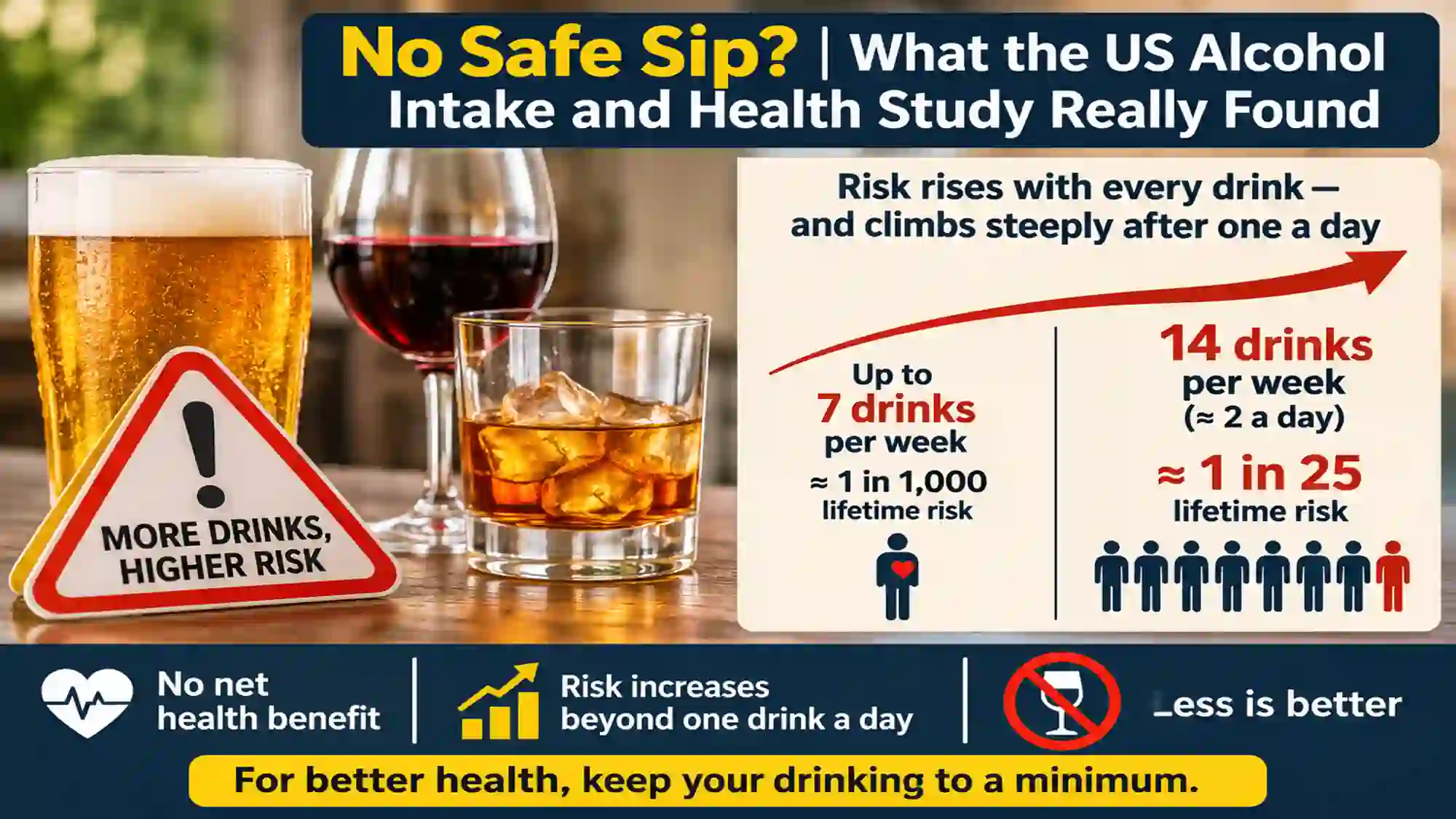
Risk does not switch on at a magic number; it rises with every drink, and the slope steepens after one a day. The headline figure: averaging 14 drinks a week (two a day) over a lifetime carries about a 1-in-25 chance of dying from an alcohol-attributable cause.
| Average intake | What the study reports |
|---|---|
| Up to 7 drinks a week | Only minimally elevated risk for most conditions; about 1 alcohol-attributable death per 1,000 people over a lifetime |
| More than 1 drink a day | Risk rises for both men and women |
| 14 drinks a week (2 a day) | About 1 in 25 lifetime risk of alcohol-attributable death, a substantially elevated risk of premature death |
Conditions examined included cancers of the oesophagus, mouth and breast, cardiovascular disease, liver disease, injuries and overall mortality. News coverage notes that alcohol is linked to more than 200 diseases, and injuries such as car crashes were also considered. Put the two headline numbers side by side and the gradient is stark: doubling intake from 7 to 14 drinks a week takes lifetime death risk from roughly 1 in 1,000 to 1 in 25, about 40 times higher.
The 1-in-1,000 figure comes from press coverage of the study (Anchorage Daily News); the 1-in-25 figure appears in the paper’s title and in university press releases.

The heart benefit that does not add up
The study does not claim alcohol does nothing good for any organ. At low intakes it finds possible reductions in ischaemic heart disease and stroke. The catch is the ledger: those gains are outweighed by increases in cancer and other chronic diseases, even at seven drinks a week. Add up every outcome and there is no significant net protective effect at any level of drinking.
That is the key shift in thinking. Asking “does a drink help my heart?” is a one-organ question. Asking “does drinking help my health?” requires summing the heart, the breast, the liver, the oesophagus and the car crash that never reached a hospital. Katherine Keyes, a co-author, called the work “the most comprehensive U.S. estimates to date of lifetime risks of alcohol-attributable mortality and morbidity.”
What the numbers cannot tell you
Good science states its limits, and this paper does:
- Population estimates, not personal forecasts. Your own risk depends on genetics, lifestyle, family history and how you drink (steadily or in binges).
- Emerging links are incomplete. The study counts only conditions causally linked to alcohol. Pancreatic cancer is an emerging association and was not fully captured, so the totals may understate harm.
- Modelled, not measured. The results rest on existing literature and national datasets. The authors used the best available data, but a model inherits the biases of its inputs.
- Contested process. Critics, including the Distilled Spirits Council, have called the process “flawed, opaque and biased”. A January House Oversight Committee report also questioned the authors’ impartiality. The authors declare no competing interests.
- Outside expert view. Warren Thompson, an emeritus Mayo Clinic physician not involved in the study, said some questions remain open but agreed that one drink a day is a sensible limit.
Science meets policy
The review was commissioned under the Biden administration to inform the Dietary Guidelines for Americans. The 2025–2030 edition, released in January 2026, tells people to “consume less alcohol for better overall health” but drops the earlier numeric ceiling of two drinks a day for men and one for women. This study points to a clearer line: risk rises above one drink a day for everyone.
An editorial published alongside the paper, by Robert Vincent, a former SAMHSA associate administrator, argues that “despite the study’s adherence to its mandate, its findings were sidelined” amid alcohol-industry criticism. Vincent says he was laid off in April in a reduction in force that hit federal alcohol-policy staff. Naimi, for his part, called the new guidelines’ “less-is-best” message useful but said they “provide no quantitative framework.”
The government disputes the framing. An HHS spokeswoman said that calling the study “shelved” was inaccurate and that HHS and USDA reviewed it alongside the broader evidence. Treat the sidelining claim as one side’s account of a contested process, not an established fact.
There is a farm-gate angle too. Alcohol guidance ripples through barley, hops, grapes and maize demand, as well as labelling rules, public-health campaigns and what consumers buy.
Sources:
Journal of Studies on Alcohol and Drugs. (2026, June 9). New research links even low alcohol consumption to cancer, heart disease, premature death: Results not included in dietary guidelines [News release]. EurekAlert! https://www.eurekalert.org/news-releases/1130579