There is water floating around you right now, even if the air feels completely dry. The problem is finding a practical way to capture it. Researchers in China have developed a wood-based material that can pull moisture from air with relative humidity as low as 15%. In outdoor observation, a larger version of the system produced as much as 1.72 litres of water per kilogram of sorbent per day.
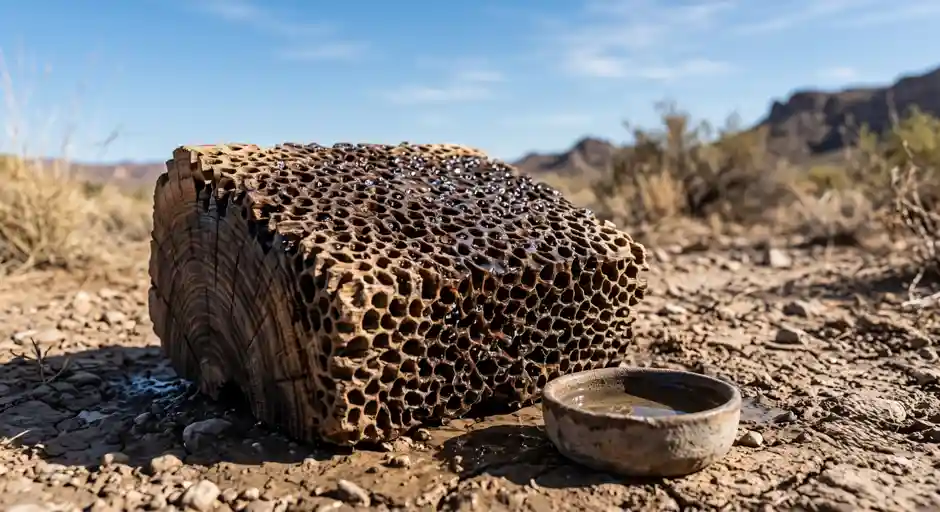
The technology starts with something surprisingly ordinary: balsa wood. Natural wood already contains long channels that transport water through a tree. They chemically modified the wood by removing lignin and part of its hemicellulose while preserving the cellulose framework. This created a highly porous structure with aligned channels that allow water vapour to move through the material more efficiently. But the wood alone is not responsible for most of the water capture.
They incorporated lithium chloride (LiCl) into the wood sponge. This salt is highly hygroscopic, meaning it strongly attracts water molecules. As humid air passes through the porous material, the salt captures water vapour and holds onto it. The resulting material could absorb water across a relative-humidity range of 15% to 90%. At 15% humidity, the best-performing composition absorbed about 0.59 grams of water per gram of sorbent. At 90% humidity, uptake increased to about 3.03 grams per gram. But capturing water is only half the problem. Once the sponge becomes saturated, the water needs to be released so it can be collected and the material can begin another cycle. Normally, this requires heating, and relying entirely on sunlight makes the process vulnerable to clouds and nighttime.
This was addressed by adding a second layer containing a photothermal hydrogel and phase-change material. It absorbs sunlight and converts it into heat, while also storing some of that heat. When sunlight becomes weak or disappears, the stored thermal energy can continue helping release the captured water. This combination allowed the system to operate through repeated absorption and release cycles. During outdoor testing in China, large-scale arrays produced between 0.96 and 1.72 litres of water per kilogram of sorbent per day, depending on the conditions. The highest reported yield—1.72 litres per kilogram per day, came from a summer test in Harbin.
The approach could eventually be useful in places where conventional water sources are limited, particularly for off-grid or water-stressed regions. But the numbers need context. The 1.72-litre figure was obtained under particular outdoor conditions, and the modelling shows that production can fall considerably in extremely dry environments because there is simply less atmospheric moisture available to capture. So, this is not a machine that can produce unlimited drinking water from completely dry air. Instead, it demonstrates something more subtle: even very dry air contains recoverable water, and a carefully engineered piece of wood can help capture it. The forest may have grown the material, but they found a way to make it harvest the sky.
Sources