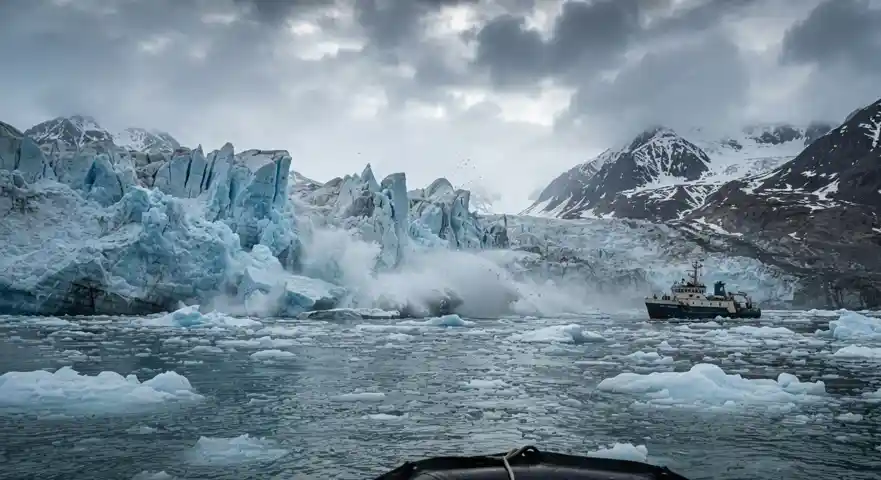
On 26th August, a glacier collapse in the Himalayas sent a flood down Nepal’s Trishuli valley. Nepal’s disaster agency had counted 1,003 deaths at the time of that report, with 3,916 people still missing. Scientists told Reuters and the BBC that climate change likely helped trigger the collapse. The obvious question is who compensates the families. A climate fund that pays for every climate-linked calamity and death is a just idea, but literally delivering it is not feasible today. The more useful question is how much of it can be built, and how fast.
Why “all” is hard
Scale. Conservative projections put the economic cost of loss and damage in developing countries at $290–580 billion in 2030, rising to $1–1.7 trillion by 2050. The dedicated fund holds a tiny fraction of that. Pledges of $822 million are a fraction of 1% of annual needs, and only about $448 million has been paid in.
Attribution. Deaths are the hardest category to compensate. The scale of harm is large. The Lancet Countdown found heat-related deaths averaging 546,000 a year between 2012 and 2021. But that figure counts heat deaths, not only those caused by climate change. A 43-country study found that 37% of warm-season heat deaths could be attributed to human-induced warming. Attribution works in fractions, not in individual cases. The research is also skewed. Health attribution studies have concentrated on high-income countries and mostly on heat and extreme weather. The places that suffer most are the least measured.
Liability. The science on who caused what is improving quickly. A Nature study estimated that extreme heat linked to 111 fossil fuel companies cost the world economy $28 trillion between 1991 and 2020. The law is moving too. The International Court of Justice ruled that states breaching climate obligations may have to stop the conduct, give guarantees of non-repetition, and make full reparation. Its advisory opinions are not binding, but they carry legal and moral weight. On 20 May 2026, the UN General Assembly welcomed the opinion by 141 votes to 8, with 28 abstentions. The opposition was led by major oil-producing states including the US, Saudi Arabia and Russia. That opposition shows how far the world is from a payer-pays regime. The loss and damage fund itself rests on voluntary contributions, not on an admission of liability.
How far we have come
The fund for responding to loss and damage (FRLD) was agreed in 2022 and operationalized the following year. By March 2026 it had received pledges from 27 partners, and 24 of them had signed contribution agreements and begun transferring money. Its first call for proposals shows the demand. It drew 176 eligible requests from 119 countries seeking $2.8 billion. At its July meeting, the Board raised the initial allocation to $342 million, enough for roughly 20 to 22 pilot projects and about 12% of what was requested. Grants in this phase range from $5 to 20 million. As of a mid-July review, the first legal agreements and disbursements had not yet been announced.
There is progress on paper. COP30 in Belém agreed to operationalise the fund and set replenishment cycles. But at the Bonn talks in June, speakers pointed to the lack of replenishment so far in the loss and damage fund, the Green Climate Fund and the Adaptation Fund. The fund has crossed a threshold: the first call has closed, and the Board has begun considering projects. But nothing has yet reached the people it is meant to help. Civil society groups want a steeper path. An open letter demands at least $50 billion a year from 2027, $100 billion by 2031 and $400 billion by 2035. COP31 opens in Antalya on 9 November, and replenishment is the test.
What the blocs have done
The G7 has preferred pre-arranged finance to compensation. It launched the Global Shield against Climate Risks with the V20 group of vulnerable economies at COP27. The gap it targets is large. V20 research found that 98% of the nearly 1.5 billion people in V20 countries have no financial protection. One of its vehicles provides $105 million in contingent liquidity for microfinance providers whose borrowers are hit by a qualifying flood, benefiting an estimated 1.9 million people. That is useful insurance-style cover, not compensation for death. At this June’s Évian summit, France, as chair, avoided mentioning climate change by name, working on it through energy security, oceans and critical minerals instead.
BRICS has stated priorities without building a mechanism. The New Delhi Declaration of 12–13 September emphasized mitigation, adaptation, finance, technology transfer, capacity building, loss and damage and climate-resilient development. It also flagged climate-finance gaps for emerging economies and objected to carbon border adjustments as protectionist. One assessment called the summit a broader push to reshape rules rather than a single breakthrough. I found no BRICS compensation fund in the coverage. The bloc’s position is also awkward, because its members account for over half of global greenhouse gas emissions, so it is both claimant and contributor to the problem.
SAARC is the weakest of the three, though it is the bloc whose members are most exposed. No summit has been held since 2014, and the organization is widely considered defunct. Institutions survive. A SAARC Action Plan on Climate Change was adopted in 2008, and the SAARC Disaster Management Centre exists. But activity is limited to technical and official-level meetings. In a crisis, affected countries tend to request help from bilateral partners rather than the regional body. India’s foreign minister has described SAARC as on pause, with BIMSTEC as the main regional platform.
A workable ladder
A promise to compensate every death will fail and breed cynicism. A staged approach could work:
- Replenishment on a schedule. Contributions should be predictable and preferably tied to emissions history, not left to annual goodwill.
- Pre-arranged payouts. Cash that arrives within days of a trigger event, through social protection and parametric cover, beats reconstruction grants that arrive years later.
- Levies on polluting sectors. Fossil extraction, aviation and shipping are frequently proposed sources of new money, and the liability science now gives such levies a stronger footing.
- A shared attribution protocol. Fractional attribution should be standardized, with real investment in data for the Global South.
- Let the legal track mature. The ICJ opinion and its follow-up give claimants leverage that no voluntary fund can.
Full compensation is a moral ambition, not a budget line. The reasonable test for COP31 is whether the money is on a path to grow ten-fold, and whether it reaches survivors quickly. Right now, it does neither.
References:
Callahan, C. W., & Mankin, J. S. (2025). Carbon majors and the scientific case for climate liability. Nature, 640, 893–901. https://doi.org/10.1038/s41586-025-08751-3
Climate Rights International. (2026, May 20). UN: Flawed resolution affirms landmark ICJ climate opinion. https://cri.org/un-flawed-resolution-affirms-landmark-icj-climate-opinion/