What if lowering high cholesterol did not mean taking a pill every day or getting injections every few weeks, but making a single change to your DNA?
Scientists are beginning to test exactly that idea. In a small first-in-human clinical trial, it was found that one infusion of an experimental CRISPR treatment reduced LDL cholesterol, the so-called “bad” cholesterol, by about half at the highest dose. More surprisingly, the effect was still present one year later. Triglyceride levels also remained substantially lower. The gene behind the treatment. The experimental therapy, called CTX310, is designed to reach the liver, which plays a central role in regulating fats circulating through the bloodstream.
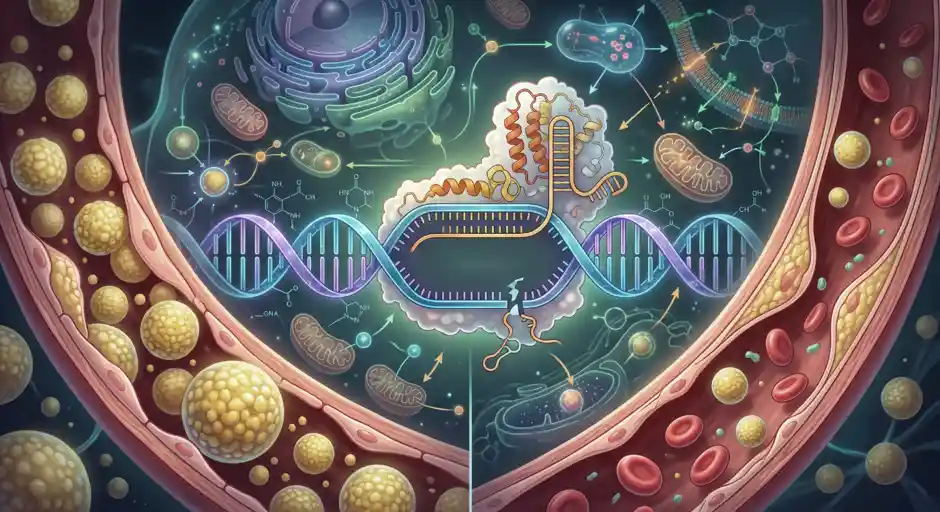
Instead of repeatedly blocking a protein, CTX310 uses CRISPR-Cas9 to permanently disrupt a gene called ANGPTL3 in liver cells. ANGPTL3 normally helps regulate the levels of several blood lipids. People who naturally have loss-of-function mutations in this gene tend to have lower levels of LDL cholesterol and triglycerides. They are essentially trying to reproduce that biological effect with gene editing.

What happened after one treatment?
The Phase 1 trial involved just 15 people with difficult-to-treat lipid disorders. Participants received a single CTX310 infusion at different dose levels and were then monitored for changes in their blood lipids and potential side effects. At the highest dose, LDL cholesterol was 52.5% lower than baseline after 12 months. Triglycerides fell by 47.8% over the same period. They were not simply measuring a temporary drop immediately after treatment. The reductions were still evident a year after the one-time infusion. No serious adverse events were considered related to the treatment during the one-year follow-up.
Why is this different from ordinary cholesterol treatment?
Most cholesterol-lowering treatments work by continuously interfering with biological pathways involved in cholesterol production or clearance. CRISPR takes a different approach. Rather than repeatedly blocking the protein produced by a gene, researchers are attempting to change the underlying genetic instructions themselves. That raises the possibility of a treatment whose effect could last for years, or potentially much longer after a single administration. But that same permanence is also why safety matters so much.
It cannot simply stop a gene-editing treatment in the way someone can stop taking a tablet. Unintended genetic changes, immune reactions and other long-term effects therefore need to be carefully monitored. The participants in this study will continue to be followed for 15 years, in line with long-term monitoring recommendations for gene-editing therapies. Half the cholesterol does not mean half the heart risk There is another important distinction.
The study measured biomarkers, particularly LDL cholesterol and triglycerides. It did not establish that CTX310 prevents heart attacks, strokes or deaths. And with only 15 participants, the trial is far too small to answer those questions. CTX310 is still an experimental therapy, not an approved replacement for existing cholesterol treatments.
Larger clinical trials will need to determine how consistent the effect is, how safe the treatment remains over many years and whether lowering cholesterol through this genetic approach actually translates into better cardiovascular outcomes. Still, the experiment demonstrates something remarkable. A single dose of CRISPR was able to alter a liver gene and produce a substantial reduction in blood lipids that remained measurable 12 months later. The bigger question now is not whether CRISPR can change cholesterol-related genes? It can. It is whether making such a change once could safely protect people from cardiovascular disease for many years to come.
Sources: