How do you make reading DNA fast, cheap, and scalable enough to change medicine? Three scientists found a way, and it has just won one of science’s most prestigious awards.
The prize
The 2026 Wolf Prize in Chemistry goes to Pascal Mayer, Shankar Balasubramanian and David Klenerman for developing low-cost, next-generation DNA sequencing methods for genomic medicine. Balasubramanian and Klenerman pioneered a massively parallel sequencing approach credited with a roughly million-fold improvement in speed and cost, helping make a human genome possible for under $200. Mayer’s role was turning those breakthroughs into a practical high-throughput system that integrated chemistry, microfluidics, optics and computation.

Balasubramanian and Klenerman, both at Cambridge, founded Solexa in 1998 to commercialize the single-molecule fluorescence approach, and the method became known as Solexa or Illumina sequencing.
Before: one strand at a time
The first widely used method, Sanger sequencing (1977), reads DNA by producing fragments that stop at each base and sorting them by size. It was elegant and accurate, but it processed a limited number of fragments at a time. The Human Genome Project took years and cost billions of dollars. Reading genomes routinely needed a different philosophy.
The big idea: massive parallelism
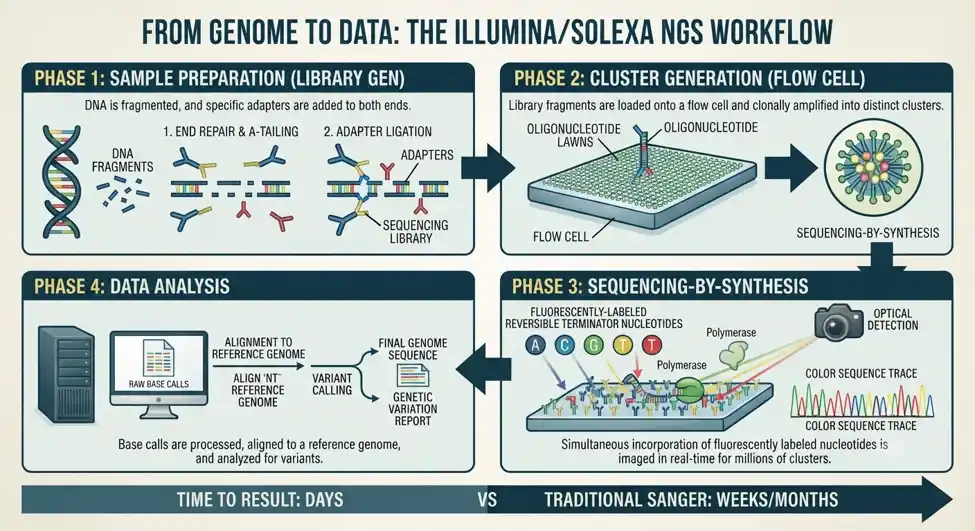
Instead of reading one fragment at a time, read millions to billions of fragments at the same time. Here is the core workflow of sequencing by synthesis:
- Shatter and tag. Genomic DNA is cut into short fragments, and short adapter sequences are attached to the ends.
- Anchor on a surface. Fragments are captured on a glass flow cell studded with matching oligonucleotides.
- Amplify into clusters. Each fragment is copied in place, forming a tiny colony of identical molecules. This gives each spot enough signal to detect. Solid-phase “DNA colony” amplification was the contribution tied to the Strasbourg and Geneva work that Mayer helped lead.
- Add reversible terminators. Each cycle supplies four nucleotides, each carrying a different fluorescent dye and a blocking group. The polymerase adds exactly one base per strand, then stops.
- Image. A camera records the color at every cluster. The color tells you which base was added.
- Unblock and repeat. The dye is cleaved, the block is removed, and the cycle repeats, building up a read of a hundred or more bases for every cluster at once.
- Assemble with software. Short reads are aligned to a reference genome or assembled, and the computation reconstructs the full sequence.
The reversible terminator trick matters. Because only one base is added per cycle, the chemistry yields a clean, countable readout instead of a smear. Combined with imaging millions of clusters at once, the result is a data firehose.

Why it changed medicine
Cheap, fast sequencing moved genomics from big-lab project to routine tool:
- Rare disease diagnosis, ending “diagnostic odysseys” for many families.
- Cancer genomics, where tumor sequencing can guide therapy.
- Noninvasive prenatal testing and liquid biopsy, which read fragments of DNA circulating in blood.
- Pathogen surveillance, where sequencing tracks outbreaks in near real time.
- Large population studies, which would be unaffordable at older costs.
Limits and open questions
- Short reads struggle with long repeats and complex structural variants. Long-read technologies complement them.
- Data burden. Storage, analysis, and interpretation are now bigger bottlenecks than the sequencing itself.
- Equity and privacy. Genomic benefits depend on who is sequenced, who has access, and how data are protected.
- Interpretation. Reading a variant is easier than knowing what it means.
The takeaway
This is a story about chemistry, optics, engineering, and computation fitting together. The ideas of fluorescent reversible terminators, in-place amplification, and parallel imaging each seemed modest. Together, they made an old dream routine.
References
- Wolf Foundation. 2026 Wolf Prize in Chemistry (laureate announcement). wolffund.org.il
- Bentley DR, Balasubramanian S, Swerdlow HP, et al. Accurate whole human genome sequencing using reversible terminator chemistry. Nature. 2008;456:53-59.
- Fedurco M, Romieu A, Williams S, Lawrence I, Turcatti G. BTA, a novel reagent for DNA attachment on glass and efficient generation of solid-phase amplified DNA colonies. Nucleic Acids Res. 2006;34:e22.
- Sanger F, Nicklen S, Coulson AR. DNA sequencing with chain-terminating inhibitors. PNAS. 1977;74:5463-5467.