The Universe is expanding. But one of cosmology’s biggest unanswered questions is whether that expansion is being driven by a constant form of dark energy, something that changes with time, or perhaps by physics that scientists do not yet fully understand.
Now, astronomers are turning to one of the oldest and most abundant substances in the Universe for clues: hydrogen.
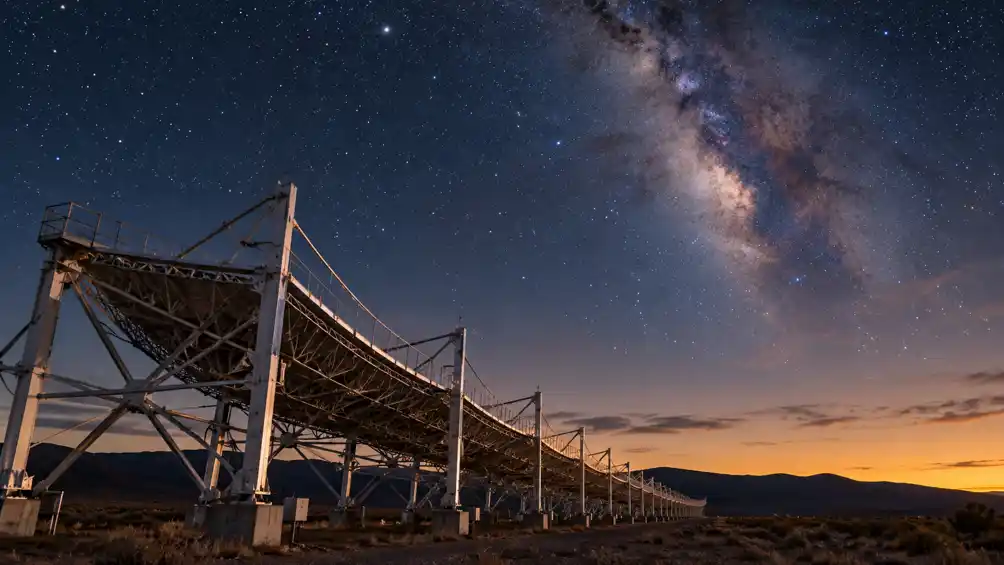
In September 2026, the Canadian Hydrogen Intensity Mapping Experiment (CHIME) reported its first standalone detection of the faint radio glow produced by neutral hydrogen from a time when the Universe was roughly five billion years old. The signal came from 94 nights of observations collected in 2019 and was extracted from CHIME’s own data without relying on an external galaxy survey.

The key is a phenomenon called the 21-centimeter line. Neutral hydrogen contains a proton and an electron, whose quantum spins can occupy slightly different energy states. When the atom transitions between these states, it produces radio emission at a wavelength of about 21 centimeters.
As the Universe expands, that wavelength is stretched a phenomenon known as cosmological redshift. The amount of stretching tells astronomers how much the Universe expanded while the signal was travelling toward Earth.
Instead of observing individual galaxies, CHIME uses 21-cm intensity mapping to measure the combined hydrogen emission across enormous regions of space. Variations in the signal reveal how hydrogen and therefore matter is distributed and clustered. Because the large-scale distribution of matter changes in a predictable way as the Universe expands, these maps can eventually provide a powerful record of cosmic expansion.
The new CHIME detection is significant because it demonstrates that this measurement can be made using the telescope’s own observations. The detected signal had to be separated from overwhelming foreground emission, radio interference and instrumental effects, making the result an important technical milestone for future surveys.
Why does this matter for dark energy? Scientists currently have several competing models for the Universe’s late-time acceleration. If hydrogen can be mapped across multiple epochs, researchers can compare how the measured cosmic structure evolved with the predictions of these models.
CHIME’s current observation is therefore not evidence that hydrogen causes the Universe to expand, nor does it solve the mystery of dark energy. Instead, it provides a new observational tool for studying the expansion history. The team already has nearly seven years of additional observations and plans to extend the analysis to earlier periods of cosmic history.

Hydrogen may therefore become something like a cosmic time capsule. By reading its ancient radio signal, astronomers can reconstruct how matter was distributed billions of years ago and potentially determine whether our current explanation for the expanding Universe is actually correct.