Coconut shells are usually treated as agricultural waste. But after a little chemical transformation, they could become part of something we drive on every day: asphalt.
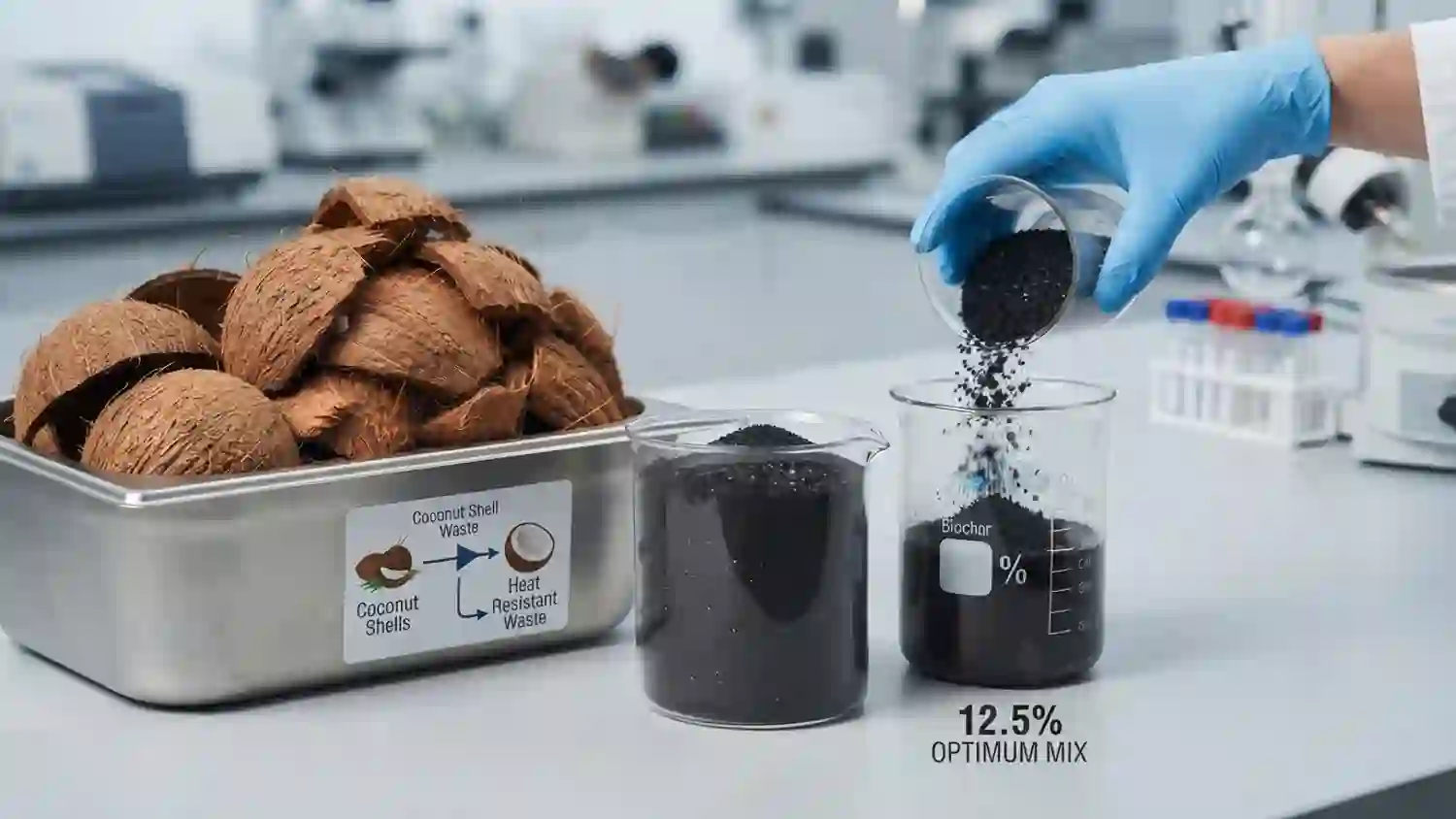
Researchers have found that turning coconut shells into biochar and adding it to asphalt can make the material stiffer, stronger and more resistant to heat. Their experiments identified 12.5% coconut shell biochar as the optimum amount for the asphalt mixture they tested. The first step is to turn the shells into biochar. Instead of simply burning them in the presence of oxygen, the researchers use controlled pyrolysis, heating the biomass under conditions that limit oxygen. This converts the carbon-rich organic material into a stable, carbon-rich solid called biochar.
That powder can then be mixed into asphalt, the sticky material that binds together the stones and sand in a road. The reason this matters becomes clearer on a hot day. Asphalt softens as its temperature rises. Under the repeated weight of vehicles, a softer road surface is more likely to deform and develop rutting, those grooves that form along heavily travelled lanes. In the experiments, adding coconut shell biochar reduced the asphalt’s penetration and increased its softening point, indicating that the modified binder became stiffer and more resistant to heat. Tests of the complete asphalt mixture also showed improvements in strength and resistance to moisture damage.

But more biochar did not simply mean a better road.
The researchers tested different concentrations and used statistical optimisation to find the best balance. At higher amounts, some properties began to decline rather than continuing to improve. The analysis identified 12.5% as the optimum dosage for the combination of properties studied. At that concentration, the mixture reached a Marshall stability of 9.2 kN, a measure of its resistance to deformation under load.
There is a second benefit hiding in the experiment: waste becomes a useful raw material. Coconut shells that might otherwise require disposal can be converted into a material that improves an existing construction product. The idea is particularly interesting for regions such as India, where both coconut waste and high temperatures are common. But this is still a laboratory study. A promising mixture in controlled experiments still has to prove that it can withstand years of traffic, weather and temperature changes on an actual road.
For now, the research offers a simple example of circular engineering: take a waste material, change its chemistry, and give it a useful job somewhere it was never expected to go.