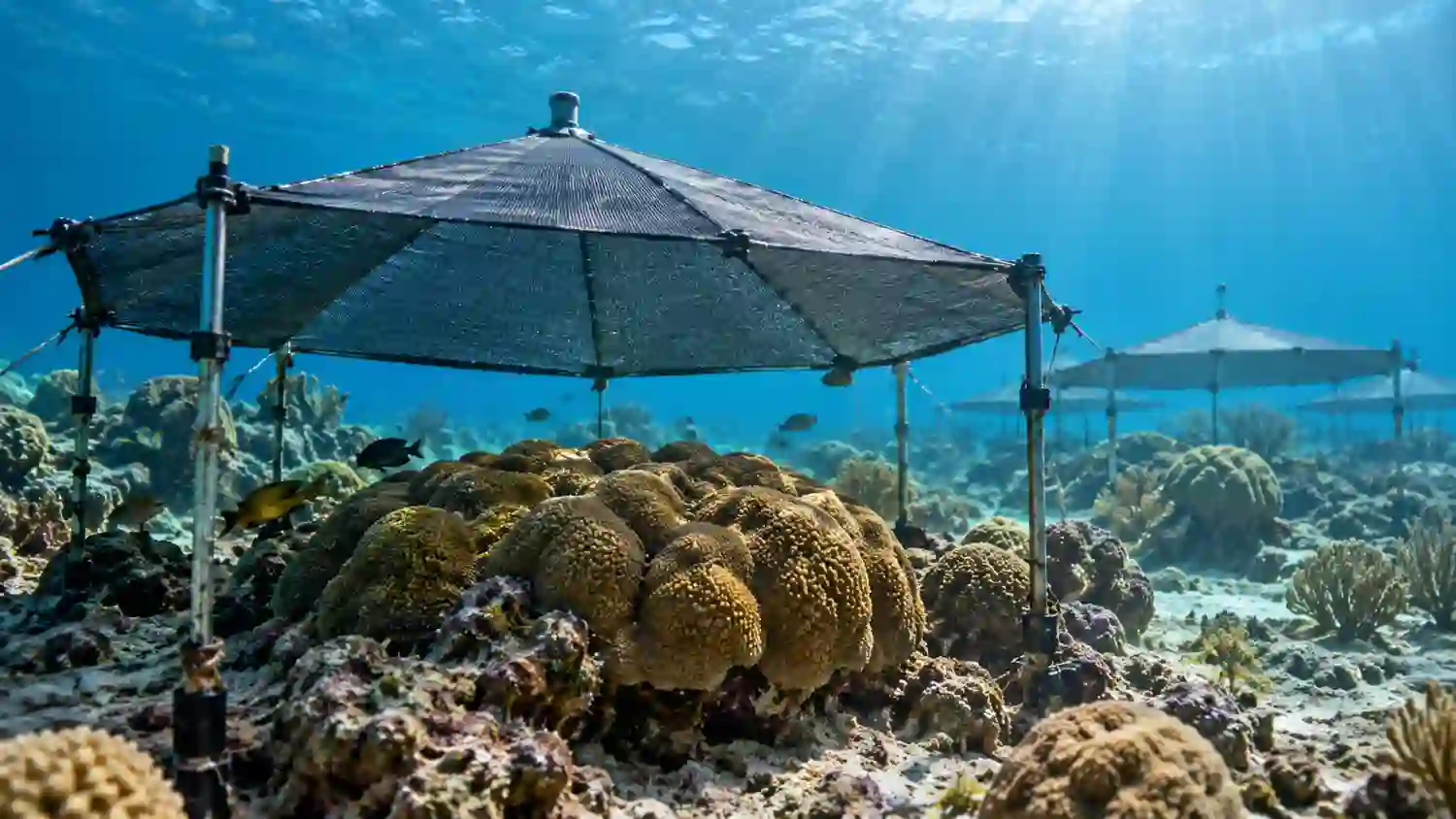
Imagine placing an umbrella over a coral reef not to keep it dry, but to protect it from sunlight. It sounds strange, yet scientists are testing exactly this idea as coral reefs face increasingly severe marine heatwaves and bleaching events.
When ocean temperatures become unusually high, corals can expel the microscopic algae living inside their tissues. These algae normally provide much of the coral’s energy through photosynthesis. Their loss causes the coral to turn white a phenomenon known as coral bleaching. If the stress persists, the coral can eventually die.
Temperature, however, is not the only problem. Intense sunlight and ultraviolet radiation can amplify the damage caused by heat. This has led researchers to ask a simple question: Could reducing the amount of sunlight reaching corals help them survive extreme heat?
In a 2026 field study in the Florida Keys, researchers installed temporary umbrella-like shade structures approximately 30 centimetres above colonies of two Caribbean brain coral species. The structures reduced incoming light by about 60%without attempting to cool the surrounding seawater.
The results were encouraging. During a period of exceptionally high thermal stress, the shaded corals experienced less additional paling, and some regained colour after the structures were installed. The researchers concluded that temporary shading could help reduce heat-related bleaching in selected high-priority corals.
The mechanism is important. Shading does not remove the underlying heat stress. Instead, it reduces the amount of intense radiation reaching the coral at a time when its photosynthetic machinery is already under pressure. By reducing this additional stress, the intervention may give the coral and its algal partners a better chance to maintain their relationship.
But there is a major limitation: scale. Covering an entire reef with underwater umbrellas would be enormously difficult and expensive. The researchers therefore envision shading as a targeted intervention for example, protecting rare, large or particularly valuable coral colonies during short periods of extreme heat.
And the evidence is not universally positive. A 2025 experiment on coral nurseries in Australia found that shading did not significantly reduce bleaching or mortality overall, although lowering some nurseries deeper in the water improved outcomes at one site. This suggests that the effectiveness of shading depends on coral species, location, water depth, light intensity and the severity of thermal stress.
Underwater umbrellas therefore aren’t a cure for coral bleaching. Reducing greenhouse-gas emissions and limiting ocean warming remain essential for long-term reef survival. But targeted shading could become one tool in a growing toolkit of emergency interventions designed to buy vulnerable corals more time.
The bigger idea is fascinating: rather than waiting for climate conditions to improve, scientists are beginning to explore whether we can temporarily engineer the environment around individual organisms to help them survive extreme conditions.