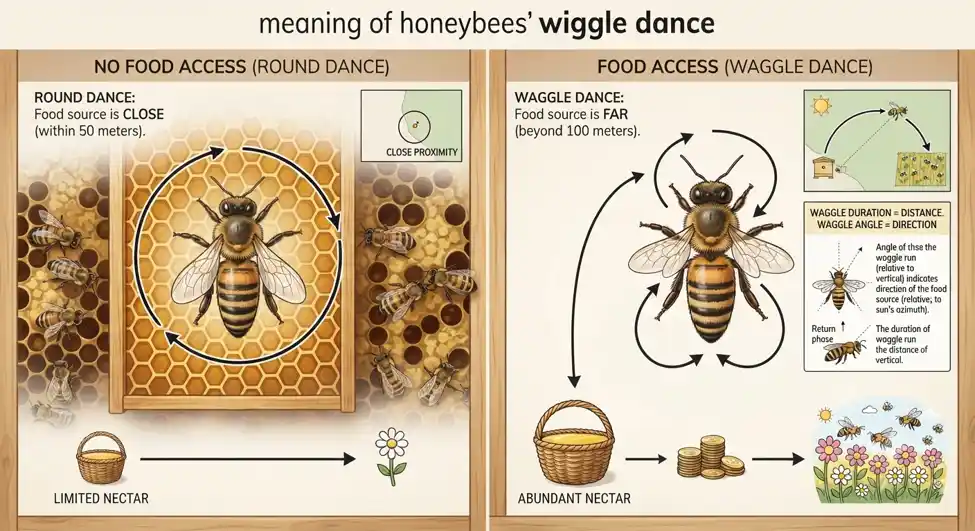
When a honeybee returns to the hive with news of food, she shakes her abdomen in a figure-eight pattern called the waggle dance. The angle tells nestmates which way to fly, and the waggle’s duration tells them how far. A 2026 study suggests the dance carries a third message: how much the dancer trusts her own information.
The experiment
Karmi Oxman, Ofer Feinerman and Sharoni Shafir at the Hebrew University of Jerusalem ran the study. They marked up to 800 foragers in an observation hive and trained them to visit feeders 150 metres away. Each day they picked one “focal” bee and manipulated what happened to the bees she recruited.

- Honest: recruits arrived at the feeder and found sugar water.
- Liar: recruits found an empty feeder, though the focal bee could always feed there.
- Unverified: recruits were intercepted at the feeder, so nobody could report back.
The feeder was then moved to a new spot, and the same bee danced about it. All other bees arriving there were caught, so only she knew about the new site.
What the bees did
Only bees with verified, honest information increased their recruitment effort over time for the new location, while liars and unverified bees did not. Effort here means the number of dance circuits per return. In the paper, honest dancers ramped up across successive dances. Unverified dancers did the reverse and tapered off, and liars stayed flat.
One detail is easy to miss. The chance that a bee would dance at all didn’t differ between groups. Confidence changed how hard she danced, not whether she danced.
Why it matters
A returning forager already tunes her dance vigor to how profitable the source is. This study adds that her dancing also reflects how reliable her information has proven to be. The authors read the extra circuits as confidence sharing, an idea from information theory where individuals scale their signal strength to how much they trust what they know. A longer dance means more bees get to watch it, so a trusted message spreads further.
There is a deeper angle too. The authors note that cutting back signaling under uncertainty could count as metacognition, acting on lost confidence in one’s own experience. They stress that simpler associative learning might explain such behavior. The bee dance is an appealing test case because it happens away from the food itself.
Caveats
- The sample was small: 24 focal bees (21 unique individuals) that danced 195 times in total.
- Few bees actually reached the new feeder, so the test measured dancing effort rather than recruitment success.
- Followers didn’t behave differently across treatments.
- Honest bees ramped up, but liars didn’t fall. The “liar” result is a lack of increase rather than a drop.
- Enthusiasm is a proxy. The study shows dance effort tracks verified reliability. It cannot show what a bee feels.
The takeaway
The waggle dance isn’t a fixed broadcast. Related 2026 work suggests that the dance also depends on its audience: precision falls when fewer bees are present or the audience is less attentive. A bee’s dance seems to reflect what she knows, how well it has held up, and who is watching. A hive of tens of thousands needs ways to keep bad information from spreading, and honest signal strength is one of them.
References
- Oxman KL, Feinerman O, Shafir S. Honey bees increase recruitment effort when dance information is honest. Behav Ecol Sociobiol. 2026;80:73. doi:10.1007/s00265-026-03744-2 (raw data: doi:10.5281/zenodo.17771503)
- Korman A, Greenwald E, Feinerman O. Confidence sharing: an economic strategy for efficient information flows in animal groups. PLoS Comput Biol. 2014;10:e1003862.
- Dong S, Lin T, Nieh JC, Tan K, et al. The audience shapes the information content of the honey bee waggle dance. PNAS. 2026;123(14). doi:10.1073/pnas.2518687123
- Perry CJ, Barron AB. Honey bees selectively avoid difficult choices. PNAS. 2013;110:19155-19159.
- Seeley TD. The Wisdom of the Hive. Harvard University Press; 1995.