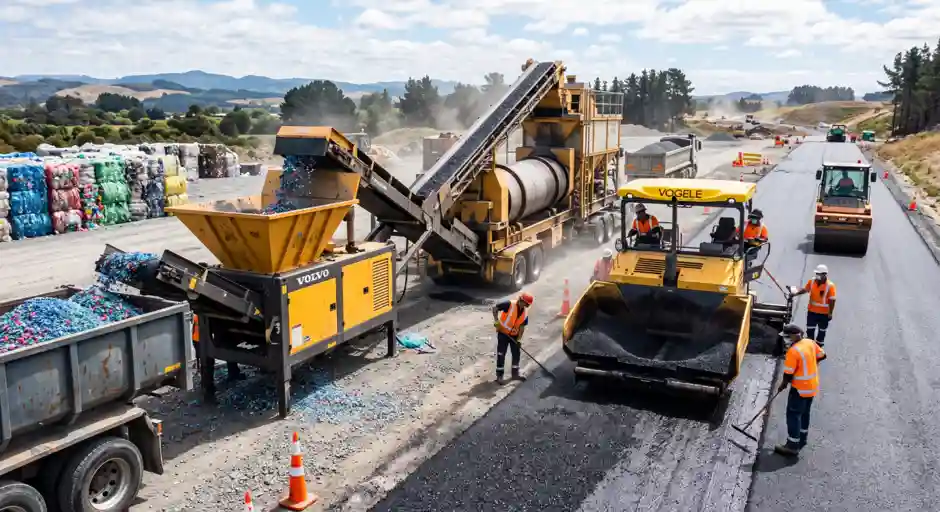
That is exactly what Hawaii decided to test. In 2022, the Hawaii Department of Transportation began an unusual experiment on Fort Weaver Road in Ewa Beach, Oʻahu, mixing recycled plastic into asphalt. The amount used was equivalent to about 195,000 plastic bottles, plastic that could otherwise have gone to a landfill. At first, the idea sounds almost too simple: take waste plastic, put it into roads, and give it a second life. But there was a problem scientists couldn’t ignore.
What happens to that plastic once the road is exposed to years of rain, sunlight, heat and traffic?
The Fort Weaver Road project was designed as more than a paving experiment. Researchers from the University of Hawaiʻi at Mānoa and Hawaiʻi Pacific University were brought in to study both how well the pavement performed and whether plastic or chemicals associated with it could escape into the surrounding environment.
The pilot used about 1,950 tons of asphalt, with the recycled plastic making up only around 0.1% of the mixture. Different pavement sections were constructed so researchers could compare plastic-modified asphalt with conventional pavement.
The environmental concern was particularly important because roads constantly interact with water. When rain falls on a road, some of that water runs across the pavement and eventually enters drains, soil and waterways. If the recycled plastic were breaking down, tiny particles such as microplastics or chemical additives could potentially be carried away with that runoff. So they collected simulated rainfall and runoff from the different road sections and tested the water for evidence of plastic particles and other substances. The goal wasn’t simply to ask whether the road could survive traffic. It was also to determine whether recycling plastic into asphalt created a new pollution pathway. That distinction matters.
Recycling something doesn’t automatically mean its environmental impact disappears. Sometimes waste is simply moved from one part of the system to another. In this case, scientists needed to determine whether keeping plastic out of a landfill was worth the potential environmental consequences of permanently embedding it in infrastructure.
The experiment also reflects a particular challenge for Hawaii. Transporting waste off the islands can be expensive, while limited landfill space and marine plastic pollution create additional pressure to find local ways of dealing with discarded plastic.
And the road experiment has continued to influence further research. In 2026, Hawaiian researchers investigated ways to use recycled plastics and discarded fishing nets in asphalt, with early testing suggesting that plastic-modified roads did not release more plastic particles than conventional pavement under the conditions studied. Tire wear, which itself produces particles, can make it difficult to separate the contribution of the recycled plastic from everything else happening on a busy road.
That is why the Fort Weaver Road experiment is more interesting than simply saying “195,000 bottles became a road.” It is really a test of a bigger idea: Can we turn plastic waste into useful infrastructure without simply creating a new environmental problem? If the answer remains yes after years of monitoring, roads could become one more place where difficult-to-recycle plastic gets a second life.
But the importance from Hawaii is that sustainable engineering isn’t just about finding a clever way to reuse waste. It is about finding out where that waste goes next.
Sources: