Human communication is not just about words. We nod, wave, point, shrug and move our faces while speaking. For people with severe paralysis, however, both speech and movement can be lost. A new brain-computer interface (BCI) is now bringing these two forms of communication together.
In a September 2026 study, researchers at the University of California, San Francisco demonstrated a single brain implant capable of decoding attempted speech and upper-body gestures simultaneously and translating them into commands for a personalized virtual avatar.
Reading the brain’s communication signals
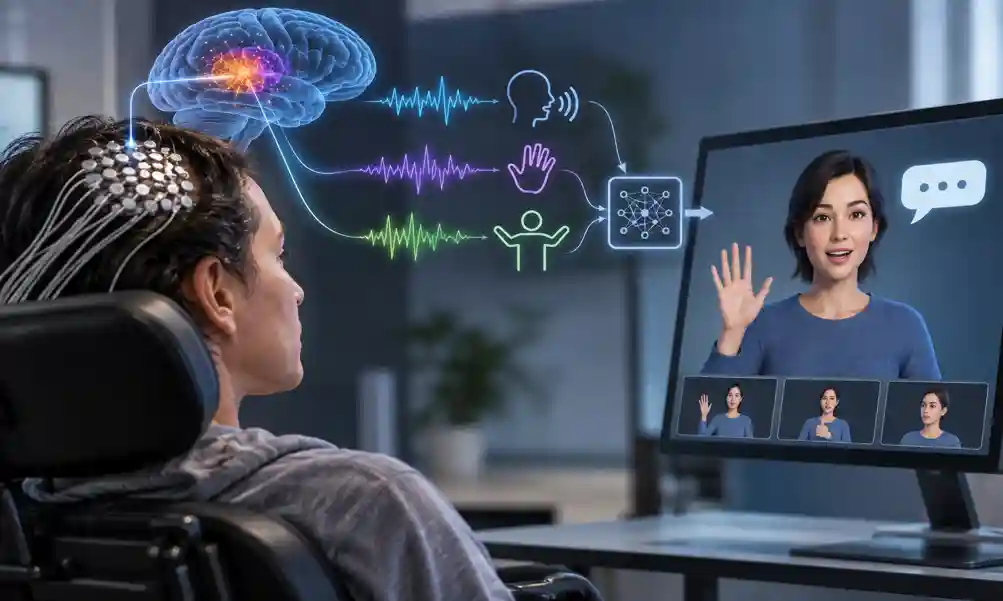
The system uses a high-density electrocorticography (ECoG) array containing 253 electrodes positioned over the sensorimotor cortex. Rather than detecting spoken sounds, the electrodes record patterns of neural activity associated with a person’s intention to speak or move.
Artificial-intelligence decoders then translate these patterns into digital commands.
Three participants with severe paralysis were enrolled in the study. Two had experienced brainstem strokes and one had amyotrophic lateral sclerosis (ALS). The system was tested on speech and movements involving the hands, arms, head, eyes and face.
Why combining speech and gestures matters
Previous BCIs have demonstrated impressive speech decoding or movement control, but these functions were generally studied separately.
The researchers found that the brain does something important when speech and gestures occur together: the neural patterns are not simply identical to performing either action independently. Training the AI using simultaneous speech-and-gesture data improved its ability to distinguish the two signals and reduced unwanted cross-activation.
In real-time experiments, the decoded signals controlled a personalized full-body virtual avatar. Speech could appear as text while gestures such as waving or nodding were reproduced by the avatar, allowing participants to communicate using multiple channels at once.
Still a proof of concept
The technology is impressive, but it is not yet a mind-reading device capable of translating unlimited thoughts.
The study involved only three participants overall, with simultaneous speech-and-gesture testing conducted in two participants. The experiments also used restricted vocabularies and structured tasks rather than unrestricted everyday conversation.
Nevertheless, the research points toward a different future for neuroprosthetics.
Instead of giving someone with paralysis only a way to type words, future BCIs could potentially restore something much closer to natural communication words, gestures and expression working together in real time.
The ultimate goal is not simply to make the brain speak.
It is to give people back the ability to communicate as a whole person.
Sources: