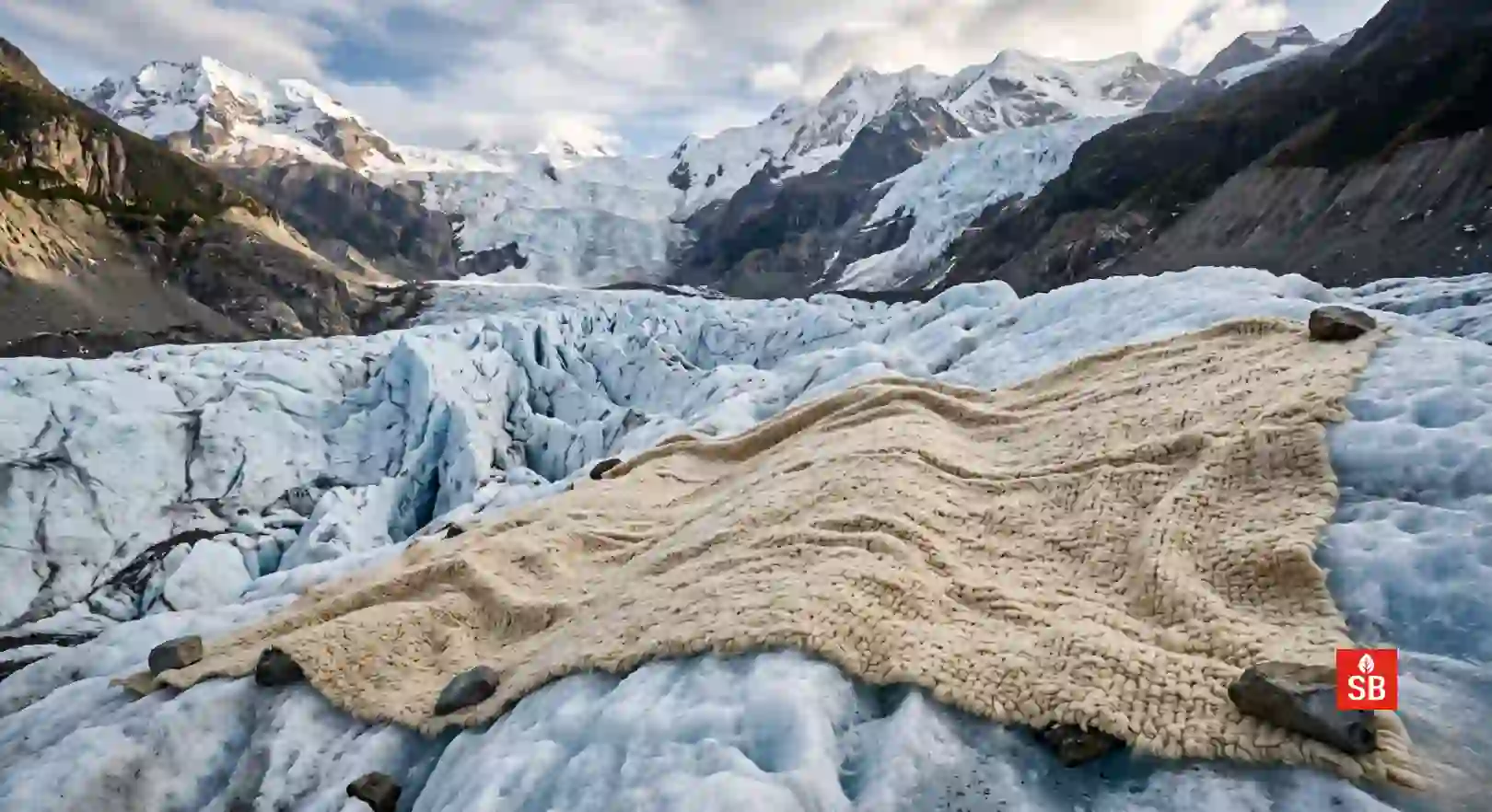
What would you use to protect a glacier from the summer sun? Plastic sheets are already used in parts of the Swiss Alps. But scientists in Switzerland have now tested something that sounds much less likely to belong on a glacier: sheep’s wool.
In June 2026, they placed two wool blankets, covering a combined 200 square metres, on the Tsanfleuron Glacier near Les Diablerets in western Switzerland. The experiment, called “Keep It Wool,” was designed to find out whether wool could slow ice melting as effectively as the synthetic covers currently used in some Alpine areas.
The early results were surprisingly encouraging. Measurements taken throughout the summer showed that the wool blankets reduced melting by about as much as the conventional synthetic covers used for comparison. These protective sheets can reduce local melting by roughly 50–70%, depending on conditions.
But why cover a glacier at all?
The basic idea is fairly simple. During summer, sunlight delivers energy to the glacier surface, causing snow and ice to melt. A light-coloured protective covering reflects much of that incoming radiation and creates a barrier between the ice and the surrounding heat. Ski resorts have used synthetic geotextile blankets for years to protect specific sections of glaciers. They can help preserve snow around ski infrastructure or slow the loss of ice in particularly important areas. The problem is that these conventional covers are made from synthetic materials.
Over time, plastic-based textiles can deteriorate under strong sunlight, wind and changing temperatures. The wool experiment is therefore testing whether a natural, renewable and biodegradable material could do the same job without introducing synthetic fibres into the environment. There is another reason they chose wool.
A significant proportion of Swiss sheep’s wool has little commercial value and is discarded or burned. The project therefore connects two problems: an agricultural material that is often treated as waste and a glacier that needs temporary protection from extreme summer melting. The wool itself also performed better than expected. They initially weren’t sure whether the blankets would remain stable under strong Alpine winds, rain and temperature changes. So far, the material has held up well enough for the experiment to continue. But there is a catch. A wool blanket cannot save Switzerland’s glaciers from climate change. Only about 0.02% of Switzerland’s total glacier area is currently covered by protective materials. That means these interventions affect an extremely small fraction of the country’s ice. Even if wool proves to be an excellent replacement for plastic, covering entire glaciers would be impractical. That is why scientists describe this as a local adaptation strategy rather than a solution to global warming.
The experiment demonstrates something valuable: sometimes an environmental problem can be approached by looking at another waste stream differently. For now, a small part of a Swiss glacier has received an unusual summer blanket. And surprisingly, sheep’s wool appears to be doing its job. But the much bigger challenge remains untouched: stopping the planet from getting warmer in the first place.
Sources: