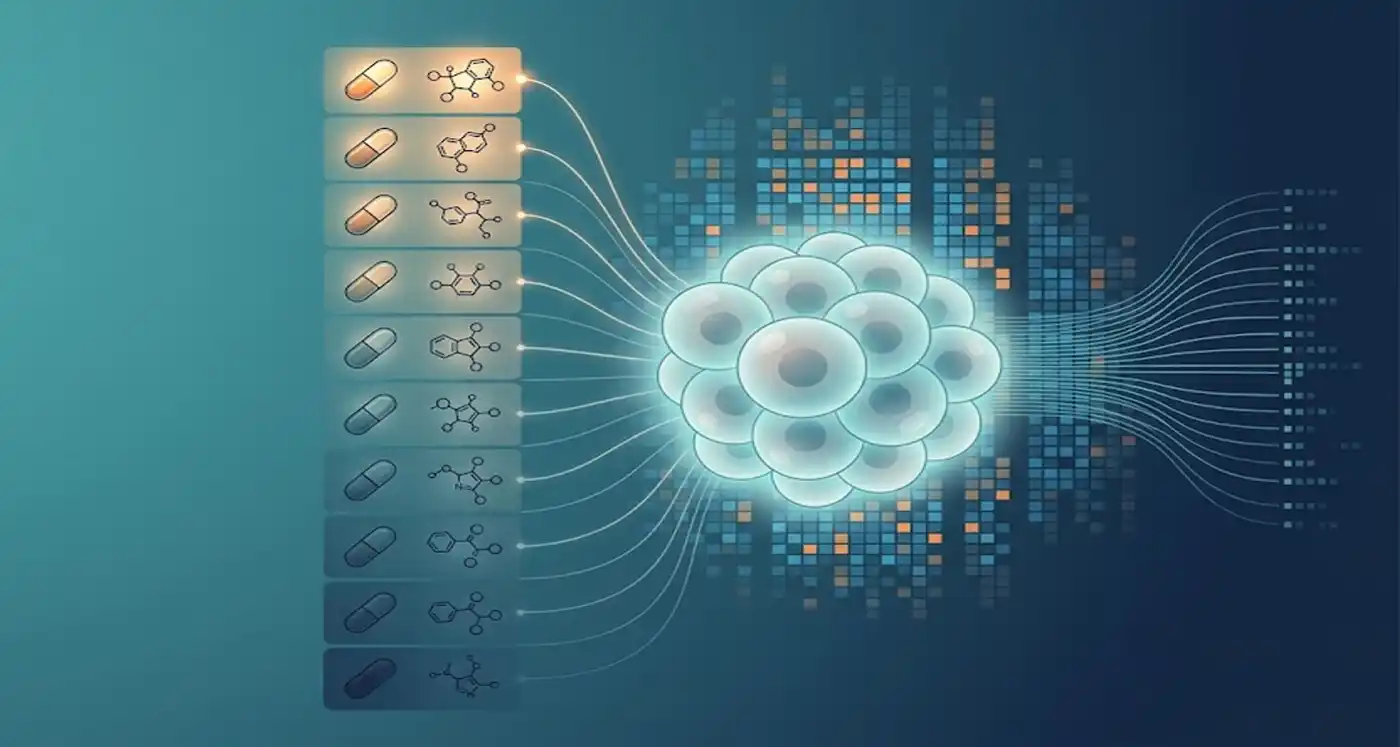
A new model called UniCure learned from 1.9 million experiments and hundreds of real patient tumours. When it ranked drugs for cancer patients, the ones already known to work floated to the top on their own. Two people walk into a cancer clinic with what looks like the same disease on paper. Same organ, same stage, same slide under the microscope. One does well on the drug they are given. The other does not. Oncologists have lived with this puzzle for decades, and choosing a therapy still involves a fair amount of educated guesswork. A large team of Chinese researchers says it has built a tool that could narrow that guesswork. Writing in Cancer Cell, scientists from the Chinese Academy of Sciences, Second Military Medical University, Shanghai Jiao Tong University, DP Technology and several hospitals unveiled UniCure, an artificial intelligence model that predicts how a tumour’s genes will react to a drug before the drug is ever given.
Listening to the whole cell, not just one target
Most drug prediction tools ask a narrow question: does this molecule hit this protein? UniCure asks a broader one. It predicts the transcriptome, meaning the full pattern of genes a cell switches on and off after a drug arrives. That pattern is a kind of fingerprint of what the drug actually did inside the cell. The catch has always been the training data. Almost all of it comes from cancer cell lines, cells that have been growing in plastic dishes for decades. They are cheap and convenient, but a poor stand in for a living tumour with its immune cells, blood vessels and messy internal variety. Models raised on dishes tend to stumble in the clinic.
Two foundation models, stitched together
UniCure works around that problem by borrowing a trick from modern AI. It bolts together two pre trained “foundation models”. One, Uni-Mol, was trained on 209 million molecular structures and understands chemistry. The other, Universal Cell Embedding, was trained on 36 million cells and understands biology. A module the team calls FlexPert lets the two talk to each other, using an attention mechanism to work out which parts of a drug matter for which parts of a cell.
Then came the heavy lifting: training on 1.9 million drug response profiles covering more than 22,000 compounds, 166 cell types and 24 tissues. Finally, and this is the crucial step, the team fine tuned the model on 345 profiles from patient derived tumour like cell clusters, or PTCs. These are tiny three dimensional clumps grown straight from fresh surgical samples of breast, bladder and lung tumours, and they keep some of their original immune and structural cells for company.
Does it actually work?
On held out test data, the model’s predicted gene changes matched the real ones with correlations above 0.9, outperforming rival tools such as TranSiGen and PRnet. It also survived harder tests. Shown drugs it had never seen, cell types it had never seen, or both at once, it kept its footing. More interestingly, it picked up biology nobody had hard coded into it. Two proteasome inhibitors, bortezomib and MG132, landed in the same cluster because their effects on cells look alike. High doses produced big shifts and low doses barely any. In lung cancer cells, the model predicted that only the subgroups rich in SRC or DDR1 would respond strongly to dasatinib, while the rest would shrug it off.
Putting it to the test on real patients
Here is where the study gets its teeth. The team asked UniCure to rank roughly 5,000 compounds for each of hundreds of real patients, scoring every drug by how well it should reverse that person’s tumour signature. Drugs already known to work rose to the top on their own. In lung adenocarcinoma, osimertinib, a standard EGFR inhibitor, averaged in the top 20 percent. Ceritinib, crizotinib and gefitinib followed suit. Cancer drugs approved for other organs ranked significantly lower, which suggests the model was reading disease specific signals rather than simply flagging anything toxic. Then came survival. Patients whose prescribed drug happened to sit in UniCure’s top 30 percent lived longer than those whose drug ranked lower, both in lung adenocarcinoma (p = 0.01) and breast cancer (p = 0.03), with similar trends in bladder and squamous lung cancer. One 81 year old woman with stage IIIA lung cancer received pemetrexed, a drug UniCure placed in her top 10 percent, and survived 1,621 days. Another woman, 74, at the same stage, received carboplatin, ranked in her bottom 1 percent, and survived 189 days. Striking, but the authors are quick to note these are retrospective records, not proof that the drug rank caused the difference.
A side door into natural products
The team also pointed UniCure at 2,019 natural compounds and then took its favourites to the bench: tubeimoside III and polygalacin D for triple negative breast cancer, protoporphyrin IX and anethole trithione for lung, isobavachromene and salvianolic acid A for bladder. All slowed cancer cell growth at micromolar doses and cut colony formation sharply, while low ranked compounds did next to nothing. The results held up in the patient derived clusters as well.
The fine print
There is plenty. UniCure reads only gene expression, so mutations, proteins and epigenetic changes slip past it. PTCs, for all their realism, are still grown outside the body. The survival findings are associations rather than evidence of benefit, the patient groups were small and uneven, and the ranking trick fell flat in colon and prostate cancer. Compound choice for lab testing also depended partly on what was easy to buy and dissolve.
Still, the model’s code and data are public, which means other groups can kick the tyres. The obvious next step, as the authors themselves say, is a prospective trial where the ranking is made before treatment rather than after, and judged on what happens next.
Reference
Chen, Z., Tian, S., Pei, J., Gu, R., Li, Y., Ding, S., Xu, Y., Zheng, X., Liu, M., Du, X., Zhou, Y., Zhu, J., Zou, J., Xu, J., Jiang, W., Ye, C., Dong, B., Zhang, Q., Ren, S., Wang, S., Wen, H., Zhang, W., & Chen, L. (2026). UniCure: A multi-modal model for predicting personalized cancer therapy response. Cancer Cell, 44, 1–14. https://doi.org/10.1016/j.ccell.2026.07.010