What if an island could act like a giant electrical switchboard?
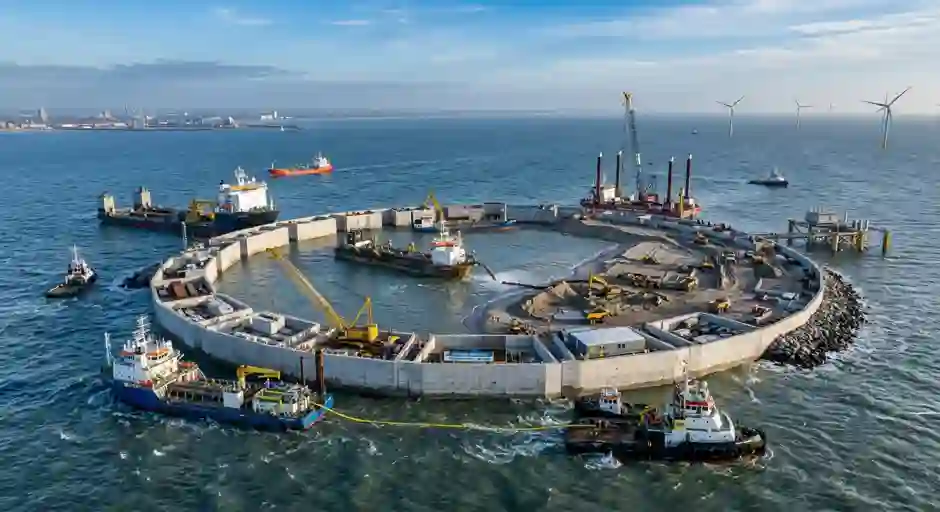
That is the idea behind Princess Elisabeth Island, an artificial island being built about 45 kilometres off the Belgian coast in the North Sea. It is being designed to collect electricity from offshore wind farms and send that power to Belgium and, eventually, other European countries. But before the island can carry any electrical equipment, engineers first have to build the island itself. They are doing this with 23 enormous concrete structures called caissons. Each one weighs around 22,000 tonnes and is roughly 58 metres long. The caissons are built at the Dutch port of Vlissingen, floated out to sea and carefully positioned in a ring in water about 45 metres deep. Once in place, they are filled with sand, turning the hollow structures into the walls and foundation of the artificial island.
The result is an island covering roughly six hectares, with a harbour and helipad. But this is not an island designed for people to live on. Its real purpose is to solve a growing problem with offshore wind power: how do you get electricity from many wind farms far out at sea back to the mainland efficiently? Belgium plans to develop up to 3.5 gigawatts of offshore wind capacity in the Princess Elisabeth Zone. Instead of sending every connection separately toward the coast, the island can act as a central hub where electricity from different wind farms is collected and transferred onward. It can also connect Belgium’s electricity grid with other European countries through submarine cables.
That makes the island less like a traditional piece of land and more like an offshore electrical junction box. And the engineering challenge is enormous. The caissons have to be transported, positioned and secured in a busy stretch of the North Sea, while the finished structure must withstand waves, storms and the harsh marine environment. The 23rd and final caisson was installed in 2026, completing the foundation works. What looks from above like a ring of concrete in the ocean will eventually become part of Europe’s offshore electricity network.
So Belgium isn’t building an island simply to create more land. It is building one because, in the future, some of Europe’s most important power infrastructure may sit far beyond the shoreline.
Source: