What would you normally do with 20,000 old car tyres?
In Maine, engineers found a surprisingly useful place for them: under a road. The unusual experiment was designed to solve two problems at once. Maine’s roads have to survive repeated freezing and thawing, which can leave gravel roads muddy, soft and badly rutted in spring. At the same time, the state has more than a million unwanted tires to deal with every year. Engineers wondered whether the waste material could actually help protect roads from the weather that damages them.
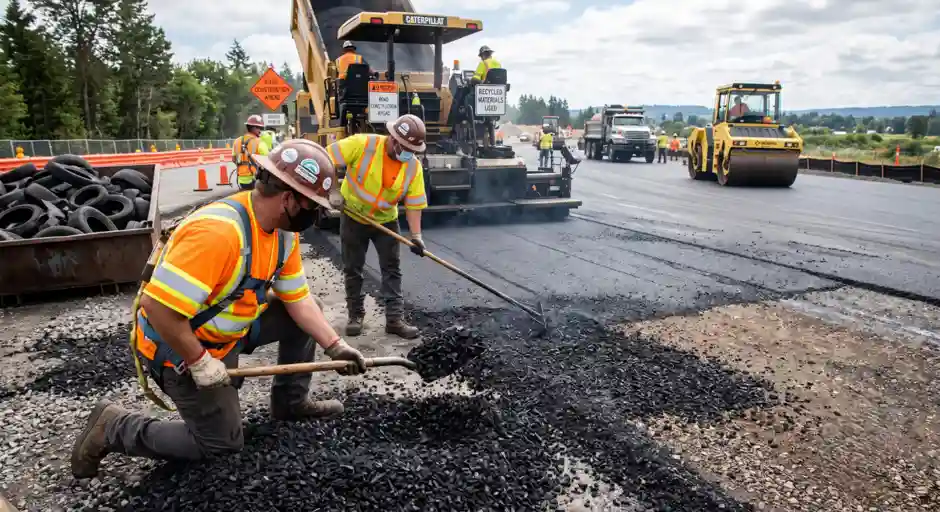
The experiment took place on a roughly 600-foot section of Dingley Road in Richmond, Maine. Instead of laying whole tyres underground, they cut the discarded tyres into pieces about 2–3 inches across. The tyre chips, including their steel belts, were placed in a layer roughly 6–12 inches thick beneath the conventional gravel road surface.
So what were the tires actually doing down there?
Their most important property was not their strength. It was their ability to insulate. During a Maine winter, water in the ground freezes. As temperatures rise in spring, that frozen layer begins to thaw. The resulting water can weaken the soil beneath a road, and traffic travelling over the softened surface can produce deep ruts and potholes. The tyre chips behaved differently from ordinary gravel. Rubber does not transfer heat as readily as mineral materials, while the spaces between the irregular tyre pieces also allow water to move through the layer. Together, these properties helped reduce the depth to which frost penetrated the roadbed.
They installed more than 100 temperature sensors at different depths so they could follow what was happening inside the road throughout the winter. When spring arrived, the experimental section showed a noticeable difference. Frost had penetrated to roughly half the depth observed in nearby sections made with conventional gravel. The gravel-only sections also deteriorated considerably during the spring thaw, while the tyre-chip section held up better. The tyres had another advantage: they were extremely light.
Conventional gravel weighs around 125 pounds per cubic foot, while the tyre material used in the experiment weighed roughly 40 pounds per cubic foot. That makes tyre chips useful as lightweight fill, particularly where putting a large amount of heavy soil or gravel on weak ground could create additional problems. And this is where the idea becomes bigger than one road. Engineers began investigating whether tyre chips could also be used behind retaining walls and beneath other roads. Their low weight could reduce pressure on structures, while their insulating and drainage properties could provide additional engineering benefits.
But this isn’t the same as simply mixing rubber into asphalt. In rubberized asphalt, processed crumb rubber becomes part of the pavement itself. The Maine experiment instead used relatively large tyre pieces as a sub-base material underneath the road. That meant the project could use much larger quantities of discarded tyres without grinding them into extremely fine rubber.
This therefore turned a waste problem into something unexpectedly useful. Those tyres were once destined for stockpiles, disposal or other forms of waste management. Instead, buried beneath a road, they became part of the engineering. Sometimes recycling doesn’t mean turning waste back into the same product, it means discovering that the waste already has a property that engineers need.