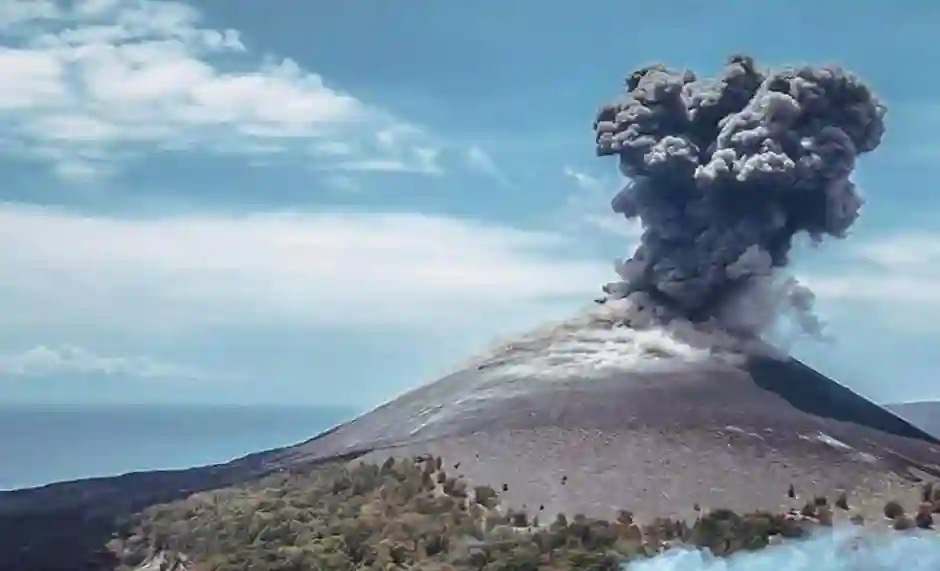
Indonesia’s Mount Anak Krakatau has erupted again, sending volcanic ash high into the atmosphere and triggering widespread disruption to air travel. The eruption has also highlighted why Indonesia remains one of the world’s most volcanically active regions, a direct consequence of its position along the Pacific Ring of Fire.
Volcanic ash brings aviation to a standstill
Mount Anak Krakatau, located in Indonesia’s Sunda Strait between Java and Sumatra, began a significant eruptive episode in early September 2026. Volcanic ash spread across parts of western Indonesia, including the Jakarta region, creating dangerous conditions for aircraft. The disruption was substantial. Eight airports were affected, with more than 340,000 travellers impacted and thousands of flights delayed or cancelled. Jakarta’s major Soekarno-Hatta International Airport was among the facilities temporarily closed as authorities monitored the movement of volcanic ash.
By September 8, airports had begun reopening as winds dispersed the ash. However, aviation authorities continued inspections of aircraft that had been grounded during the disruption, while further eruptions from Anak Krakatau remained possible. The danger to aviation is not simply the poor visibility created by an ash cloud.
Why volcanic ash is dangerous to aircraft
Volcanic ash is composed of tiny particles of pulverised rock, minerals and volcanic glass. When sucked into a jet engine, these particles can melt inside the engine’s extremely hot environment and subsequently solidify on critical components.
This can interfere with airflow and engine operation and, in severe circumstances, cause engine failure. Ash can also scratch aircraft windscreens, contaminate sensors and damage other aircraft systems. This is why aviation authorities may close airspace even when an eruption is occurring many kilometres away from an airport. During the Anak Krakatau event, ash was reported at altitudes reaching approximately 50,000 feet, making the hazard particularly significant for commercial aviation.
Anak Krakatau: The child of Krakatoa
Anak Krakatau literally means “Child of Krakatoa.” The modern volcano emerged from the sea after the catastrophic destruction of the original Krakatoa volcano during the 1883 eruption, one of the most powerful volcanic events in recorded history. Anak Krakatau later became an active volcanic island in the Sunda Strait. Its location is particularly significant because it sits in one of Earth’s most tectonically dynamic regions. In December 2018, an eruption and collapse of part of Anak Krakatau’s volcanic flank generated a tsunami that struck coastal areas of Java and Sumatra, killing hundreds of people. The volcano therefore represents more than an aviation hazard: it is a reminder of the complex interaction between volcanoes, earthquakes, submarine landslides and tsunamis.
Why does Indonesia have so many volcanoes?
The answer lies beneath the Earth’s surface. Indonesia sits at the intersection of several tectonic plates and microplates, including the Indo-Australian Plate and the Eurasian/Sunda region. Oceanic crust is being forced beneath other tectonic blocks in a process known as subduction. As the descending plate sinks into the Earth’s mantle, water and other volatile materials are released into the surrounding rocks. This helps generate magma. The magma can eventually rise toward the surface, producing chains of volcanoes. This process has created the volcanic arcs running through Indonesia. Indonesia has roughly 130 active volcanoes, making it one of the world’s most volcanically active countries.
What exactly is the “Ring of Fire”?
The Pacific Ring of Fire is a vast horseshoe-shaped belt surrounding much of the Pacific Ocean. It stretches from New Zealand and Indonesia through Japan, the Philippines, the Aleutian Islands, western North America and down through Central and South America. It is not actually a single geological ring. Rather, it is a broad zone containing numerous tectonic plate boundaries, subduction zones, volcanoes and earthquake-producing faults. The U.S. Geological Survey describes the Ring of Fire as the region around the Pacific where the Pacific Plate interacts with many surrounding tectonic plates. Approximately 90% of the world’s earthquakes occur along this broad belt, and it contains around 75% of the world’s active volcanoes, according to National Geographic.
A planet constantly in motion
The Ring of Fire exists because Earth’s tectonic plates are constantly moving. In many parts of the region, one plate is forced beneath another. This process is subduction and it generates enormous stresses that can produce earthquakes and creates the conditions for magma formation and volcanic eruptions. That means the same geological forces responsible for Indonesia’s volcanoes are also connected to earthquakes and tsunamis across the wider Pacific region.
Anak Krakatau is part of a much bigger story
The latest eruption does not mean that the entire Ring of Fire is suddenly becoming more active. Instead, it demonstrates how Earth’s internal engine continues to reshape the surface of the planet. Indonesia’s geography places it directly within one of Earth’s most dynamic tectonic environments. For aviation, the immediate concern is volcanic ash. For volcanologists, the eruption provides another opportunity to understand how magma moves beneath an active volcanic system. For millions living across the Indonesian archipelago, it is another reminder that life exists alongside a constantly changing geological landscape.
From the skies above Jakarta to the tectonic plates deep beneath the Sunda Strait, Anak Krakatau’s latest eruption is a powerful demonstration that Earth’s surface is anything but still.