Tiny bits of plastic are everywhere. Now scientists are using old river science to follow them from the road to the sea, and to work out where they pile up. Just out of sight of the white yachts at Newport Beach, California, a graduate student in waders is pushing an aluminium pipe two feet into the mud. Clare Murphy-Hagan, a researcher at the University of California, Riverside, pulls the pipe back out. Inside is a long plug of mud holding a record of the bay’s past. The bottom dates to about 1950, she says, “right around the horizon of the widespread use of plastic.” Everything above that is 75 years of crushed takeout boxes, worn tyre rubber and clothing fibres, settled over the bay like confetti. Microplastics, she says, are “everywhere in the sample.” Which leaves the question nobody could really answer until recently: how did they get there?
We know plastic is everywhere. We don’t know how it travels.
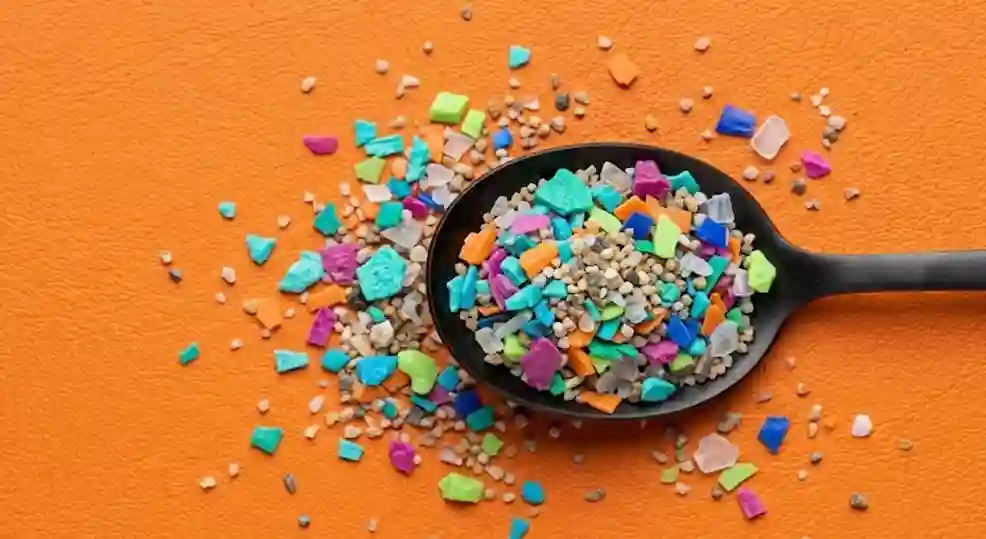
A microplastic is any piece of plastic smaller than five millimetres. Some are so small you need a microscope. Up to 40 million tons enter the environment every year, and about 1,300 animal species mistake the pieces for food. But the route it takes, from road to storm drain to creek to bay to ocean floor, has stayed fuzzy. Early research came mostly from ocean scientists, who found plastic floating at sea and scooped it up with fine nets, almost as if catching plankton.
That method was never built to follow a single particle from start to finish, says Andrew Gray, a water scientist at UC Riverside and Murphy-Hagan’s advisor. Skimming the surface misses everything below it, and that is where you need to look to see plastic washing off a highway.
Think like a grain of sand
The fix came from an unglamorous field. For about a century, scientists have studied how sand grains tumble along in moving water. Gray’s lab now applies that same thinking to plastic.
Picture sand, which is more than twice as heavy as water, Gray says. Drop it in a glass and it sinks, and only the smallest grains stay floating. Now drop that sand into a fast, churning river. The swirling flow lifts the bigger grains off the bottom and holds them up. If the current is strong enough, the sand spreads evenly from riverbed to surface. Plastic behaves in a similar way. So if you know a particle’s weight, size and shape, and how rough the water is, you can predict where it will go. Feed that into a computer and you can follow thousands of particles at once, says James Lofty, an engineer at the Karlsruhe Institute of Technology in Germany. What comes out is a map of where plastic collects. “Once you know where it accumulates, you know where to focus money,” he says.
Why those spots matter
Meredith Seeley of the Virginia Institute of Marine Science put four kinds of microplastic into jars of salt marsh mud. Within two weeks, the microbes in those jars had changed compared with the jars that held no plastic. PVC did the most damage, blocking microbes that do a job plants depend on. That kind of change “would have huge repercussions for the food web,” she says.
Others are trying to catch the plastic earlier. Win Cowger of the Moore Institute for Plastic Pollution Research tested rain gardens, small planted patches built into the kerb that filter rainwater before it reaches a creek. Across four San Francisco sites, they cut levels of 21 pollutants. At one garden, 75 to 90 percent was removed before the water reached the bay.
The missing middle
Estuaries, the muddy places where rivers meet the sea, are an “understudied in between compartment,” Murphy-Hagan says. Almost nobody has mapped them. Her Newport Bay work aims at that gap. Since 2020 she has collected mud cores and lowered nets through the full depth of nearby rivers. The trick is letting water enter the net at exactly the speed it is already moving, so nothing gets sucked in or pushed away. That gives a fair picture of what the river is really carrying. She then put the size and weight of those particles into a computer model and compared its predictions with the top five centimetres of her cores, which hold about a year of buildup. Near the creek mouths, model and mud “compared reasonably well.”
Plastic is not one thing
One of the most interesting findings is that different plastics ended up in different places. Heavy tyre particles sank near the river mouths. Light Styrofoam gathered along the banks. Plastic fibres, light enough to travel on water and on wind, showed up everywhere. “There’s lots of complexities in microplastic behavior,” says Katelyn Kirby, a river engineer at the National Research Council of Canada. “They’re sometimes thought of as one class of particles, but they’re so varied.” Kirby and software developer Mohammad Ghazizadeh helped build a program called CaMPSim-3D, now running at five Canadian sites from British Columbia to the Arctic. It releases millions of imaginary particles into a simulated river, drawn from real sources like busy highways and sewage plants, then follows each one. A clear pattern showed up. Floating plastic gathers along the shoreline, while heavier plastic sinks into deep riverbeds.
The program is free online, and researchers already use it to spot likely trouble areas. One day it might help plan beach cleanups. “We want the impact of our research to be as wide as possible,” Kirby says. For Murphy-Hagan, the aim is more specific than a big global number. “We have to know the real-world dosage and exposure,” she says, right down to a single beach. Only then can anyone say which places are truly at risk, and where cleanup crews should start.
| Source: Dougherty, J. A., et al. (2026). Load and concentration based performance outcomes for emerging organic contaminants in bioretention stormwater treatment systems. Environmental Science: Water Research & Technology, 12, 2470–2488. Ghazizadeh, M., et al. (2025). A high-performance ray tracing particle tracking model for the simulation of microplastics in inland and coastal aquatic environments. Computer Physics Communications, 307, 109423. McDermott, A. (2026). How do microplastics move through water and land? Earth scientists find ways to track their journey. Proceedings of the National Academy of Sciences, 123(36), e2628766123. https://doi.org/10.1073/pnas.2628766123 Murphy-Hagan, C., Gray, A. B., Singh, S., Hapich, H., & Cowger, W. (2025). Quantifying microplastic fluvial flux from a coastal watershed: A microplastic rating curve approach. Journal of Environmental Management, 394, 127445. Seeley, M. E., Song, B., Passie, R., & Hale, R. C. (2020). Microplastics affect sedimentary microbial communities and nitrogen cycling. Nature Communications, 11, 2372. https://doi.org/10.1038/s41467-020-16235-3 Thompson, R. C., et al. (2024). Twenty years of microplastic pollution research: What have we learned? Science, 386, eadl2746. https://doi.org/10.1126/science.adl2746 |