Say “psilocybin” and most people picture one thing: a trip. Candles, music, a therapist nearby, and a few hours of altered reality that’s supposed to leave you feeling better about life. That picture is still true. But three new studies suggest psilocybin’s story is getting a lot bigger, including one strange discovery that has almost nothing to do with the mind at all.
When Mushrooms Meet Chemotherapy
Here’s a problem most people don’t know about. Chemotherapy saves lives, but for a huge number of patients it also wrecks their nerves. Up to 60% of people on certain chemo drugs develop something called CIPN – burning, numbness, and pain in the hands and feet that can last for years (Heles et al., 2026). Sometimes it’s so bad that doctors have to lower the chemo dose or stop treatment early, even if the cancer isn’t gone yet.
There’s no real fix for this. Doctors have one drug they sometimes try, called duloxetine, and it barely helps (Heles et al., 2026). So here’s the twist: a team at MD Anderson Cancer Center gave mice two doses of psilocybin before chemotherapy, and the nerve damage basically never happened (Heles et al., 2026). The protection lasted through six rounds of chemo and eight months of follow-up. Even better, the cancer itself didn’t grow any faster. The mushroom compound was protecting nerves, not helping tumors.
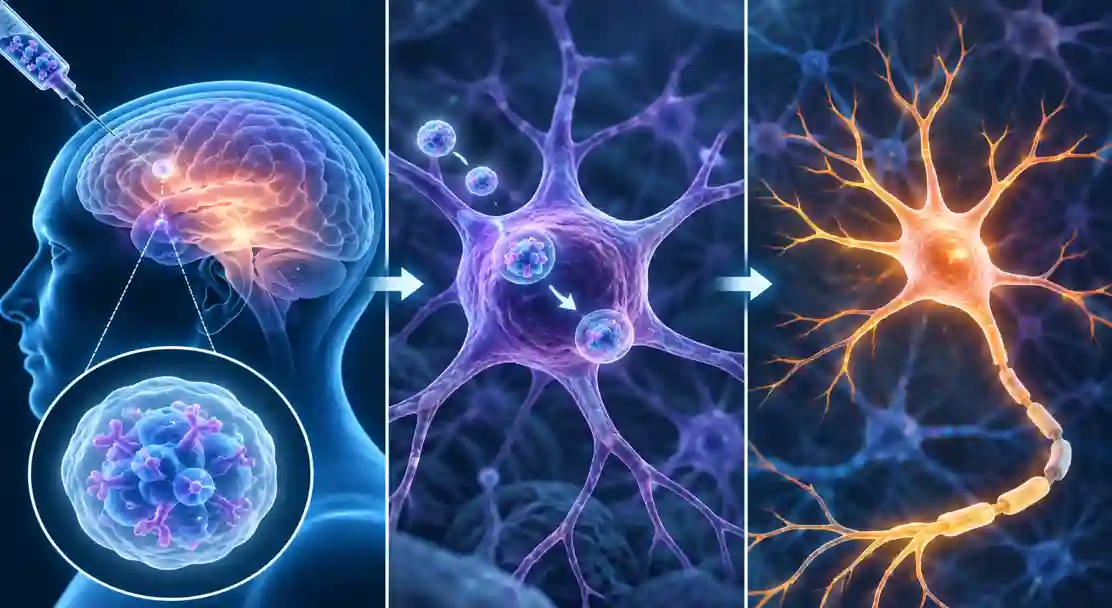
Why would a psychedelic do that? It comes down to basic nerve biology. The nerve running from your spine to your big toe is a single cell, sometimes three feet long. To keep its far tip alive, that cell has to constantly send tiny power packs called mitochondria all the way down its length, like fuel trucks driving a highway that never ends. Chemo shuts the highway down. Cut off from fuel, the far end of the nerve slowly starves and dies, which is what causes the numbness and pain.
Psilocybin keeps the trucks moving. It switches on a receptor sitting right on the nerve itself, which flips on a chain of internal signals that keeps the “delivery system” working (Heles et al., 2026). The researchers also tested a non-hallucinogenic cousin compound called tabernanthalog, and it worked just as well, meaning the trip itself isn’t what’s protecting the nerves.
Big caveat: this was all in mice. Nobody has tried this in cancer patients yet. But it’s a genuinely new idea to use psilocybin, not to change how someone feels, but to physically protect their nerves during treatment.
Testing It Safely in Parkinson’s
Depression and anxiety are incredibly common in Parkinson’s disease, but people with Parkinson’s have always been kept out of psychedelic studies. Doctors worried it might trigger hallucinations or make things worse, since Parkinson’s already messes with the same brain chemical psilocybin acts on.
A small pilot study at UC San Francisco finally tested it, in just 12 people (Bradley et al., 2025). The results were reassuring: no one had a serious problem, no one’s hallucinations got worse. Mood improved a lot, and it stayed better three months later.
The surprising part? People’s movement also seemed to improve, less stiffness, better scores on standard motor tests. Nobody’s sure why. Maybe feeling less depressed helps people move better. Maybe psilocybin affects the brain circuits involved in both. With only 12 people and no comparison group, it’s really just an interesting clue, not proof of anything.
A Depression Trial That Admits Its Own Weak Spot
The third study is more familiar territory – a proper randomized trial testing psilocybin against a placebo for hard-to-treat depression, run through Britain’s public health system (Rucker et al., 2026). The results looked strong: people who got psilocybin improved far more than those who got a placebo, and the difference held for six weeks (Rucker et al., 2026).
But here’s what makes this study worth trusting: the researchers admit a big weakness. Almost everyone could tell which treatment they’d gotten. Psilocybin makes you trip; a sugar pill doesn’t. So some of that “improvement” might just be people knowing they got the real thing and expecting to feel better. The researchers say so themselves, plainly, instead of hiding it.
So what does it all mean?
Put the three studies together and a theme appears: the same receptor and the same growth-boosting signals show up whether scientists are looking at mouse nerves, a shaking hand, or a depressed brain. That’s genuinely interesting science. But none of this means psilocybin is a proven cure for anything yet. One study was in mice. One had 12 people. One admitted its own blind spot. This is what science looks like in its early, messy, promising stages, not a finished answer.
And to be clear: nothing here is an argument for trying mushrooms yourself. Every result came from pharmaceutical-grade psilocybin, precise doses, and careful medical supervision, not something bought online or picked in a forest.
If these early signals hold up in bigger trials, psilocybin could end up doing double duty: helping protect the body during brutal treatments like chemotherapy, and helping the mind recover from conditions that current medicines don’t treat very well. That’s a much bigger role than “psychedelic therapy” usually gets credit for. For now, though, the honest answer is: promising, unproven, and worth watching closely.
Source:
Bradley, E. R., Sakai, K., Fernandes-Osterhold, G., Szigeti, B., Ludwig, C., Ostrem, J. L., Tanner, C. M., Bock, M. A., Llerena, K., Finley, P. R., O’Donovan, A., Zuzuarregui, J. R. P., Busby, Z., McKernan, A., Penn, A. D., Wang, A. C. C., Rosen, R. C., & Woolley, J. D. (2025). Psilocybin therapy for mood dysfunction in Parkinson’s disease: An open-label pilot trial. Neuropsychopharmacology, 50(8), 1200–1209. https://doi.org/10.1038/s41386-025-02097-0
Heles, M., Pasvolsky, L., Sathishkumar, H., Naara, S., Vu, Y., Stewart, C. L., Xie, T., Gleber-Netto, F. O., McCarthy, W., Yaniv, D., Kamal, S. S., Elahi, H., Zhu, P., Uhelski, M. L., Chatwin, J., Lara, A., Stolley, D. L., Migden, M. R., Lee, Z.-H., … Amit, M. (2026). Psilocybin prevents chemotherapy-induced peripheral neuropathy through mitochondrial trafficking preservation. Science, 393(6815), eaec6116. https://doi.org/10.1126/science.aec6116
Rucker, J. J., Mantingh, T., Kerr-Gaffney, J., Bird, C., Chu, P., Modlin, N. L., Campbell-Coker, K., Hambleton, S., Seath, P., Hignett, R., Fennema, D., Hampsey, E., Tsapekos, D., Thomas, R. J., Cattell, J., Jafari, H., Day, C., Borissova, A., Lloyd, M., … Young, A. H. (2026). Psilocybin-assisted therapy for treatment-resistant major depressive disorder in a public healthcare setting: A randomized controlled trial. Nature Medicine. https://doi.org/10.1038/s41591-026-04541-0